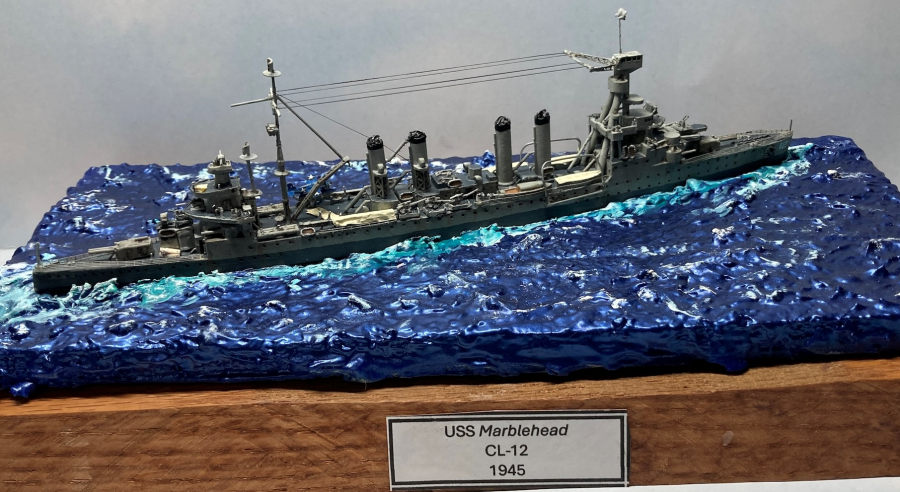
| KIT #: | |
| PRICE: | $16.00 |
| DECALS: | None |
| REVIEWER: | Joe Essid |
| NOTES: | Triumph Models figures. Flyhawk railings |
| HISTORY |
 You can read about the
stalwart light cruiser USS Marblehead
in my
MM preview, but during
the build I discovered a few other interesting facts.
You can read about the
stalwart light cruiser USS Marblehead
in my
MM preview, but during
the build I discovered a few other interesting facts.
The kit clearly has a 6’ stern casemate gun mounted on a platform. After some research into extant photos of the ship, I discovered one from the 1930s showing that particular gun. I’m still unsure when it was removed, to give way to a new aft superstructure with more AA and radar.
Another, and more sobering, photo surfaced at Wikipedia of Marblehead and three other Omaha-class cruisers being cut up, postwar. They look like what I see at the local scrap yard: thus the fate of old technology. For a warship with a proud history, it saddens me to think of a vessel being turned into shredded steel ready to go to some mill, and I wonder where all of Marblehead’s steel ended up. More famous ships met that fate, even Bull Halsey’s Enterprise.
The Omahas weathered the storm of World War II but were obsolete at VJ Day. The Navy no longer needed fast scouts to race ahead of a battle-line to look for trouble. Cold-War scouting meant a carrier taskforce with aircraft ranging ahead to find the enemy, today satellites and other over-the-horizon technology.
| THE KIT |
See the preview. It’s a one-part wargaming piece, not a model per se. The builder will need to supply many small parts. As I found, however, Dobbies’ ship remains a cost-effective alternative to more expensive and detailed kits.
| CONSTRUCTION |
 My razor saws went to work in
several spots, notably to remove the aft casemate gun, the fire-control director
forward of that gun, and the poorly molded 3” AA guns amidships. The molding of
the resin barrels there extends down to the deck. I lopped them off, as well as
the barrels of the four casemate 6” guns forward. Those guns were replaced by
brass aftermarket barrels.
My razor saws went to work in
several spots, notably to remove the aft casemate gun, the fire-control director
forward of that gun, and the poorly molded 3” AA guns amidships. The molding of
the resin barrels there extends down to the deck. I lopped them off, as well as
the barrels of the four casemate 6” guns forward. Those guns were replaced by
brass aftermarket barrels.
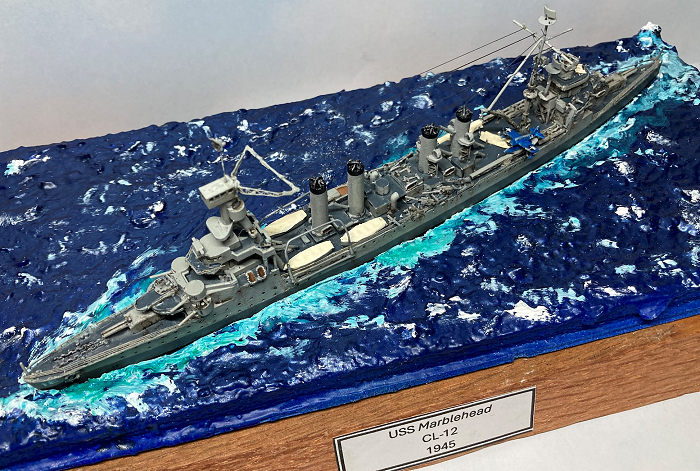
Using the blueprints of the 1942 refit, I did what I could to put three 3” AA guns on each side. They are not aligned to match the originals, as the catapults and ships’ boats would not allow three to fit, plus 2 smaller AA guns. I also added plastic guns and mounts left from extra parts in Dragon’s 1/700 USS Pennsylvania.
The boats were printed with overly thick thwarts. I considered replacing them with some Tamiya boats in the stash. In the end, I chose not to remove the kit’s boats and further damage the resin deck. I installed davits of stretched sprue and glued aluminum foil over the three whaleboats to make canvas covers. After 1942, the blueprints note that Marblehead carried two whaleboats and a launch. We’ll just call my extra whaleboat one hoisted aboard at some point in 1945, which is how I decided to depict her.
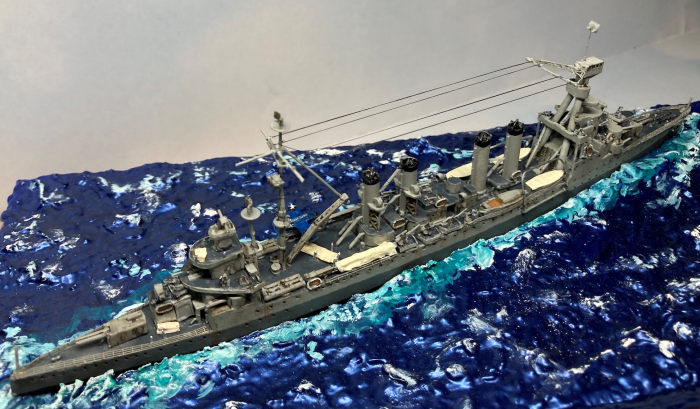
With spares and some scratch-building, I built up a new rear superstructure and masts for radar, plus a hoist for the aircraft. Other PE from Dragon’s Pennsylvania went forward, and here and there I added a few PE hatches to make a blank section of superstructure interesting. The prints do not give clear indications of positions. What I like about the build is how I can lop off and replace the radar arrays later with more accurate ones. I’ve seen some PE sets and may go that route.
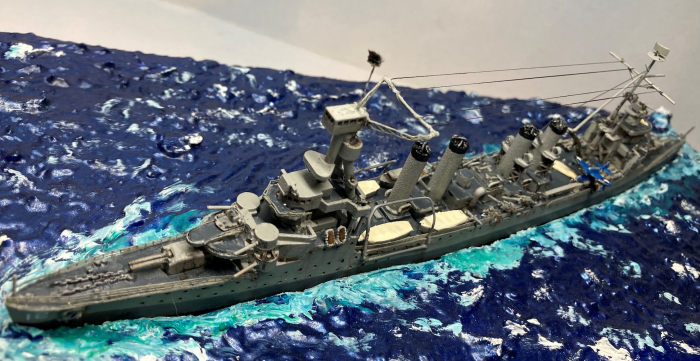 Late in the build I added
railings from Flyhawk around the main deck, plus a few bits left from
Pennsylvania to the
superstructure. I have no advice on attaching railings beyond what a
ship-modeler suggested online: tack one end down with thick CA, bend it around a
part of the hull, then use thin CA to get it to stick to the deck by capillary
action. After a few haphazard starts, I found that the method works without
leaving blobs of glue here and there. Without an accelerator, I had to secure
the model in a foam drydock and use a toothpick to hold each bit of railing in
place while the CA set. A character-building exercise!
Late in the build I added
railings from Flyhawk around the main deck, plus a few bits left from
Pennsylvania to the
superstructure. I have no advice on attaching railings beyond what a
ship-modeler suggested online: tack one end down with thick CA, bend it around a
part of the hull, then use thin CA to get it to stick to the deck by capillary
action. After a few haphazard starts, I found that the method works without
leaving blobs of glue here and there. Without an accelerator, I had to secure
the model in a foam drydock and use a toothpick to hold each bit of railing in
place while the CA set. A character-building exercise!
For splinter-shields, I cut off lengths of PE runner. A 1/700 Kingfisher from the Pennsylvania kit went on one catapult. I’d broken the other catapult, so I used foil to cover the repair, adding some 1/700 figures in poses that suggest them pulling a canvas cover off the catapult while at sea.
The deck between the catapults remained too vacant. Some photos of Marblehead show canvas covers for AA guns and other areas to be kept dry in heavy weather, so I added some rolls of canvas made from folded masking tape. I imagined the covers being stowed when action might loom. Doing the work are tiny (human-hair sized) resin sailors from a set of 100 by Triumph Model.
| COLORS & MARKINGS |
After washing the ship, I airbrushed it in Light Gull Gray, using Mission Paints. Next I brush-painted Model Master blue-gray enamel for the decks, and after top-coating everything in Tamiya flat, I masked the lower hull and brushed on a stripe of black, then an intermediate one of Mission Dark Gull Gray. I had no insignia for the little Kingfisher. With a tiny wargaming-figure brush I painted stars on the wings; they’ll do until I get some decals.
Painting the tiny figures meant abstraction; I used a light blue for their tunics and dark blue for their dungarees. A dot of white suggests headgear. These little swabbies are fragile and easy to lose, but with 100 it proved easy enough to position a dozen or so on deck, to avoid my ship looking like a latter-day Marie Celeste.
Once I had gotten all the nooks and crannies painted, I flooded port holes and other crevices with Flory’s dark wash, then added rust with an Indian Red Prismacolor pencil. At that point I added additional spars and details to the aft masts. I’ve found that dry brushing late in the build makes a ship’s features pop, so I did that with a homebrew gray-white I also used on the life rafts.
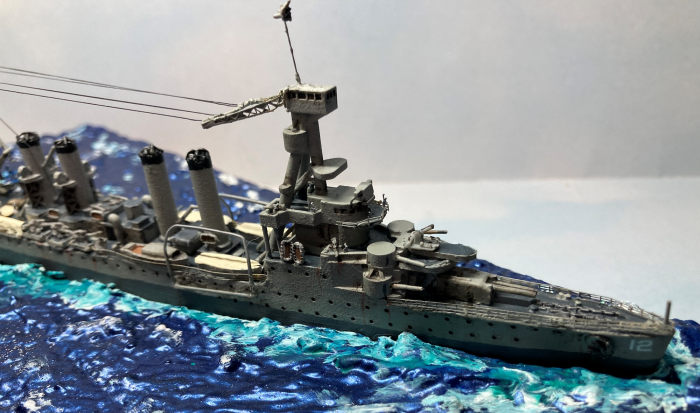 I’d not planned to weather the ship
much, but after looking at the photo of the scrapping, I decided that a tired
but proud veteran late in the War would be my goal.
I’d not planned to weather the ship
much, but after looking at the photo of the scrapping, I decided that a tired
but proud veteran late in the War would be my goal.
I strung four lines of rigging with EZ-Line, more to suggest the complexity of the ship than replicate it. I could not resist adding another line: a “Jacob’s Ladder” appears in the blueprints, running from the third funnel’s searchlight deck to the aft masts. I pity the swabs who had to use it. I still need a flag for the ship’s stern. I’ve some decals on order to mount on foil and simulate waving in the wind.
When all was ready, I mounted the kit in the seascape base that I’d built, aping as best I could Frank Spahr’s fine work you can find in the archives at MM. I don’t know if Frank has a cat, but I needed to reshoot some photos for one side, because a hair from an orange tabby was quite prominently projecting from the base at the waterline!
The base got glued to a piece of red oak that I’d beveled with our table saw. I added an informational tag to the base, mostly for the visitor who asks “now which ship is that one?”
| CONCLUSIONS |
I enjoyed the project, but it was indeed a rabbit hole for a lot of scratch-building and PE work.
Though I got things close to 1943-5, my build is not accurate. For a wargaming model, Dobbies produces a good product. I opted to buy Trumpeter’s 1/700 Liberty ship instead of Dobbies’ miniature.
When the stupid tariffs end, I’d like to build CL-9, USS Richmond, named for my hometown in Virginia. It looks enough like Dobbie’s USS Raleigh in 1945 fit with accurate 3” AA amidships. I may convert that next. Richmond also wore a cool Atlantic-theater camo scheme in 1944.
If you want an accurate WW II Omaha-class light cruiser that does not need a lot of scratch-building and surgery, however, hunt down the resin offerings from Niko or Corsair Armada. If you want a fleet of wargaming pieces, try Dobbies.
| REFERENCES |
Topp, W. “Twenty Thousand Miles to Home—The Miraculous Journey of The USS Marblehead.” Military History Now. https://militaryhistorynow.com/2019/07/17/twenty-thousand-miles-to-home-the-miraculous-voyage-of-the-uss-marblehead/
USS Marblehead plans and photos. https://archive.org/details/cl12bogp1942/mode/2up
Wikipedia. https://en.wikipedia.org/wiki/USS_Marblehead_(CL-12)
9 February 2026 Copyright
ModelingMadness.com. All rights reserved. No reproduction in part or in whole
without express permission. If you would like your product reviewed fairly and fairly quickly, please
contact
the editor or see other details in the
Note to
Contributors.