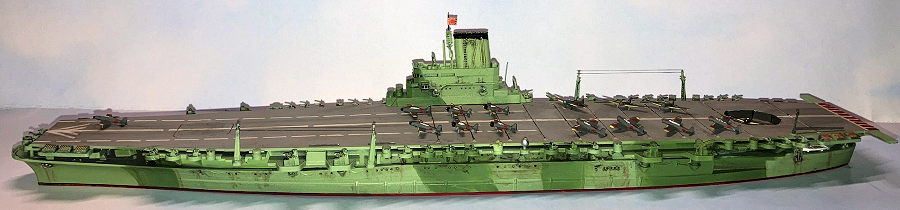
Tamiya 1/700 IJN Shinano
| KIT #: | 77024 |
| PRICE: | $20.00 when new in 1985 |
| DECALS: | None |
| REVIEWER: | Joe Essid |
| NOTES: | A simplified kit full of nostalgia |
| HISTORY |
There appear to be more speculations about the Japanese “supercarrier” Shinano than any other vessel in the Imperial Navy. What began as a third Yamato-class battleship got completed, after the Midway disaster, as a 72,000 ton carrier with an armored flight deck, intended to move aircraft forward to bases while supporting strike carriers in the Imperial fleet. She never got assigned her own air group though some Navy planes did train by using her deck.
 Still being fitted out after
sea trials and lacking some of her watertight doors,
Shinano was torpedoed on her
maiden voyage in November 1944 by
USS Archerfish,
becoming the largest vessel ever sunk by a submarine.
Still being fitted out after
sea trials and lacking some of her watertight doors,
Shinano was torpedoed on her
maiden voyage in November 1944 by
USS Archerfish,
becoming the largest vessel ever sunk by a submarine.
When Shinano was ordered to move from Yokosuka to Kure in order to avoid air attack, she did so at night and thus without air cover or any escort beyond three destroyers that had recently returned from the carnage at Leyte Gulf. The hangers contained no aircraft, beyond 50 Ohka suicide flying bombs as well as six Shinyo suicide boats that were to have been delivered to Okinawa and the Philippines.
The carrier went down leaving 1080 civilian contractors and crewmen to be rescued by the escorts. The rest of the 2500 people aboard were lost. Captain Toshio Abe, who wisely tried to delay the unready carrier’s departure, went down with his ship.
With only three photos taken of this vessel, we cannot say too much with certainty, save that she remained the largest carrier built until USS Forrestal launched in 1954.
| THE KIT |
I began a project to refit and update my 1980s rebox of Tamiya’s kit, first released in 1971. A retooling appeared later in the 70s and the 2025 example features parts not present earlier; like many of the older Waterline series shortcuts were taken, such as a lack of ship’s boats and other small details.
Across the gulf of 40 years, I recall it didn’t have too many parts and only a few thin, easily broken ones. Despite those shortcomings, the big carrier comes across with the gravitas one would expect of such a vessel.
I’d look for a recent issue of this ship unless you are, like me, hopelessly nostalgic. You could also try Fujimi’s kit in the same scale but with far more details (Ohkas in the depths of the beast!) but I don’t need more than one Shinano to go with Yamato and Musashi.
 In any case, my original kit
survived and it means a great deal to me. This was the first real model built
after a hiatus during my undergrad years, when I only found time to paint
wargaming figures. I learned about the doomed carrier from Avalon Hill’s
Victory in the Pacific, still
one of my favorites. The game cost me a budget-searing $50 in 1985 at The El
Corte Ingles department store at Nuevos Minisiterios, Madrid, a city where I
lived for a year teaching English.
In any case, my original kit
survived and it means a great deal to me. This was the first real model built
after a hiatus during my undergrad years, when I only found time to paint
wargaming figures. I learned about the doomed carrier from Avalon Hill’s
Victory in the Pacific, still
one of my favorites. The game cost me a budget-searing $50 in 1985 at The El
Corte Ingles department store at Nuevos Minisiterios, Madrid, a city where I
lived for a year teaching English.
I got my money back in fun, over beer and snacks with other expat teachers who shared my fascination with the Pacific War. A few weeks after I bought the game, I saw a rack of Tamiya Waterline kits at El Corte Ingles and bought Shinano, also for more money than I could afford.
When I returned to the States in 1986, to begin five years in the airless desert of grad school, the game returned with me, as did this kit. I was amazed that it survived the passage via slow-boat surface mail unscathed. If I recall rightly, I’d removed the island and placed it on the flight deck, wrapped both in tissue paper, then sealed them in Tamiya’s box, which has long vanished. Only the elaborate radar mast had been broken on arrival, and that was easily repaired.
| CONSTRUCTION |
Partly disassembling the kit for repainting reminded me of my earlier work. Like others in the series, this vessel has a waterline lower hull molded in red where two large metal weights sit. The hull above is the Yamato in two large pieces; there’s only one bit of forward deck to install before mating the works to the one-piece flight deck. The high-angle and triple-barrel AA guns are plentiful and easy to damage, but also easy to install with some care taken by the builder.
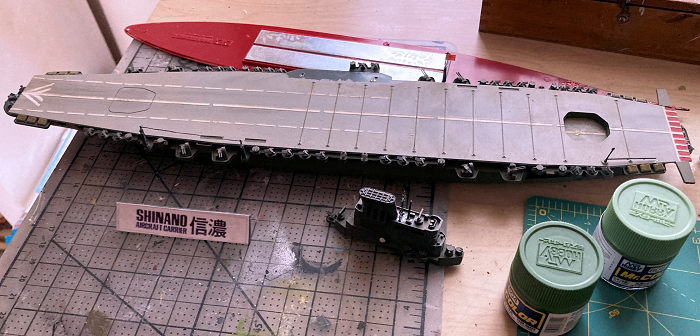 I had to replace a few
barrels on the guns and source (appropriately) three missing triple-barrel AA
from extras unused in my build of
Yamato,
reviewed in MM. While I was at
it, I added two ship’s boats from the
Yamato
kit’s extras.
I had to replace a few
barrels on the guns and source (appropriately) three missing triple-barrel AA
from extras unused in my build of
Yamato,
reviewed in MM. While I was at
it, I added two ship’s boats from the
Yamato
kit’s extras.
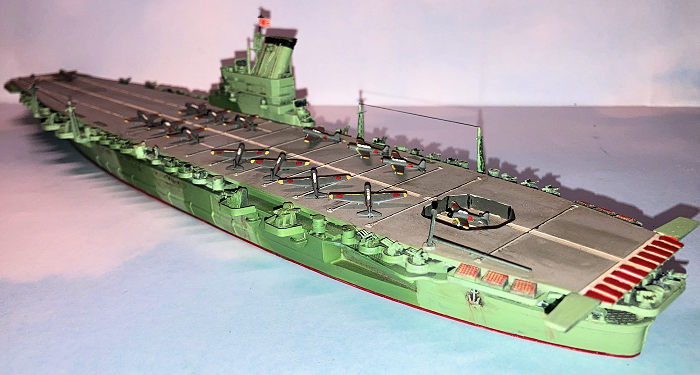
After my stateside return, one of the four towers on the flight deck vanished. During the painting sessions, I scratch-built a replacement, as nothing in the stash would match it, beyond cutting down some photo-etch parts left from my build of Dragon’s USS Pennsylvania. That would look odd; a PE open-latticework tower would clash with the solid pieces Tamiya provided. I ended up making a new tower from Evergreen sheet, adding a “t” of stretched sprue on top to hold a rigging line, and after it was painted and flat-coated, drawing lattice on with a fine-point technical marker. It was not perfect but after a wash of light green to tone down the contrast, it serves well enough until I find a better substitute.
It’s also possible, from images that I have seen of models, that these towers were not gridwork but solid, multi-stepped masts. I may well build a set as they’d be easy to replicate.
| COLORS & MARKINGS |
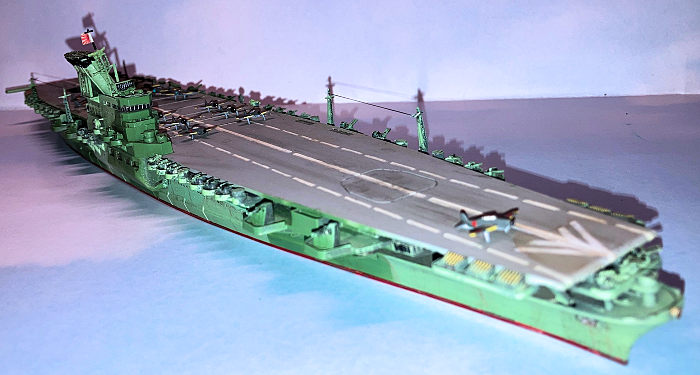
In 85, I used what kinda-sorta matched the box art, showing the carrier in formation with a merchant ship and two destroyers. The ships are green, which greatly surprised me back then. Since 1985 I’ve read about late-war camo for Japan’s surviving carriers to disguise them as transport vessels. Incidentally, the deck looks pink in the boxing, but more on that in a moment.
The hull’s green proved impossible to match originally, but at a nicely stocked Madrid LHS in my Tetuan neighborhood I grabbed a Humbrol dark green and a light gray. These I brushed on, along with details for the flight deck and some skid-marks from aircraft landing.
Humbrol paints from that era dried without brushstrokes, so I did a decent job. Current research, however, reveals a very different scheme of two greens. There’s also speculation that the carrier’s no-slip surface over the armored deck was actually pink, from the uncured cedar or pine sawdust used in the aggregate. Tim Reynaga did a fine job, 20 years back, depicting that in his build of the 1/1200 Revell AG kit. It’s worth your time to read here in MM.
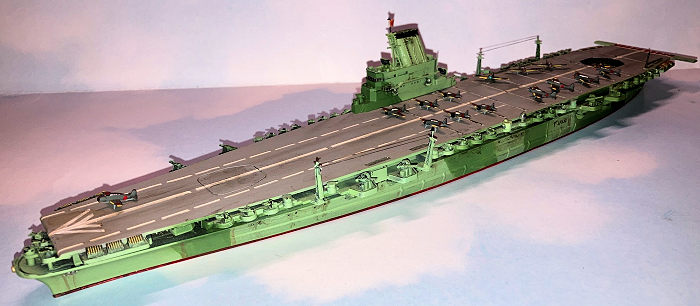 I decided that I wanted to
keep my deck gray, preserving some work from all those years ago but also to
build Shinano as she
might have appeared operationally, had
Archerfish
missed or been on patrol somewhere else that night. For the hull several
patterns for the camo can be found, but in the end I made my own pattern and
used Mr. Color number 604 and 605
to give the
desired hues. I’m not used to spraying lacquer, so I thinned them to about 70%
and set a fairly high pressure on my airbrush.
I decided that I wanted to
keep my deck gray, preserving some work from all those years ago but also to
build Shinano as she
might have appeared operationally, had
Archerfish
missed or been on patrol somewhere else that night. For the hull several
patterns for the camo can be found, but in the end I made my own pattern and
used Mr. Color number 604 and 605
to give the
desired hues. I’m not used to spraying lacquer, so I thinned them to about 70%
and set a fairly high pressure on my airbrush.
I shot the lighter green first, let it cure overnight, then using the same low-tack yellow Duck tape I’d put down to protect the flight deck to mark areas I wanted in the darker green.
For the aircraft I left the 1985 paint be, including toothpick-applied hinomaru and yellow wingtips I’d painted then to add some variety to the ship’s appearance. I did add more yellow this time: ID lines to the front of the wings. I then drew some framing on the canopies with a very sharp #2 pencil.
When all was painted and flat-coated, I applied Flory washes to add minor weathering, given the ship’s limited service, touched the anchors up with a silver Prismacolor pencil, then lightly brushed a Mission red-brown to the anchors, plus streaks to the hull to show some limited rusting. I added the heaviest weathering to the flight deck for soaked-in spills, something I see frequently, even after cleaning the concrete floor in my shop with a heavy-duty degreaser.
EZ-line provided rigging for the two deck antennae, redoing Yamato’s while at it, and I declared the Shinano refit completed. When I complete Musashi, I’ll pose all three giants together. It would be fun to add to that virtual shipyard my Tamiya CV-6 Enterprise, then one of the New Jersey class, HMS Rodney or Nelson, Roma, Richelieu, and of course Bismarck.
| CONCLUSIONS |
Don’t bin your old kits, especially if they make you feel wistful.
Whenever I look at this build, years fall away and memories of Madrid flood back: lingering over world-famous artwork at the Prado, catching glimpses of the snowy Sierra de Guardarrama shimmering in the distance during siesta on a hot Madrid afternoon, reading El Pais while sipping café con leche in Plaza Mayor before mass-tourism changed the place, going bowling with my students after class, spending late nights over drinks at our favorite expat pubs.
Why do models conjure more memories than do other souvenirs? One spends so much time building and painting them that some kits link the builder to a certain time and place now lost.
I’ve been back to Madrid twice, and though much as not has changed in my old Tetuan neighborhood, I have. But hey, I still have my Shinano.
| REFERENCES |
Enright, J. & Ryan, J. Shinano! The Sinking of Japan’s Secret Supership. New York, St. Martin’s: 1987.
Joe Essid
3 October 2025
Copyright ModelingMadness.com. All rights reserved. No reproduction in part or in whole without express permission.
If you would like your product reviewed fairly and fairly quickly, please contact the editor or see other details in the Note to Contributors.