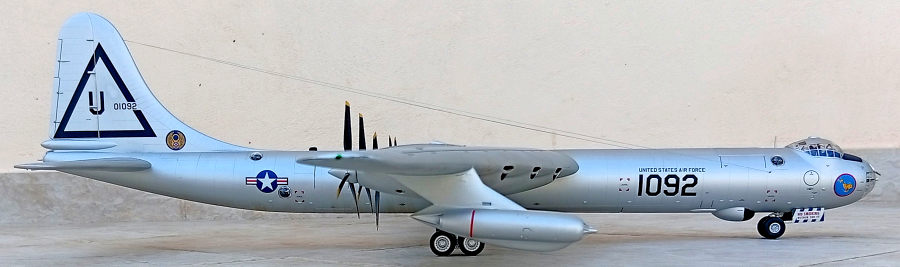
Revell 1/72 B-36H Peacemaker
| KIT #: | 04632 |
| PRICE: | €70.00 when new |
| DECALS: | Two options |
| REVIEWER: | Spiros Pendedekas |
| NOTES: | Monogram tooling |
| HISTORY |
Few aircraft in the entire sweep of aviation history have ever embodied the sheer audacity, grandeur, and almost mythic ambition of the Convair B-36 Peacemaker. Immense in scale yet unexpectedly elegant in its long, soaring lines, it was not merely an aircraft but a flying statement of intent—an airborne monument to human ingenuity at a moment when the world itself seemed to be redrawing its boundaries. Even today, decades after its final flight, it stands in memory as one of the most extraordinary, awe-inspiring machines ever to take to the skies.
Conceived in the shadowed urgency of the Second World War, the B-36 was born from a requirement so bold it bordered on the fantastical: to carry a devastating bomb load across entire oceans, strike targets deep within enemy territory, and return home without the aid of forward bases. It was a vision that demanded not just improvement, but reinvention—an aircraft of unprecedented size, endurance, and technological daring. In its conception alone, it represented a leap into the unknown, a wager that engineering could stretch to meet the vast ambitions of global strategy.
Although the war ended before the Peacemaker could be called
upon in combat, history—ever restless—soon found it a new and even
more consequential purpose. As the fragile alliance of wartime
victory dissolved into the tension and suspicion of the Cold War,
the B-36 rose to become the towering backbone of the United States'
strategic nuclear deterrent. In an era before intercontinental
ballistic missiles and when aerial refuelling was still an emerging
art, it was unmatched: a solitary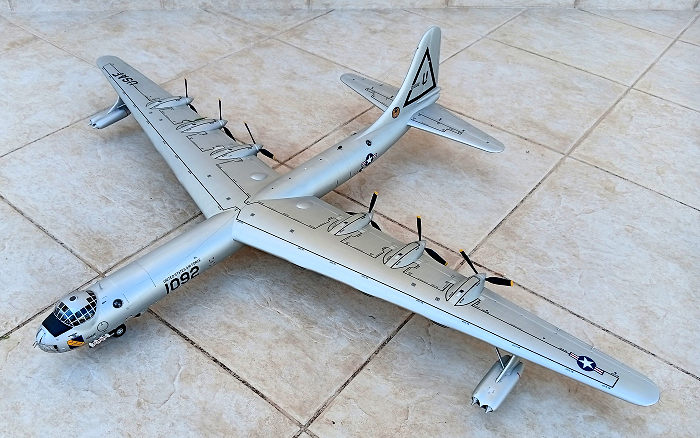 giant capable of crossing
continents with immense payloads, silently patrolling the upper
reaches of global tension. It became, in every sense, a guardian of
balance in a world holding its breath.
giant capable of crossing
continents with immense payloads, silently patrolling the upper
reaches of global tension. It became, in every sense, a guardian of
balance in a world holding its breath.
Everything about the B-36 was breathtaking in its extremity. Its wingspan—so vast it dwarfed even the later Boeing 747—gave it the presence of a moving landscape. It remains the largest mass-produced piston-engined aircraft ever constructed, a title that still inspires disbelief. Beneath those colossal wings sat six Pratt & Whitney R-4360 Wasp Major engines, each a marvel of mechanical complexity, arranged in a distinctive pusher configuration that gave the aircraft its unmistakable silhouette. And then, as if that were not enough, later variants added four General Electric J47 turbojets, igniting behind the wings like bursts of controlled lightning. The result was the legendary phrase that still echoes through aviation lore: “Six Turning and Four Burning.” No other bomber in operational history so boldly united piston-era grandeur with the raw surge of jet power.
The B-36 was not only vast—it was astonishingly sophisticated. Within its enormous fuselage lay pressurised crew compartments connected by a narrow, almost tunnel-like passage, through which crew members travelled on wheeled trolleys during the longest missions ever attempted in a combat aircraft. These flights could stretch beyond thirty hours, carrying crews across oceans and continents in a suspended world of instruments, engines, and endurance. Its cavernous bomb bays were engineered to house the most powerful conventional and nuclear weapons of the era, while its extensive defensive armament reflected the sobering belief that such a giant would have to defend itself against determined interception on every leg of its journey.
Yet, for all its formidable presence and war-ready design, the Peacemaker never dropped a bomb in anger. Its legacy was forged not in combat, but in restraint. Day after day, year after year, it served with the Strategic Air Command, its vast silhouette a silent promise carried across the skies. In its steady patrols and unspoken vigilance, it helped define the uneasy equilibrium of the early nuclear age—an era in which peace was maintained not by absence of power, but by its overwhelming presence held in careful balance.
By the late 1950s, however, the relentless march of technology began to reshape the skies once more. Faster, sleeker jet-powered bombers emerged, most notably the Boeing B-52 Stratofortress, signalling the end of the piston-and-jet hybrid era that the B-36 had so magnificently embodied. One by one, the great Peacemakers were retired, their immense wings falling silent after a brief but unforgettable reign.
Today, the Convair B-36 Peacemaker endures not merely as a relic, but as a legend carved in aluminium and ambition. It stands as the ultimate flowering of the piston-engined strategic bomber—a machine of staggering scale, daring imagination, and almost poetic excess. More than seventy years after its first flight, the memory of its six vast propellers and four roaring jets still stirs something profound in all who encounter its story. It reminds us of a singular moment in time when engineers reached beyond the limits of the possible, and for a brief, brilliant instant, made the impossible fly.
| THE KIT |
 It was back in 1980 when Monogram released its all-new 1/72
Convair B-36 Peacemaker. The kit immediately impressed the modelling
world, not only because of the sheer size of the subject but also
because of the ambitious engineering and level of detail offered.
Over the years it has been reissued several times under both the
Monogram and Revell labels, remaining to this day the only
injection-moulded kit of the B-36 in this scale. Somewhere along the
way, additional parts were introduced to cater for different
variants.
It was back in 1980 when Monogram released its all-new 1/72
Convair B-36 Peacemaker. The kit immediately impressed the modelling
world, not only because of the sheer size of the subject but also
because of the ambitious engineering and level of detail offered.
Over the years it has been reissued several times under both the
Monogram and Revell labels, remaining to this day the only
injection-moulded kit of the B-36 in this scale. Somewhere along the
way, additional parts were introduced to cater for different
variants.
The example presented here was a gift from my fellow officers sometime around 2004, making it a particularly meaningful addition to my collection.
An excellent kit by every measure, the Monogram B-36 was a remarkably daring undertaking for its time. Even today, it remains one of the biggest injection-moulded aircraft kits ever produced, a true engineering achievement whose impressive size and thoughtful design continue to command admiration more than four decades after its original release.
For a more in-depth look at the kit's contents, you may read its preview, found in the ever-growing MM archives.
| CONSTRUCTION |
I began construction by assembling the two-level crew compartment, attaching the control columns, instrument panels, seats and the remaining interior details to their respective floors. Once completed, the entire crew compartment was secured to the starboard fuselage half, ready for the subsequent stages of assembly.
The nose and tail gun turrets were also assembled and installed on the same fuselage half. These were followed by the four gunner sighting units, each of which was carefully fitted behind its respective blister window opening in the fuselage sides.
The basic colour of the crew compartment was black, a choice I was quite happy with, as it naturally limits the amount of interior detail visible through the relatively small window openings. The seats received medium green-grey cushions, while the nicely printed kit decals were used to represent the instrument panels. The remaining raised detail was brought to life with silver dry-brushing, and the gun turrets were finished in gunmetal.
 Not wishing to change the modelling habits of a lifetime -
and admittedly because I have always preferred the clean lines of an
aircraft - I decided to display the bomb bay doors closed.
Consequently, I did not spend time adding detail to an area that
would remain completely hidden once the fuselage halves were joined.
Not wishing to change the modelling habits of a lifetime -
and admittedly because I have always preferred the clean lines of an
aircraft - I decided to display the bomb bay doors closed.
Consequently, I did not spend time adding detail to an area that
would remain completely hidden once the fuselage halves were joined.
After the impressive main wing spar had been installed, all of the previously assembled components were trapped between the fuselage halves, together with approximately 80 grams of fishing weights secured immediately aft of the lower crew compartment, to ensure the completed model would sit correctly on its landing gear. The horizontal stabilisers were attached at this stage as well, completing the distinctive tail assembly.
The massive wings were assembled next. Each wing is made up of a 14-part assembly, with the engine rear faces and front air intakes trapped between the upper and lower wing halves. I must admit that I approached this stage with some apprehension, expecting a rather complicated assembly. In the end, however, the engineering proved to be excellent, making the process straightforward and trouble-free.
Once completed, the wings were attached to the fuselage via the substantial main spar, resulting in an exceptionally strong, secure and reassuringly rigid structure.
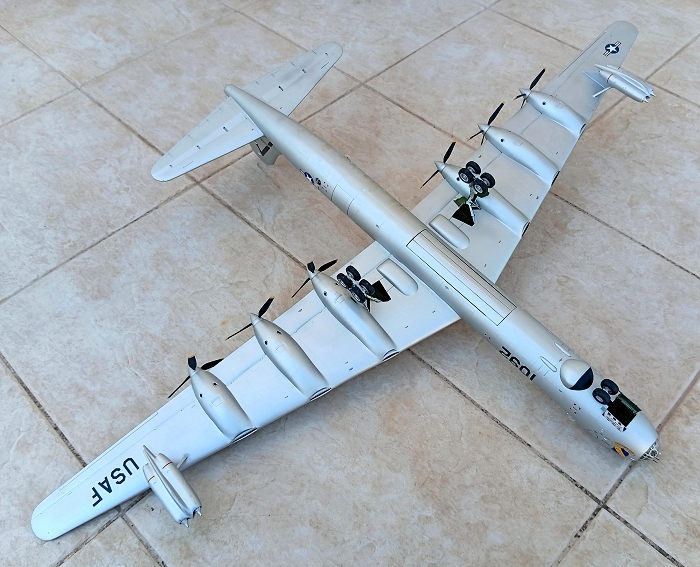
The next step was the assembly and installation of the four jet engines. Each pair of engines is a six-part assembly, which was carefully built up before being attached to the rear of the wings. Admittedly, this stage proved to be the most challenging part of the construction. The fit required some patience and careful adjustment, but with a little attention and dry-fitting, everything eventually came together satisfactorily.
The bomb bay doors were then attached in the closed position. I expected this stage to be more challenging, given the large size of the doors and the importance of achieving a clean fit. However, the assembly proved to be much easier than anticipated and straightforward.
With this, the basic assembly of the model was complete. By all means, the result was quite surprising. Once the factor of the sheer size of the parts is taken away, the kit proved to be much easier to assemble than one might initially expect. The main challenge is not complexity, but simply overcoming the intimidation of handling such large components.
The fit was, in fact, very good, requiring only modest amounts of filler in the usual areas such as joints and seams. After a careful filling and sanding session, the giant was finally ready to move on to the paint shop.
| COLORS & MARKINGS |
The complete model was sprayed with my trusty Humbrol 11 Silver, of which I used a considerable amount, as one would expect on such a large airframe. In accordance with my everlasting lazy habits, I decided not to apply any panelling effects, trusting that the transparent carrier film between the extensive wing walk lines would naturally create some subtle variation in tone once the decals were applied, which indeed proved to be the case.
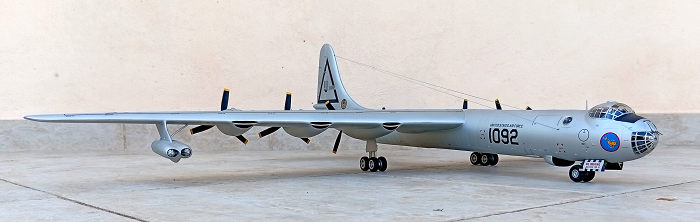 Although not specified, I buffed the Humbrol 11 finish, as
this is something I usually do. The result was a deeper, richer
metallic sheen, exactly the effect I was looking for.
Although not specified, I buffed the Humbrol 11 finish, as
this is something I usually do. The result was a deeper, richer
metallic sheen, exactly the effect I was looking for.
With the natural metal finish complete, the model was ready for decals. I chose to represent the bomber version using the kit markings. The decals performed absolutely wonderfully. Not only were they beautifully printed, with excellent registration and sharp detail, but they released from the backing sheet quickly after immersion in water and adhered perfectly to the various surfaces.
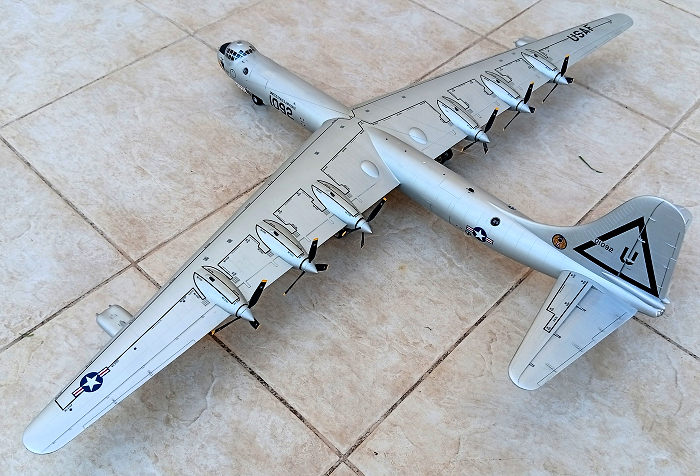
This was especially impressive with the large wing walk lines, which are often a dreaded operation on a model of this size. In this case, however, they proved surprisingly easy to apply and turned what could have been a difficult task into a very enjoyable part of the build.
Once I was fully satisfied with the decal application, a final coat of Future was applied to seal everything in place.
| FINAL CONSTRUCTION |
The final details were next addressed, beginning with the landing gear. The assemblies are beautifully molded and capture the complex appearance of the real aircraft while remaining strong and practical in design. I was particularly pleased with how securely and rigidly the completed model sat on its undercarriage. All landing gear components, including the struts and wheel rims, were painted silver. The tires were finished in black, while the landing gear bays and the inner surfaces of the doors were painted in green zinc chromate.
The six beautifully molded propellers were completed next. Their spinners were painted silver, the blades black and the tips yellow, before being attached in position.The upper DF loop antenna was painted black, while the lower radome was finished with a black forward section and an off-white rear section.
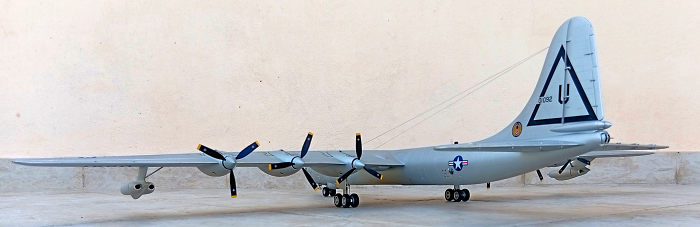 I decided not to weather the aircraft, as operational B-36s
were generally very well maintained and heavy weathering would not
have been appropriate for the appearance I wanted to achieve.
Instead, I applied a final satin coat to tone down the metallic
finish and give the aircraft its final appearance.
I decided not to weather the aircraft, as operational B-36s
were generally very well maintained and heavy weathering would not
have been appropriate for the appearance I wanted to achieve.
Instead, I applied a final satin coat to tone down the metallic
finish and give the aircraft its final appearance.
The transparencies had their extensive and well-defined framing carefully hand-painted before being attached in position. This is quite a demanding task, as the canopy requires a considerable amount of framing to be completed. Unless one is particularly enthusiastic about such delicate painting work, a dedicated set of masks would certainly make life easier.
The antenna mast on top of the fuselage was added next, while the aerial wires were represented using thin stretched sprue, running from the fin to the corresponding attachment points on the forward fuselage sides. Finally, small drops of clear red and green paint were used to represent the wingtip navigation lights, and with that, the giant Peacemaker was finally completed.
| CONCLUSIONS |
The Monogram/Revell 1/72 B-36 Peacemaker is a truly remarkable kit and a wonderful example of the ambition and courage of classic model manufacturers. When Monogram decided to release a model of such an enormous and complex aircraft, it was a bold decision, and one that deserves admiration even decades later.
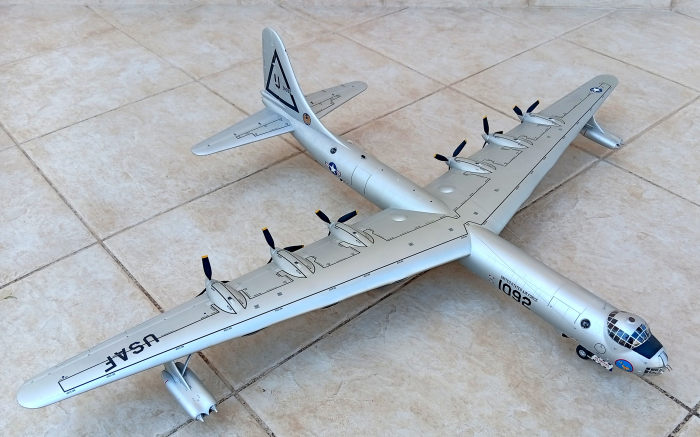 Despite its impressive size, the construction proved to be a
very pleasant experience. The fit is, in many areas, almost
excellent, especially considering the age and enormous dimensions of
the kit. The engineering is logical and surprisingly
straightforward. The main challenge is not complexity, but simply
handling such large components and overcoming the initial
intimidation caused by the sheer size of the aircraft.
Despite its impressive size, the construction proved to be a
very pleasant experience. The fit is, in many areas, almost
excellent, especially considering the age and enormous dimensions of
the kit. The engineering is logical and surprisingly
straightforward. The main challenge is not complexity, but simply
handling such large components and overcoming the initial
intimidation caused by the sheer size of the aircraft.
The raised panel lines may not satisfy those who only appreciate modern engraved detail, but personally I find them perfectly acceptable. They are finely executed, correctly placed and contribute to the character of this classic kit.
The cockpit detail is not excessive, but it is perfectly adequate for the purpose. Very little can be seen through the relatively small glazed areas, especially with the predominantly black interior. The landing gear is strong and well designed, the transparencies are excellent, the instructions are clear and easy to follow, and the decals are simply superb.
There is no other injection-moulded 1/72 Peacemaker available, making the Monogram/Revell offering the only game in town. Fortunately, it is a fantastic game indeed. For those who have the necessary display space and the desire to build one of aviation's greatest giants, this kit is highly recommended, and, without a doubt, a kit worth tackling.
Happy Modeling!
17 August 2026
Copyright ModelingMadness.com. All rights reserved. No reproduction in part or in whole without express permission.
If you would like your product reviewed fairly and fairly quickly, please contact the editor or see other details in the Note to Contributors.