Revell 1/72 B-36 Peacemaker
|
KIT #: |
04632 |
|
PRICE: |
€70 in 2003 |
|
DECALS: |
Two Options |
|
REVIEWER: |
Spiros Pendedekas |
|
NOTES: |
Monogram tooling |
Few aircraft have ever inspired the imagination like the Convair
B-36 Peacemaker. Massive, elegant and revolutionary, it was designed
during WWII to carry a devastating payload across oceans and strike
distant targets without relying on foreign bases.
Entering service during the early Cold War, the B-36 became a
symbol of strategic power. With unmatched range and payload capacity, it
provided a vital deterrent capability before aerial refuelling and
intercontinental missiles became practical.
Its enormous wings, six pusher-mounted radial engines and later
four turbojets created the legendary “Six Turning and Four Burning”
configuration. The Peacemaker represented the final triumph of the
piston-engine bomber era while opening the way to the jet age.
Although it never flew combat missions, the B-36 remains a
monument to engineering ambition: an extraordinary aircraft that pushed
the limits of what seemed possible and became the largest piston-engined
bomber ever produced.
 It
was back in 1980 when Monogram released its all-new 1/72 Convair B-36
Peacemaker. The kit immediately impressed the modelling world, not only
because of the sheer size of the subject but also because of the ambitious
engineering and level of detail offered. Over the years it has been reissued
several times under both the Monogram and Revell labels, remaining to this
day the only injection-molded kit of the B-36 in this scale. Somewhere along
the way, additional parts were introduced to cater for different variants.
It
was back in 1980 when Monogram released its all-new 1/72 Convair B-36
Peacemaker. The kit immediately impressed the modelling world, not only
because of the sheer size of the subject but also because of the ambitious
engineering and level of detail offered. Over the years it has been reissued
several times under both the Monogram and Revell labels, remaining to this
day the only injection-molded kit of the B-36 in this scale. Somewhere along
the way, additional parts were introduced to cater for different variants.
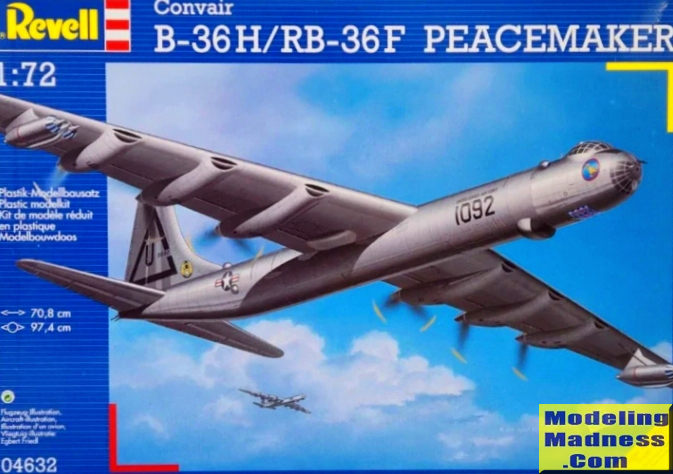
The example presented here was a gift from my fellow officers
sometime around 2004, making it a particularly meaningful addition to my
collection. As expected, the kit comes in a massive, relatively sturdy
top-opening box, perfectly suited to the dimensions of the model. The very
nice boxart is by artist Egbert Friedl, depicting 50-1092 machine flying in
formation with another example some time in 1952.
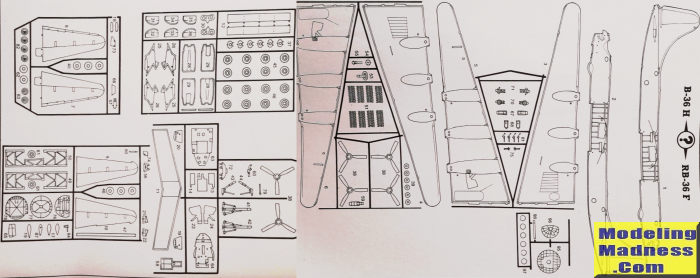
Upon opening the box, I was greeted with 143 silver-gray styrene
parts. The enormous fuselage halves are packaged separately, while the
remaining components are neatly arranged on six large sprues. Molding is
sharp with hardly any flash present. Surface detail consists of finely
raised panel lines, entirely typical of a kit designed in 1980. Their
placement appears accurate and, in my opinion, they remain perfectly
acceptable, particularly for those who appreciate the character of classic
Monogram kits. Overall shapes and proportions look convincing, reflecting
the company's well-earned reputation for capturing the appearance of the
real aircraft.
The cockpit is reasonably detailed without being overly elaborate.
Nicely printed decals for the upper and lower instrument panels sre
provided, together with four crew figures, while the remainder of the
interior is sufficient for what will ultimately be visible through the
extensively framed canopy. Given the limited visibility once assembled,
Monogram struck a sensible balance between detail and practicality.
The defensive armament is also well represented. Both the nose and
tail gun turrets are sufficiently detailed and designed to remain movable
after assembly. The bomb bay is also adequately represented and includes the
appropriate components for both the B-36H bomber and the RB-36
reconnaissance variant.
Landing gear looks good and is robustly engineered, appearing more
than capable of supporting the considerable weight of the completed model.
The six pusher propellers are nicely molded, while the four jet engines are
also well represented, capturing the distinctive appearance of the later
Peacemaker variants.
One additional aspect worth mentioning is the excellent structural
engineering of the kit. The parts are designed and moulded with strength in
mind (the massive box-style wing spar immediately springs to mind), giving
the completed model a very solid and robust feel. This is particularly
important for a subject of such enormous dimensions, where inadequate
engineering can result in sagging wings or structural problems over time.
Monogram clearly understood the challenges involved and incorporated
sufficient strength into the design, ensuring that the finished model should
remain stable and intact for many years.
Transparencies are well molded and crystal clear, with good
representation of the distinctive extensive framing. Instructions are very
nicely presented in the familiar Revell style of the 2000s, coming in the
form of a 20-page, double-sided, black-and-white A4 booklet, containing a
brief history of the type, a colour chart, a sprues map, with the
construction spread over no fewer than 59 clear, concise and easy-to-follow
steps. Colour call-outs are provided throughout wherever required, making
the assembly process straightforward and logical.
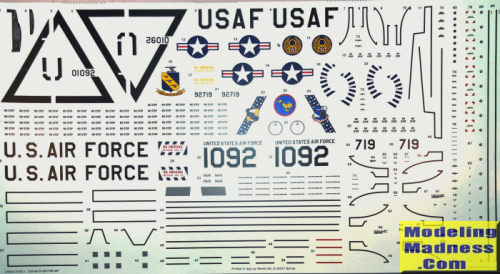 Two
marking options are provided, #50-192 machine, belonging to 98th Bomb
Squadron, 11th Bomb Wing, as it stood in Carswell Air Force Base, Texas,
June 1952, and #49-2719 reconnaissance bird, assigned to 72nd Strategic
Reconnaissance Wing, as it stood in Ramey Air Force Base, Puerto Rico, 1955.
Color shades are provided in Revell codes and in generic terms, with Federal
Standard (FS) numbers included where applicable.
Two
marking options are provided, #50-192 machine, belonging to 98th Bomb
Squadron, 11th Bomb Wing, as it stood in Carswell Air Force Base, Texas,
June 1952, and #49-2719 reconnaissance bird, assigned to 72nd Strategic
Reconnaissance Wing, as it stood in Ramey Air Force Base, Puerto Rico, 1955.
Color shades are provided in Revell codes and in generic terms, with Federal
Standard (FS) numbers included where applicable.
The decal sheet is truly impressive, occupying a large portion of
the box and matching the enormous dimensions of the model itself. Printed by
Cartograf, it features excellent colour density, sharp printing and perfect
registration. If kept well preserved, it should provide no problems during
application. Among the many stencils included are the distinctive wing walk
lines, an important feature on the B-36 due to the enormous size of the
aircraft's wings.
Construction begins with the cockpit assembly, where the
instructions call for the nose wheel bay and the nose landing gear leg to be
attached to the cockpit floor at the outset, after which the remainder of
the cockpit and crew compartment is assembled. The upper and lower crew
stations are completed as separate subassemblies.
Construction continues with the assembly of the bomb bay on the
fuselage halves, the configuration depending on whether the bomber or
reconnaissance version is being built. The nose and tail gun turrets are
also assembled and installed in their respective positions, followed by
attachment of the six visual targeting mechanisms used by gunners to aim the
aircraft's remote-controlled defensive cannons.
The impressive wing spar is finally trapped in between, before the
fuselage halves are joined, trapping all the above subassemblies in between.
Approximately 60 grams of nose weight are installed in a well-defined
compartment immediately aft of the crew stations to ensure the completed
model sits correctly on its landing gear.
The horizontal stabilizers are next assembled and attached, before
attention turns to the massive wings. Their construction begins by attaching
the six engine air intakes, the propeller spinner bases and the remaining
internal components to the lower wing halves, after which the upper wing
halves are fitted. Although the number of parts may initially appear
intimidating, the process is actually quite straightforward, with the
engineering guiding the modeller towards a positive fit.
Construction then moves to the landing gear, where you can build the
model either with the landing gear extended or fully retracted. Assembly
then proceeds to the four jet engine pods. Some care is required at this
stage, as the fit has been reported by several builders to require a little
extra attention. The bomb bay doors are fitted next, either in the open or
closed position depending on the chosen configuration. The optional crew
access ladder can also be added at this stage, providing an attractive touch
for those wishing to display the aircraft on the ground.
Instructions then call for adding external details, such as the
various antennas, aerials and fairings specific to the selected variant.
Care should be taken during this stage to ensure the correct components are
used, as the B-36H bomber and RB-36 reconnaissance versions differ in
several external details.
The wings are then attached to the fuselage, with the build being
completed by fitting the propellers, the various transparencies and the
antenna mast, bringing this impressive aircraft to life.
Although the sheer size of the Peacemaker may initially appear
intimidating, construction is actually far less complicated than one might
expect. The engineering is logical, the assembly sequence is
straightforward, and the large parts are generally easy to handle. Rather
than being an overly complex project, it is simply a very large one.
The Monogram/Revell 1/72 B-36 Peacemaker remains one of the most impressive
and ambitious aircraft kits ever produced. One cannot help but admire the
boldness and confidence required to release such a massive project,
especially back in 1980. Even today, it stands as one of the largest and
most impressive injection-moulded aircraft kits available.
Despite its age, the kit continues to impress with its accurate
overall shapes, good molding quality and sharp detail. The raised panel
lines are typical of the era but are neatly executed and perfectly
acceptable for many modellers. The cockpit and crew areas are sufficiently
detailed, especially considering how little will be visible through the
framed canopy, while the landing gear, transparencies and comprehensive
decal sheet are well executed.
Combined with straightforward engineering and a sensible price, this
kit represents remarkable value. Of course, its enormous size requires space
and some dedication from the modeller, but for those willing to accept the
challenge, the Monogram/Revell B-36 is a project well worth tackling. A true
classic that rewards the effort with a magnificent centrepiece.
Happy modeling!
Copyright ModelingMadness.com. All rights reserved. No
reproduction in part or in whole without express permission from the editor.
If you would like your product reviewed fairly and fairly quickly, please
contact the editor or see other details in the
Note to
Contributors.
Back to the Main Page
Back to the Review
Index Page
Back to the Previews Index Page
 It
was back in 1980 when Monogram released its all-new 1/72 Convair B-36
Peacemaker. The kit immediately impressed the modelling world, not only
because of the sheer size of the subject but also because of the ambitious
engineering and level of detail offered. Over the years it has been reissued
several times under both the Monogram and Revell labels, remaining to this
day the only injection-molded kit of the B-36 in this scale. Somewhere along
the way, additional parts were introduced to cater for different variants.
It
was back in 1980 when Monogram released its all-new 1/72 Convair B-36
Peacemaker. The kit immediately impressed the modelling world, not only
because of the sheer size of the subject but also because of the ambitious
engineering and level of detail offered. Over the years it has been reissued
several times under both the Monogram and Revell labels, remaining to this
day the only injection-molded kit of the B-36 in this scale. Somewhere along
the way, additional parts were introduced to cater for different variants.