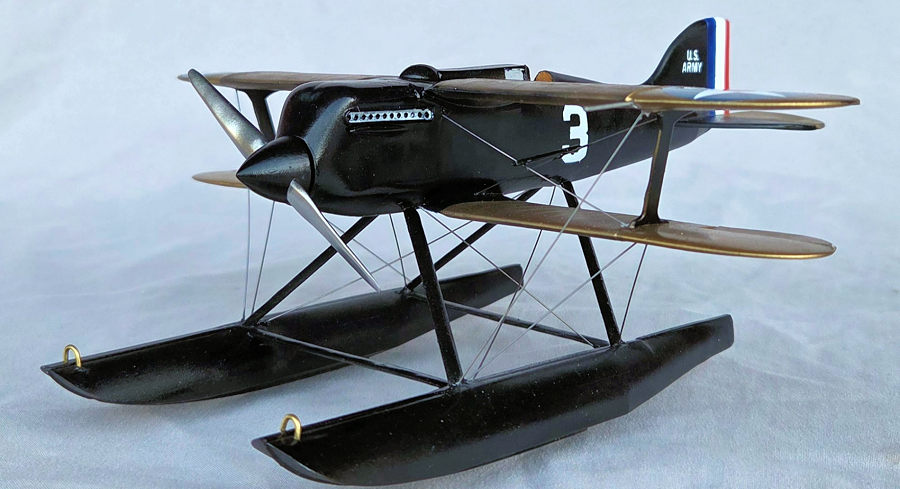
Valkyrie Designs 1/32 RC3-2 Racer
| KIT #: | 000001 |
| PRICE: | $150.00 |
| DECALS: | One option |
| REVIEWER: | John Summerford |
| NOTES: | 3D printed. Includes markings mask. |
| HISTORY |
Jimmy Doolittle left UC Berkely’s School of Mines at the start of his senior year to join the Army’ Signal Corps when the US entered WWI. He was ordered to attend UC’s aviation ground school as a reserve cadet. Although he wanted to fight in Europe, he was an instructor when the war ended. Flying and Army life appealed to him and the Army still needed instructors. Since he could be assured of a steady paycheck, versus trying to earn an income as a barnstormer, he stayed in the (now) Air Service.
 Despite
being involved in numerous accidents, Doolittle was retained by the Army after
the drawdown of 1919. He was transferred to postings in Texas and then sent to
Air Service Mechanics School Kelly Field, where, upon graduation he was promoted
to first lieutenant in the Air Service, Regular Army. His new status ensured
that he would survive further staff cuts due to smaller budgets.
The Air Service wanted to keep the public “air minded” by demonstrating its capabilities in defending the country. As such, it participated in air shows and publicized long-distance flights. On his second attempt, from September 4 through the 5th, 1922, Doolittle completed the first coast to coast flight in under 24 hours, from Florida to California, including a stop at Kelly field. He spent months preparing for the flight by familiarizing himself with all segments of the flight path. His DH-4 was modified at McCook Field, Dayton, Ohio, (later to become Wright-Patterson AFB) with a new fuel tank and a newly developed instrument, a turn-and-bank indicator. The success of the flight led to Doolittle being transferred to the Air Service Engineering School at McCook field.
While in Dayton, Doolittle was able to fly numerous aircraft and also performed aerobatics, both as a soloist and part of a team. His requests for more cross-country record attempts, however, were denied.
His aptitude for engineering enabled him to enroll at the Massachusetts Institute of Technology for a master’s degree in aeronautics starting September 1923. He was placed on detached service from McCook Filed for two years. In multiple ways, he “flew” through the master’s course in one year and earned a doctorate in the second year.
By the time Doolittle returned to McCook Field in 1925, progress in military aviation was stunted by the small budgets and more progress was being made on engines than airframes. Racing was one way to get funding for developing faster “Pursuit” designs.
The Curtiss Aeroplane & Motor Company, by then, the largest aircraft manufacturer in the country, resumed construction of racing aircraft after WWI, primarily as test beds for new airframe designs, engines and propellers and supplied the military with racers since 1920. For 1925, the Army and Navy were awarded $250,000 each to purchase four Curtiss R3C-1 aircraft, made mostly of wood. One was static tested to destruction, two went to the Navy and the fourth to the Army. Fortunately for the Army, it got the fastest one.
The planes were entered in the Pulitzer race held on October 12 at Mitchel Field, New York. The Army’s plane, piloted by Lieutenant Cyrus Bettis won the race, the Navy’s plane piloted by Lieutenant Al Williams, came in second and third place went to Leo Dawson in a Curtiss P-1 Hawk.
Two weeks later, the Schneider race
was held over Chesapeake Bay. The three military aircraft were
 converted
to R3C-2s by removing the wheels and installing floats. Since Doolittle was the
backup pilot for the Pulitzer race, he was the primary pilot for the Schneider
race. He easily won the race when both Navy planes dropped out with engine
trouble. He set a seaplane record of 232.573 MPH. Second place went to British
Captain Hubert Broad flying at 199.169 MPH. Italian Giovanni de Briganti crossed
the finish line at 168.444 MPH.
Doolittle felt that the plane could fly faster and he asked the observers from the National Aeronautics Association and the Federation Aeronautique International to be present for a speed record attempt the following day. Before the attempt, he adjusted the pitch of the propeller account for the engine running at full throttle, not at cruise setting. It worked. He flew the three-kilometer course at 245.713 MPH, again, claiming a new world seaplane record.
When he returned to McCook Field, his fellow pilots found an admiral’s costume jacket, with a for-and-aft hat, and paraded “Admiral Doolittle” around Dayton, in a lifeboat trailered by a truck.
After the race, the Army accepted a recommendation from a study conducted by Cornell University’s College of Engineering that the Army’s time and resources be spent on activities other than racing. The Navy reduced its racing efforts in 1926 and garnered only a second-place finish. When the Navy quit racing, the door was open for Britian to claim the Schnieder Cup.
In 1926, Doolittle was the first person to perform an outside loop. Curtiss “borrowed” him for two sales tours in South America. In 1929 he was seconded to the Guggenheim Fund to develop instrument flight. By 1930 he was dissatisfied with the Lieutenant’s pay he was still earning. He asked Shell Oil company if they wanted to form an aviation section and they agreed by starting his pay at three times what he was earning in the Army. Before he joined Shell, he received reserve status as a Major.
Under Shell’s sponsorship, Doolittle entered the national air races during the next two years. The only race that he lost was the 1931 Thompson Trophy, when his engine failed.
He kept abreast of developments in military aviation and knew that the larger engines being designed needed higher octane rated gas to supply more horsepower. He persuaded his employer to be the first company to refine 100 octane avgas, which proved to be a strategic asset for the military later. When WWII started in Europe, he was called up from the reserves. After the Japanese attacked Pearl Harbor, he was tasked with retaliating against them. From there, he went on to eventually command the 8th Airforce.
| THE KIT |
 Inside the
shipping package is a combination of bubble wrap and packing peanuts. The major
prints float in the packing and the smaller pieces are in zip-top bags with a
hand-written label of the parts within. The parts are printed in gray resin with
great detail in the radiators and exhausts. The struts are printed as one piece
with large mating surfaces for the floats and fuselage, making alignment easy.
Also, the wings and their struts are printed attached to the fuselage halves.
Total parts count, including a Jimmy Doolittle figure, is 19. Of note is the lack of rudder pedals (which probably cannot be seen anyway) and control stick in the cockpit. Instrument faces are not included, nor clear windshield panes. Painting masks are included for the markings, or one could source decals, if so desired.
There are no instructions and the label found inside the box can serve as a rigging diagram. Rigging material is not included.
| CONSTRUCTION |
3-D printed models assemble differently than styrene but are simpler. The first thing one must do is cut through the forest of the support matrix. I found that sprue cutters used next to the part was easiest way to get that done. Bits of the matrix flew all over the workbench and I was picking them up throughout the build. The Fuselage/wing parts were cleared and cleaned up first.
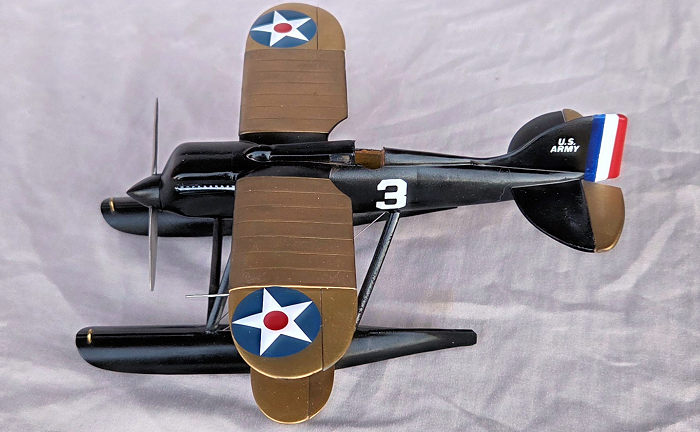 Quality
control issues were apparent and several emails with photos were sent to Mr.
Valkyrie. He conceded that there was room for improvement and offered to send an
improved kit. None of the issues that I had were beyond my ability to handle,
and I didn’t want to wait any longer to have an R3C-2 on my shelf, so we agreed
to classify this build as a Beta Test. As such, this is the first completed kit
from Valkyrie Designs. Throughout the build, I sent photos and made suggestions
to Mr. Valkyrie. That means my experience is unique, so I won’t go into detail
here.
What can be expected is:
Identify rigging attachment points and formulate a rigging plan.
Sand down the “grain” from the printer. It might be helpful to apply primer and repeat the process.
Use a fine grade primer on the radiators.
Use epoxy for attaching the major parts. Have the solvent recommended by the manufacturer handy for cleaning the seams and reducing the need for filler later.
Filler will still be needed. It’s the nature of the beast.
| COLORS & MARKINGS |
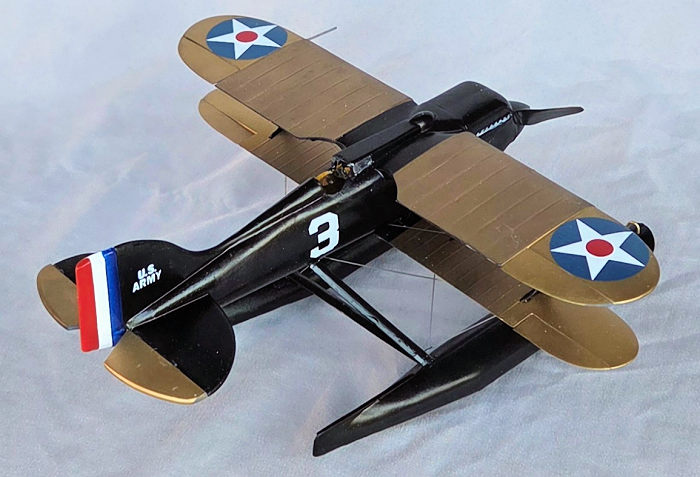 Thinking
that it would be quicker to paint both sides of the control surface pieces at
once, they were left on the print matrix. That was a mistake since they also
needed sanding. As usual, the primer coat revealed where more filling and
sanding was needed. Tamiya’s TS-14 rattle-can gloss black was applied to
everything (except the rudder, which was primed white) and doubled as a base
coat for the metallic paints.
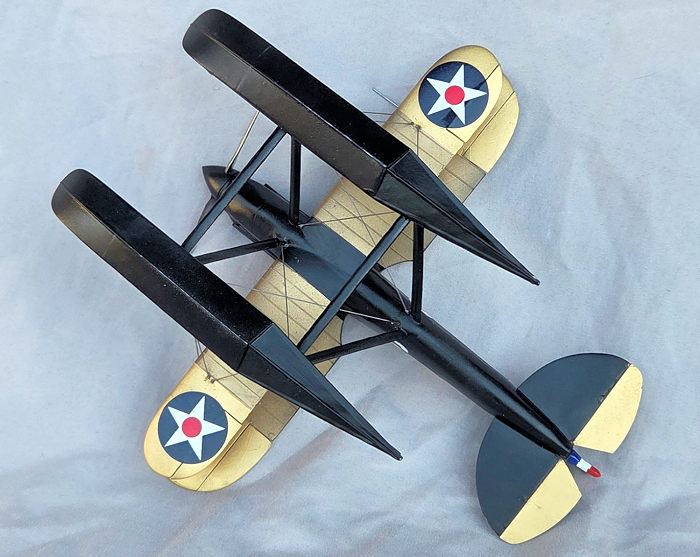
Alclad II Chrome was misted onto the prop and it was set aside. The Rudder was given a base coat of white, then masked for the red stripe. After that cured, it was masked for the blue stripe and also set aside. The exhaust ports were brush-painted aluminum, then the fuselage and pontoons masked. The latter was masked by wrapping a plastic bag around them. This was also done around the tail.
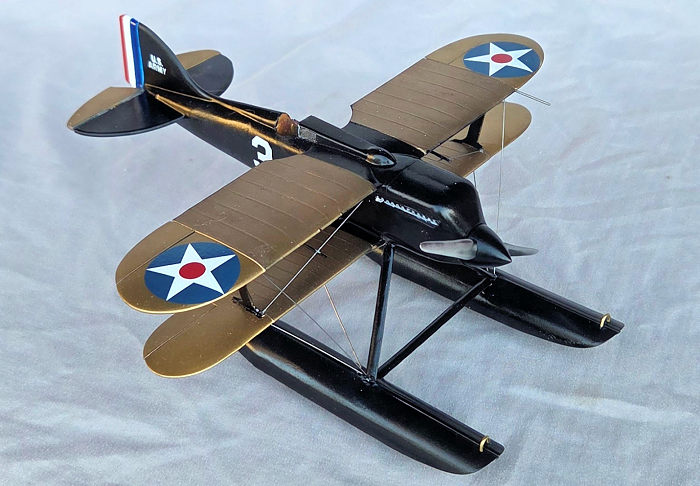
The wings and control surfaces were given a coat of AK Interactive’s Extreme Metal Brass. When that cured, the radiators were masked and the wing tips and control surfaces were overcoated with Alclad’s Gold.
Stencils from the kit were used for the racing numbers and fin lettering. The masking centers of the “A”s and “R” can be laid down, but it is FAR easier to daub the centers with black paint using a very fine brush. The insignia were sourced from the decal dudgeon.
| FINAL CONSTRUCTION |
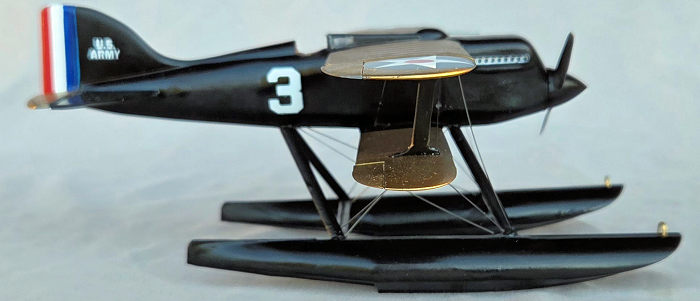
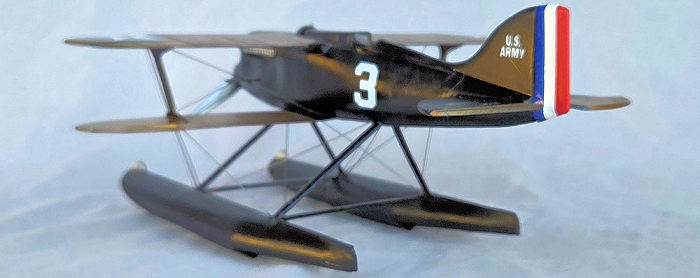 Fortunately,
the rigging isn’t very complex for a biplane. Unfortunately, it’s a float plane,
which adds complexity. The rigging wasn’t cable, but rods, so I prefer to use
.015 music wire to simulate that. The problem with that material’s use is that a
lot of handling is required, which induces flexing. A couple of times I had to
replace wire segments because they had become bowed. I started with rigging the
pontoons first to stabilize them for further handling, then installed the
segments that attach the pontoons to the lower wing. The interwing wires came
next. The most difficult task of the entire build was installing the spreader
bars. Getting them aligned along the three axes between two crossing wires took
several attempts. The last segments installed were the pair running from the
upper wings to the pontoons.
Cletes at the tips of the pontoons were made for brass rod bent to shape over the handle of a needle file and glued into place. The control surfaces attached, followed by a pitot tube cut from a paper clip. That made the prop the final bit.
| CONCLUSIONS |
I have wanted to build a 32nd scale model of the R3C-2 when I first read about it over 40 years ago. Doolittle’s autobiography, I Could Never Be So Lucky Again, further fueled my desire. (He had an amazing career and is a must-read for anyone interested in aviation.) There was limited edition cast resin kit available in the early 2000s, but I missed out on that one. I am thrilled to have this model on my shelf.
I thought I could build the model in about two weeks, but it took a month. This is my second 3-D printed kit and I learned a lot about assembling them. They are a bit simpler, due to fewer parts but require more prep work. Rigging and the lack of instructions dictate that some experience is required to assemble the kit. VERY helpful information can be found on the National Air and Space Museum’s website at
https://airandspace.si.edu/collection-objects/curtiss-r3c-2/nasm_A19280002000
This racer is not a subject that makes for an easy build due to potential for breaking something during frequent handling. ( Fortunately, I didn’t break anything.) Given the way this kit is engineered, it is difficult to paint, but the tradeoff is worth it. A review of the Testors (Hawk) 48th scale kit can be found Modeling Madness’ archives here https://modelingmadness.com/review/preww2/bertor3c.htm and highlights potential issues. It should be noted that the printed kit is more accurate.
Over the past several years I have built racers from 20’s and 30’s and the responses I have received from modelers worldwide (well, North America and Europe) tells me that there is an appetite for modern, accurate, renditions of these aircraft.
15 October 2026
Copyright ModelingMadness.com. All rights reserved. No reproduction in part or in whole without express permission.
If you would like your product reviewed fairly and fairly quickly, please contact the editor or see other details in the Note to Contributors.