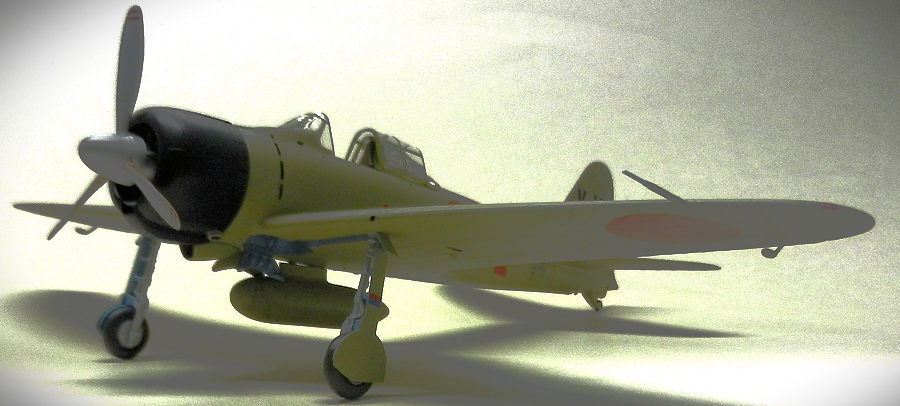
Tamiya 1/48 A6M2 Zero
| KIT #: | 61016 |
| PRICE: | CAD$16.00 |
| DECALS: | Five options |
| REVIEWER: | Pablo Calcaterra |
| NOTES: |
| HISTORY |
Even though Martin Caidin in the book that he co wrote with Saburo Sakai claims that the battles over Port Moresby had been one sided during the first half of May 1942 and that no Zero was lost in combat during that period of time, fact is that the Tainan Wing lost 4 Mitsubishi fighters in combat between May 1 and May 14.
The first 2 planes of the fortnight were lost on May 1 and May 2 and, as I commented in the build of my Airacobra model they were both victims of 2nd Lt. Donald MacGee. Moreover, he was the only P-39 pilot with confirmed Zero kills in successive days. Link.
The first kill, flying Nip Nemesis, was described in the article mentioned above. About the second kill more information has surfaced (at least for me!) thanks to procuring a copy of Eagles of the Southern Sky by Ruffato and Claringbould.
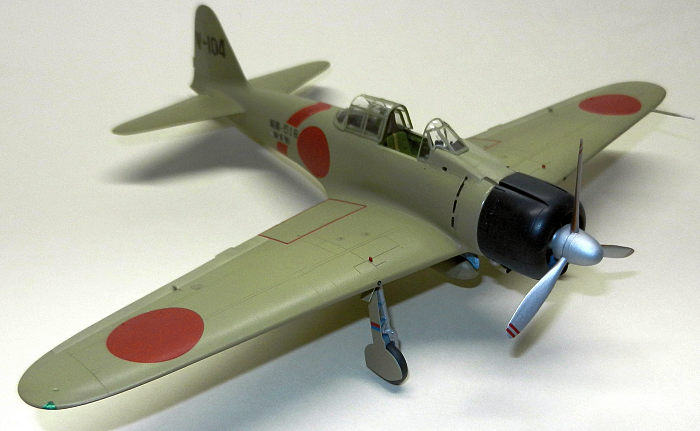 On May 2
at 6.30 in the morning 9 Zeros divided in 3 Shotais took off from Lae on a
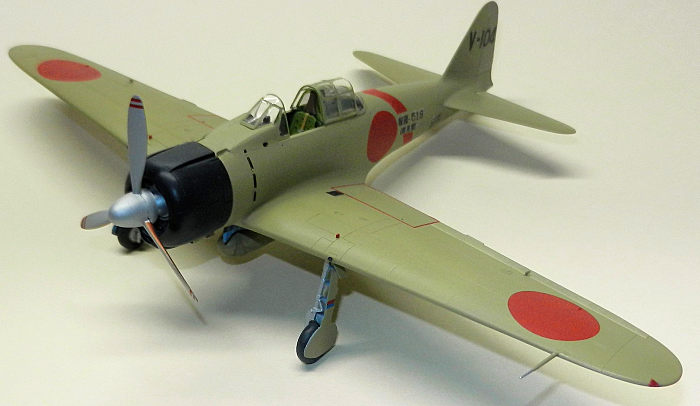
fighter sweep to Port Moresby. Piloted by Flyer 1c Kawanishi Haruo V-104 was
the 3rd plane in the Shotai led by Lt Sasai with FPO1c Nishizawa as 2nd
element.
On May 2
at 6.30 in the morning 9 Zeros divided in 3 Shotais took off from Lae on a
fighter sweep to Port Moresby. Piloted by Flyer 1c Kawanishi Haruo V-104 was
the 3rd plane in the Shotai led by Lt Sasai with FPO1c Nishizawa as 2nd
element.
Kawanishi Haruo had been a successful pilot with the Tainan Wing. He was one of the ones that participated in the first attacks on the Philippines in 1941 including missions to Clark Field, Iba and Del Carmen. He had flown 6 missions over New Guinea by the time of this death but he had not show down any Allied plane on this theater.
Having lost 1 plane due to mechanical malfunction the Japanese tangled with the last 3 Kittyhawks of RAAF 75 Sqn and 7 Airacobras. One P-40 was shot down with the loss of D.W. Munro and another one crash landed leaving the Australians with only one plane left...
The Tainan pilots landed back at Lae at 9.10 am stating that they had a combat against 15 enemy planes (in fact it was 10) while shooting down 8 of these (in fact it was just 1) for the loss of a single Zero…that being the one flown by Kawanishi at the hands of MacGee. The Zero had crashed 16 miles from Port Moresby behind the village of Porebada
International News Service war correspondent Pat Robinson described his adventures when on September 13, 1942 he was informed that a Zero had been found several miles away from Seven Mile aerodrome. Using a jeep thru some very bad roads, these became impassible and they left it to walk thru the jungle and finally had to climb up a hill where, at the top, they found burnt trees and the remains of the Japanese plane. Among the destroyed parts they found the head, an arm and a leg among the debris. Robinson along with the other 4 people recovered as many of Kawanishi’s parts as possible and took them back to Moresby. They also took note of serial number and other details of this plane while shooting some pictures.
 Kawanishi
was buried in Bomana with full military honours but re interred in an
exclusive Japanese cemetery near the same location in 1944.
Kawanishi
was buried in Bomana with full military honours but re interred in an
exclusive Japanese cemetery near the same location in 1944.
During the 1990s the remains of the plane were recovered and put in storage in a container by John Douglas. In 2004 the container was removed by the storage company. It is presumed that the remains of the plane were sold for scrap…
What I found fascinating reading Eagles is that the official Japanese method to award the kills to all the pilots in the fight (and not individually) greatly reduced the number of kills attributed to each Zero jockey. For instance, using this method Sakai had only 4.3 kills! His first official kill (shared) was this very same May 2nd 1942 whereas Samurai! claims he was already notching victories in New Guinea before this date... According to Japanese records he participated in 24 combats over New Guinea in which an Allied plane was actually shot down. Does this mean that he shot down those 24? Clearly not because many other Japanese fliers (including the greats as Ota, Sasai, Nishisawa among others) also claimed a kill in those very same combats, combats in which many times a single Allied plane was actually shot down! No better example than May 2nd…It is clear that Sakai’s 64 victories are not real, with the official Japanese number being 28.
Eagles has very good tables at the end. It shows that for the loss of 81 Allied planes shot down (including bombers), the Japanese lost 27 Zeros in combat for an exactly 3:1 ratio in favor of the Axis flyers. With an average of 3.35 missions per day and 3.94 sorties per mission, the Japanese lost 0.91 Zeros per sortie.
| THE KIT |
 Scott
recently previewed this kit. I can add that this is the venerable but
surprisingly good 1973 Tamiya Zero. Details are not as complete as those
like of Eduard but for me these are simple and accurate enough (for my
standards!).
Scott
recently previewed this kit. I can add that this is the venerable but
surprisingly good 1973 Tamiya Zero. Details are not as complete as those
like of Eduard but for me these are simple and accurate enough (for my
standards!).
Instrument panel is a flat piece onto which a decal has to be applied. There are no holes in the seat while this has the straps molded into it.
Part count is very low but fit is also very good with only some issues that I will describe below.
Decal sheet is very good with 5 different Model 21 planes including that of Sakai.
| CONSTRUCTION |
After cleaning most of the parts I sprayed those for the landing gear, landing gear bay, engine and cockpit in Vallejo Light Grey Primer.
Cockpit parts were given a coat of Model Master Interior Green with boxes and throttles in black. Some details were picked in red per pictures found on line. The decal for the instrument panel was attached using a dilution of Future.
After marking the position with a pin I gently and slowly opened the holes on the seat (I started to see some white crack lines forming on the plastic towards the end of the process!) The seatbelts were made with a combination of foil taken from a bottle of wine and painted in a beige colour with buckles made of small rectangles of aluminum foil.
 With the
cockpit ready everything was enclosed in the fuselage halves that had a very
good fit.
With the
cockpit ready everything was enclosed in the fuselage halves that had a very
good fit.
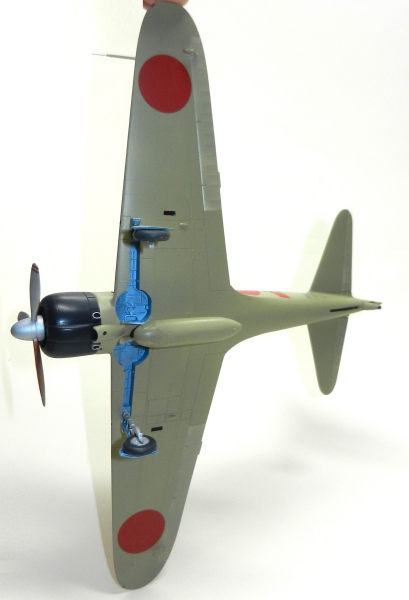
Landing gear bays and interior of the engine cowling were painted in a mix of aluminum with some drops of dark blue, building the colour in thin layers.
Engine was painted aluminum and then a very diluted mix of water and black was applied with a brush and let it run over all the grooves and parts of it.
I had to open a hole (only marked) for a vent (?) that comes from the engine straight down thru the intake at the end of the engine under the nose.
Wings were attached and some gaps were found between top of wings and fuselage and behind the wings under the fuselage. The first were covered with strips of Evergreen followed by some Tamiya and Vallejo plastic putty. The latter was fixed with some sanding and several coats of Tamiya putty.
Some rescribing had to be done at top and bottom of fuselage as I had to sand these areas a bit to get a smooth surface.
Tail planes were attached with no issues. Cowling halves were glued in place.
With all the openings masked (cockpit with foam) and the wheel bays and engine cowling with blue tac (a very good method I find as it is very accurate and leaves no gaps) the plane was ready for painting.
| COLORS & MARKINGS |
I primed the model with Vallejo Light Grey Primer. For the fabric covered surfaces I sued a mix of 10 drops of Vallejo Hemp with 3 drops of Light Grey primer and 1 drop of Vallejo Sand Yellow. One it had dried I masked them.
The plane was painted with a mix of Vallejo Hemp 871040 with some drops of Vallejo Sand Yellow 270817 (to give it a caramel tone). Ratio was 20:2 (probably should have used 20:1).
The engine cowling was painted with a mix of Vallejo Black and Vallejo Dark blue 70.899 in a 12:4 ratio.
 Propeller
was painted aluminum with the back face in a mix of brown and red brown. Wheels
were painted with Vallejo Dark Grey Primer.
Propeller
was painted aluminum with the back face in a mix of brown and red brown. Wheels
were painted with Vallejo Dark Grey Primer.
I then added the landing gear legs having removed the Blue Tac masks.
After several light coats of Quick Shine it was time to apply the decals.
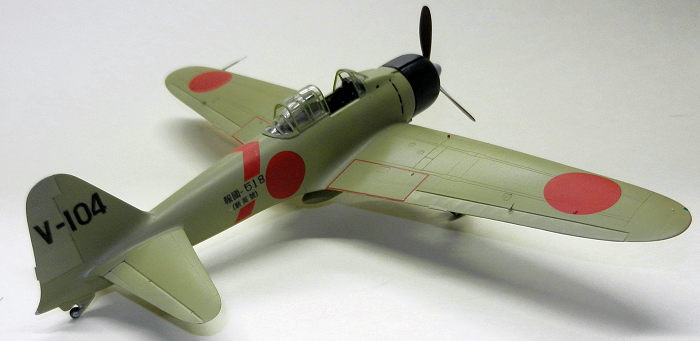
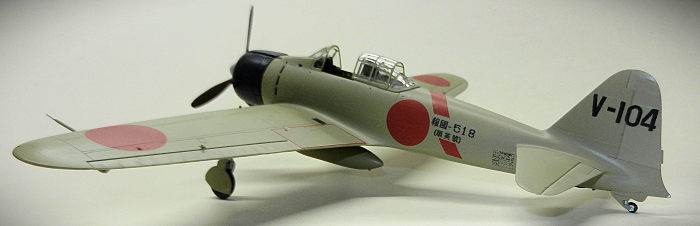
I used the information seen in profile #6 from Eagles and printed the numbers and text on the fuselage on clear decal paper. As the company/group that had donated the money for this plane is unknown I used the text from profile #7 in the same book. Not accurate but better than 3 black squares as seen in profile #6. I also printed the manufacture code of the plane 1640 and after looking for a similar font in PowerPoint I found one that was very close to those seen in the book. With this font I printed V-104.
I stated by adding the large text on the fuselage. Using it as a reference I cut small sections of the red band for the Akagi Zero supplied by Tamiya and created the red V on the fuselage. Then it was the turn of the manufacturer information close to the tail followed by the meat balls. I had to reprint V-104 because I had applied a coat of Decal solution that was too thick and it developed white areas on top of the black ink. Once these were reprinted I applied them to the tail followed by 1640 inside the manufacturer plate close to the tail (I had removed the Tamiya supplied number as they give you a single but this number was different for each plane!)
| CONSTRUCTION CONTINUES |
The engine was attacked to the cowling which in turn was added to the fuselage. Navigation lights were painted in Chrome Silver and then clear red and green. Formation light on the tail cone was painted Chrome Silver.
Placing the plane upside down I started by adding the wheels followed by the landing gear doors, the arresting hook, painting the small details on the tail wheel, the air intake after the engine and the drop tank that I dirtied a bit around the cap using extremely thinned dark paint.
 Moving to
the top I corrected the colour of the fuselage under the canopy per Scott’s
directions (black instead of green), bent up the aluminum made cocking handles
for the machine guns that I had scratch built, cut a small rectangle of clear
plastic for the gunsight and added the windshield, back of the canopy and with
some white glue the hood. A drop of black paint very diluted with Vallejo
Thinner was used to apply some dirt on a very few access panels on the wings. I
know…it looks too clean…let’s assume it represents the plane when it arrived in
New Guinea.
Moving to
the top I corrected the colour of the fuselage under the canopy per Scott’s
directions (black instead of green), bent up the aluminum made cocking handles
for the machine guns that I had scratch built, cut a small rectangle of clear
plastic for the gunsight and added the windshield, back of the canopy and with
some white glue the hood. A drop of black paint very diluted with Vallejo
Thinner was used to apply some dirt on a very few access panels on the wings. I
know…it looks too clean…let’s assume it represents the plane when it arrived in
New Guinea.
Finally, it was time to add the pitot and add the propeller. The last detail was to paint in red the landing gear position indicators.
Remember…no antenna mast or loop…these Zeros had no radios (nor parachutes!) to save weight.
| CONCLUSIONS |
Simple, no headaches. Tamiya…without having to be a Museum quality model like Edward’s. A pleasure to build the Zero that I wanted for my “Air War over Port Moresby combo”
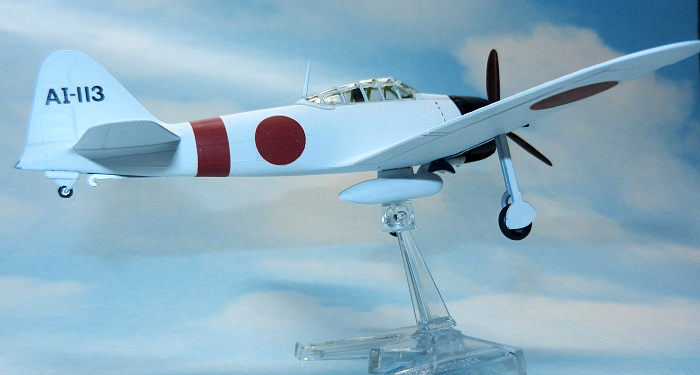
PS: In parallel I built the traditional Matchbox Zero. (See the above image) Memory lane…building again a kit that I put together 50 years ago…but this time using the proper tools (no heavy brush streaks of thick white Humbrol paint…). The only deviation from the instructions was the propeller (in aluminum with the black I red brown).
| REFERENCES |
Samurai! By Sakai, Saito and Caidin
Pacific wrecks
Eagles on the Southern Sky by Ruffato and Claringbould
6 April 2026
Back to the Previews Index Page
Back to the Previews Index Page