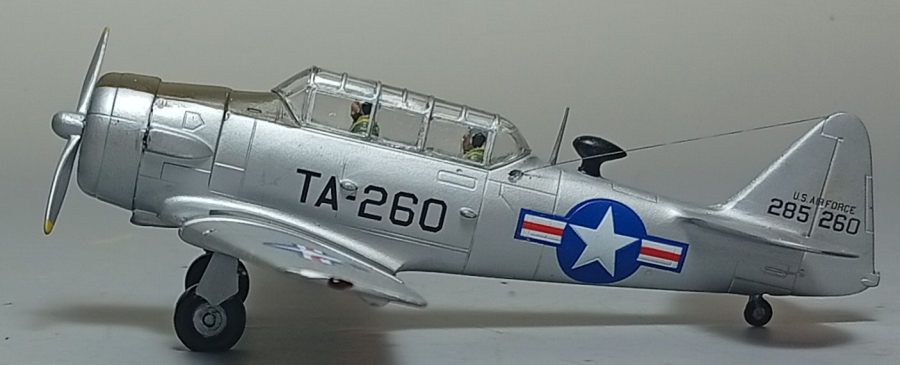
Hawk 1/72 T-6 Texan
| KIT #: | 610 |
| PRICE: | $ |
| DECALS: | One option |
| REVIEWER: | Spiros Pendedekas |
| NOTES: | 1955 tooling |
| HISTORY |
Few aircraft
in aviation history can claim to have shaped as many pilots, careers, and
air forces as the North American T-6 Texan. While sleek fighters and mighty
bombers often captured the spotlight, it was the humble Texan that stood
quietly behind countless wartime successes, preparing generations of young
aviators for the challenges that lay ahead.
First taking to the skies in the late 1930s, the T-6 was designed as an
advanced trainer, bridging the gap between basic flight instruction and the
demanding performance of front-line combat aircraft. It was an airplane that
demanded respect. Unlike simpler trainers, the Texan possessed enough power,
weight, and complexity to teach pilots the skills they would need in combat.
It could be forgiving when treated properly, yet quick to remind students
that aviation required discipline, precision, and confidence.
 For many
young men of the Second World War, the T-6 represented far more than an
aircraft. It was their first taste of real military flying. Before they
climbed into the cockpits of Spitfires, Mustangs, Thunderbolts, Corsairs, or
Hellcats, they learned their trade in the Texan. Here they practiced
formation flying, aerobatics, navigation, instrument flying, and gunnery.
Here they made mistakes, gained experience, and slowly transformed from
enthusiastic recruits into capable military aviators.
For many
young men of the Second World War, the T-6 represented far more than an
aircraft. It was their first taste of real military flying. Before they
climbed into the cockpits of Spitfires, Mustangs, Thunderbolts, Corsairs, or
Hellcats, they learned their trade in the Texan. Here they practiced
formation flying, aerobatics, navigation, instrument flying, and gunnery.
Here they made mistakes, gained experience, and slowly transformed from
enthusiastic recruits into capable military aviators.
Known as the Texan in the United States Army Air Forces, the SNJ in U.S.
Navy service, and the Harvard throughout much of the Commonwealth, the
aircraft became a truly global machine. Thousands were produced, serving
with dozens of nations across nearly every continent. Its distinctive
silhouette, long greenhouse canopy, and unmistakable radial engine note
became familiar sights and sounds at training bases around the world.
What made the T-6 so successful was not cutting edge technology or
extraordinary performance. Its greatness lay in its balance. It was robust,
reliable, economical, and versatile. It could withstand the rigours of daily
training while providing students with a realistic introduction to the
aircraft they would eventually fly in combat. In many ways, it was the
perfect teacher - demanding enough to build skill and confidence, yet
dependable enough to forgive the occasional error of an inexperienced
student.
 Long
after the guns of World War II fell silent, the Texan continued to serve. It
trained pilots during the Cold War, participated in counter-insurgency
operations, and remained in military inventories for decades. Even today,
many examples continue to grace airshows and museums, their distinctive
radial engines evoking memories of a bygone era. Few historic aircraft can
still stir such affection among pilots and enthusiasts alike.
Long
after the guns of World War II fell silent, the Texan continued to serve. It
trained pilots during the Cold War, participated in counter-insurgency
operations, and remained in military inventories for decades. Even today,
many examples continue to grace airshows and museums, their distinctive
radial engines evoking memories of a bygone era. Few historic aircraft can
still stir such affection among pilots and enthusiasts alike.
There is something deeply nostalgic about the T-6. It was not usually the
aircraft that earned the victory, claimed the headlines, or became the
legend. Instead, it was the aircraft that prepared others to achieve
greatness. Every ace, every combat veteran, every young pilot who nervously
pushed the throttle forward for the first time carried with them lessons
learned in machines like the Texan.
Perhaps that is why the T-6 remains so beloved today. It symbolizes not only
the golden age of military aviation, but also the journey of learning,
perseverance, and growth. It reminds us that behind every famous fighter
pilot stood countless hours of practice, instruction, and determination. The
Texan was the classroom in which many of aviation's greatest stories truly
began. More than eighty years after its introduction, the North American T-6
Texan remains one of the most important training aircraft ever built. A
rugged, elegant machine whose legacy lives on wherever the history of
aviation is remembered and celebrated.
| THE KIT |
Hawk first
released their then-newly tooled 1/72 T-6 Texan in 1955, and the kit went on to
enjoy a remarkably long life, being reboxed and reissued many times over the
decades, including numerous releases under the Testors label. That longevity
alone makes it one of the true classics of vintage modeling.
 The specific
kit is the 1965 reissue. Apart from being a true collector’s item, what makes
this example truly special is not just its age, but its journey: it was handed
to me in 2026, sixty years later, by the wife of a much loved local club member
who has since passed away.
The specific
kit is the 1965 reissue. Apart from being a true collector’s item, what makes
this example truly special is not just its age, but its journey: it was handed
to me in 2026, sixty years later, by the wife of a much loved local club member
who has since passed away.
A lovely little kit by every measure, it is a genuine remnant of a bygone era,
simple, unpretentious, and wonderfully easy to build. This was the kind of model
that a youngster could assemble in an afternoon and then proudly take off to
play with, long before scale modelling became the highly detailed and demanding
hobby we know today. If you would like a closer and more detailed look at its
contents, you can read its preview in
the ever growing MM archives.
The vintage kit was actually discovered by my son, who immediately took a liking
to the classic T-6 and insisted, quite enthusiastically, that we build it
together. For a moment I did consider keeping it untouched as a collector’s
piece, given its age and provenance, but in the end I resisted that temptation.
I’ve always felt that every kit deserves its chance to be built, not just stored
away, and this one was no exception. So onto the bench it went, ready to be
turned into a shared little project and, in the process, brought back to life.
| CONSTRUCTION |
Construction
proved surprisingly straightforward. With fewer than twenty parts in the entire
kit, there is very little that can go wrong. For the record, I began by joining
the fuselage halves, followed by attaching the one-piece wing underneath and
then the horizontal tailplanes. The single piece engine/cowling was next
attached to the front of the fu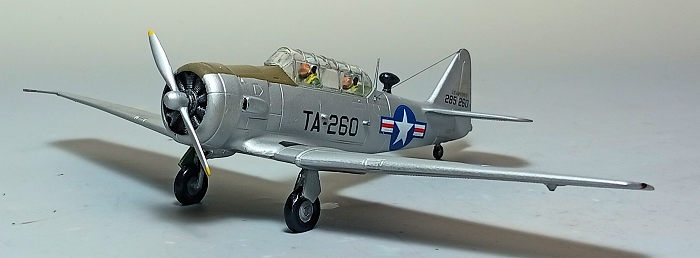 selage.
To improve the appearance of this simple area, I drilled out the molded-on
exhaust to give it a hollow, more realistic look, and also drilled out the air
intake underneath, using a micro-drill. The engine itself was painted black and
subsequently given a heavy silver dry-brush, which helped bring out the molded
detail and added a more convincing metallic appearance.
selage.
To improve the appearance of this simple area, I drilled out the molded-on
exhaust to give it a hollow, more realistic look, and also drilled out the air
intake underneath, using a micro-drill. The engine itself was painted black and
subsequently given a heavy silver dry-brush, which helped bring out the molded
detail and added a more convincing metallic appearance.
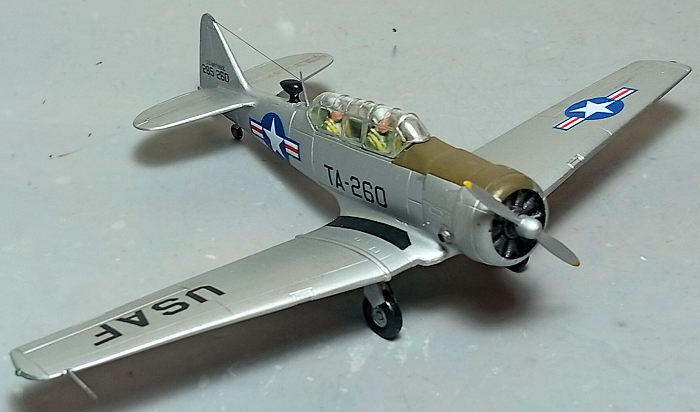
There is virtually no cockpit to speak of. The only items to install between the
fuselage halves are the two pilot figures. The cockpit area was painted in a
home-brewed Green Zinc Chromate mix, while the inclined area representing the
instrument panel was painted black. The pilot figures are rather generic in
appearance, but they contribute greatly to the nostalgic charm of the model. I
painted them in green flying suits, with white helmets, linen seat belts, yellow
life vests, black headphones and boots, and flesh-toned faces before securing
them in place.
With that, basic assembly was essentially complete. The whole process was
remarkably brisk and entirely enjoyable, with no significant fit issues
encountered along the way. Small amounts of filling and sanding were required
here and there, but nothing out of the ordinary for a kit of this vintage. Once
these minor imperfections had been addressed, the model was ready for the paint
shop!
| COLORS & MARKINGS |
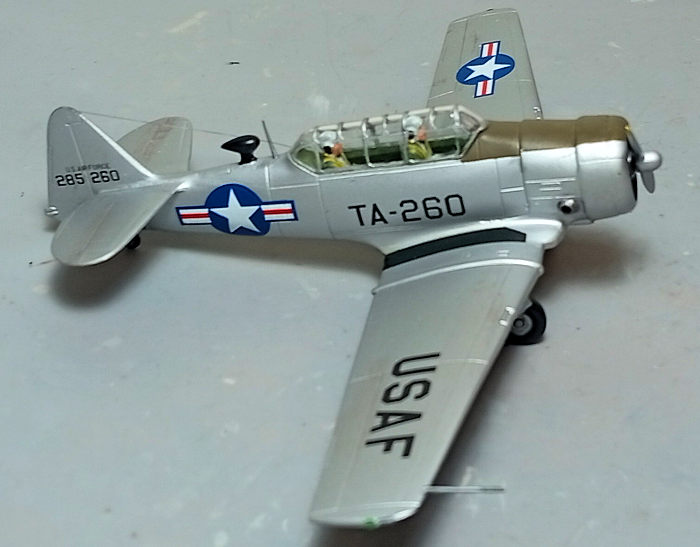
Painting was
every bit as straightforward as the assembly. The entire airframe received a
coat of my trusty Humbrol 11 Silver, while stocks last. The top mounted DF loop
was painted black, while the anti-glare panel ahead of the cockpit was painted
Olive Drab, resulting in a finish that could hardly have been simpler to
achieve.
 Once the
paint had fully cured, I buffed the silver areas with a soft cloth, to give them
a deeper shine, and applied a coat of Future, to protect the silver finish. The
model was then ready for markings.
Once the
paint had fully cured, I buffed the silver areas with a soft cloth, to give them
a deeper shine, and applied a coat of Future, to protect the silver finish. The
model was then ready for markings.
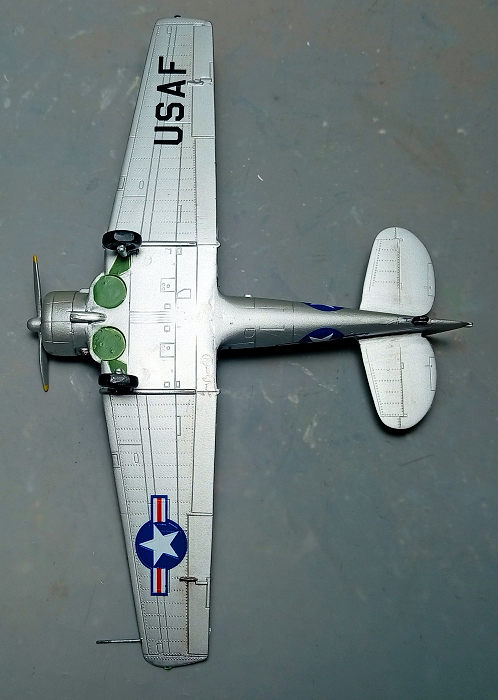
The 60yo kit decals were well printed and still in one piece, but,
unfortunately, their carrier film had yellowed beyond salvation, making most of
the sheet unusable. The only exceptions were the two wing walk lines, which I
decided to try. To my pleasant surprise, they performed beautifully. I trimmed
the black lines very closely to remove as much carrier film as possible, and
they settled down perfectly without any issues.
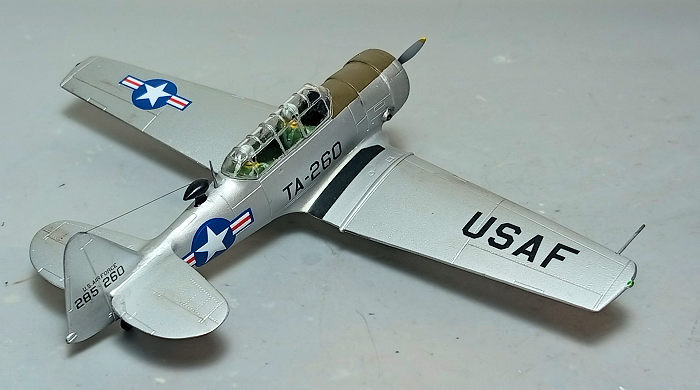
For the remainder of the markings, I turned to the spare decal box and used
leftover insignia from a 1/72 Hobby Boss Easy Assembly T-6. The blue of the
national markings was noticeably lighter than ideal, but it was a compromise I
was perfectly willing to accept on a model of this nature. The replacement
decals behaved flawlessly, and once everything had dried, a final coat of Future
sealed the markings and prepared the model for the finishing stages.
| FINAL CONSTRUCTION |
With the decals sealed and protected, it was time to
attend to the final details. The landing gear was painted silver and
attached, while the wheel wells - or what passes for wheel wells on a kit of
this vintage - were painted in Green Zinc Chromate. I couldn’t resist adding
brake lines from stretched sprue, painted black. The wheels received silver
rims and black tires. To add a touch of realism, I lightly filed the bottoms
of the tyres to create the impression of weight resting on them, a small
modification that helps bring even a simple model to life.
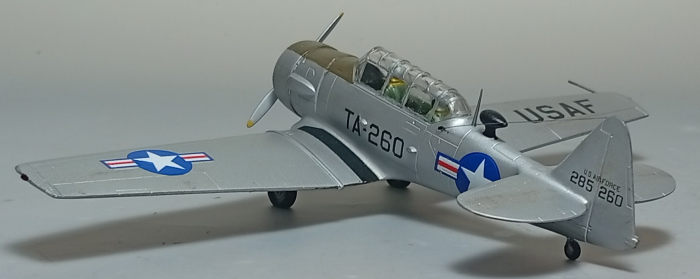 At this
stage, the tailwheel was also attached and painted. Having previously fallen
victim to my usual less-than-delicate handling, it required reattachment
before the model could finally stand proudly on its three wheels.
Fortunately, the repair was straightforward and soon forgotten. The
propeller was painted silver with yellow tips and then attached in position.
With the major components now in place, only a few finishing touches
remained.
At this
stage, the tailwheel was also attached and painted. Having previously fallen
victim to my usual less-than-delicate handling, it required reattachment
before the model could finally stand proudly on its three wheels.
Fortunately, the repair was straightforward and soon forgotten. The
propeller was painted silver with yellow tips and then attached in position.
With the major components now in place, only a few finishing touches
remained.
Weathering was kept to a minimum, consisting mainly of dark brown and black
dry pastels applied sparingly to tone down the bright aluminium finish and
impart a subtle sense of use. Once satisfied with the effect, I applied a
matt clear coat to achieve the desired final appearance.
The canopy had its well defined framing hand painted and attached in place
without difficulty. Appropriate lengths and widths of stretched sprue were
used to represent the aerial mast and antenna wire, which was run from the
fin to a suitably opened hole on the port side of the fuselage.
Finally, small dabs of clear red and green paint were applied to represent
the navigation lights on the wingtips. With that, the little vintage T-6 was
complete - a simple, enjoyable project that perfectly captures the spirit of
an earlier era of scale modelling, when kits were designed to provide a few
hours of uncomplicated fun and the joy of seeing an aircraft take shape
before your eyes.
| CONCLUSIONS |
There is no denying that there are more detailed, and
more sophisticated T-6 kits available today. Yet comparing this vintage kit
to modern offerings somewhat misses the point. This Hawk T-6 comes from a
time when kits were designed to be built, not endlessly perfected. It goes
together quickly, asks very little of the builder, and rewards the effort
with a model that unmistakably looks like a Texan. Its greatest strength
lies in its simplicity. Rather than spending weeks correcting, detailing,
and refining every corner, the modeller is free to enjoy the process.
Could it be improved? Certainly. One could add full cockpit detail, rescribe
surfaces, replace parts, and invest countless hours bringing it up to modern
standards. But doing so would risk losing what makes it special in the first
place. Sometimes it is better to leave a vintage kit as it is and appreciate
it on its own terms.
This little Hawk T-6 is a small time capsule from the golden age of plastic
modelling. It recalls a time of simple box art, pocket-money kits, and
weekends spent building without pressure or expectation. It is also a
personal piece, carrying the memory of a fellow club member whose kit it
once was, which adds a quiet depth to the build that no modern kit could
replicate.
In the end, this is not the best T-6 available. It is not the most accurate,
nor the most refined. But it is something equally valuable: a charming,
honest, vintage kit that delivers exactly what it has always promised. I
enjoyed every moment of it. It was quick, relaxing, nostalgic, and deeply
satisfying from start to finish. More than seventy years after the original
mold first appeared, this little Texan still does exactly what it was
designed to do - provide a few hours of pure modelling enjoyment and leave
the builder with a smile.
Sometimes, that is more than enough.
Happy Modeling!
Spiros
Pendedekas 25 June 2026 Copyright ModelingMadness.com. All rights reserved. No
reproduction in part or in whole without express permission from the editor. If you would like your product reviewed fairly and fairly quickly, please contact the editor or see other details in the
Note to
Contributors.