| KIT #: | 610 |
| PRICE: | € |
| DECALS: | One option |
| REVIEWER: | Spiros Pendedekas |
| NOTES: | 1955 tooling |
| HISTORY |
The North American T-6 Texan was one of the most successful advanced
trainer aircraft ever built, serving with air forces around the world from the
late 1930s onward. Powered by a Pratt & Whitney R-1340 Wasp radial engine
producing approximately 600 horsepower, the T-6 provided trainee pilots with
handling characteristics that closely resembled those of frontline fighters,
making it an ideal stepping stone to combat aircraft.
The aircraft had a maximum speed of around 335 km/h (208 mph), a range of
approximately 1,175 km (730 miles), and a service ceiling of 7,300 m (24,000
ft). Its robust construction, forgiving flight characteristics, and excellent
reliability made it a favorite among instructors and students alike. The T-6
featured a low-wing monoplane design, retractable landing gear, and tandem
seating under a long greenhouse canopy.
More than 15,000 T-6s and its variants were produced, serving in dozens of
countries and remaining in military use for decades after World War II. Known as
the "Pilot Maker," the Texan trained thousands of Allied airmen who later flew
legendary fighters such as the P-51 Mustang, Spitfire, and P-47 Thunderbolt,
securing its place as one of aviation history's most important training
aircraft.
| THE KIT |
 Hawk first released their then-newly tooled 1/72 T-6 Texan in 1955, and
the kit went on to enjoy a remarkably long life, being reboxed and reissued many
times over the decades, including numerous releases under the Testors label.
That longevity alone makes it one of the true classics of vintage modeling.
Hawk first released their then-newly tooled 1/72 T-6 Texan in 1955, and
the kit went on to enjoy a remarkably long life, being reboxed and reissued many
times over the decades, including numerous releases under the Testors label.
That longevity alone makes it one of the true classics of vintage modeling.
The specific kit is the 1965 reissue. Apart from being a true collector’s item,
what makes this example truly special is not just its age, but its journey: it
was handed to me in 2026, sixty years later, by the wife of a much loved local
club member who has since passed away.
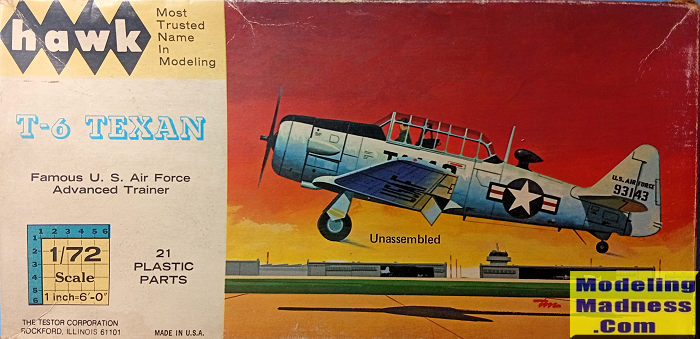
The kit comes in a small, good quality but, naturally, beaten by time, top
opening box, carrying a nostalgic boxart of a T-6 taking off. Upon opening the
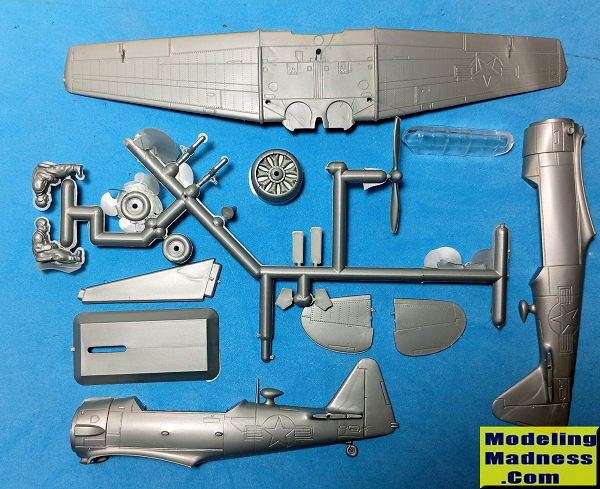
box, I was greeted by just 20 silver grey styrene parts. While the larger parts
are sharply molded, I noticed some flash at the smaller parts, easily cleaned
off. Panel lines are a combination of raised and recessed, while the insignia
locations are molded into the fuselage and wings as recessed guides, a trend
back then. General shapes of parts look accurate and I like the fact that the
wing comes in one piece, simplifying construction.
Overall detail is minimal, with only two very generic figures to be placed in
the otherwise totally void cockpit. The engine comes as a one piece affair with
the cowling and looks generic and shallow, as does the landing gear and
propeller. The one piece canopy is reasonably molded and usable, with its
distorting thickness being rather an advantage, to lessen the interior
emptiness.
Instructions add to the overall nostalgia, coming in the form of a one sided b/w
leaflet, containing some profile and detailed views courtesy of NA Aviation,
while construction steps are not pictorial, just 9 written steps (which I think
it will be sufficient, taking into account the simplicity of the kit).
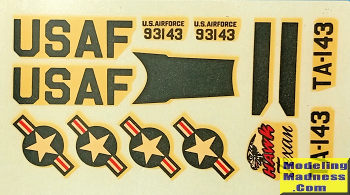 Only one scheme is provided, for 93143/TA-413 USAF machine in seemingly overall
silver - seasonal pics show a matt finish, so I will leave it from this point
onwards to the Experten. The 60 yo decals are still in one piece, quite sharply
printed, but badly yellowed. Will the Greek sun do its magic, when taped on a
sunlit window? Will they crack upon submerging to lukewarm water? Only time will
tell.
Only one scheme is provided, for 93143/TA-413 USAF machine in seemingly overall
silver - seasonal pics show a matt finish, so I will leave it from this point
onwards to the Experten. The 60 yo decals are still in one piece, quite sharply
printed, but badly yellowed. Will the Greek sun do its magic, when taped on a
sunlit window? Will they crack upon submerging to lukewarm water? Only time will
tell.
Instructions want you to trap the seat brackets between the fuselage halves,
then attach the cowling and prop, insert the two pilots, attach the canopy, the
wing, the elevators and the landing gear, ending a definitely simple and
seemingly pleasant build.
| CONCLUSIONS |
June 2026
Copyright
ModelingMadness.com. All rights reserved. No reproduction in part or in whole
without express permission. If you would like your product reviewed fairly and fairly quickly, please
contact
the editor or see other details in the
Note to
Contributors.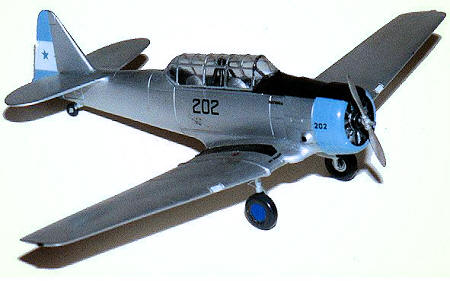 Editor's note: If I might steal a bit of Spiros'
preview space, I've built quite a few of these kits and everything
Spiros states is true. At the time I was building these (all of which were in
Testors boxes or were bagged), was the time that Aeroclub had released a large
number of cast metal accessories in 1/72. Among those were various styles of
seats and various sizes and styles of props. I used these items on most builds
and they really added a lot to the overall presentation.
Editor's note: If I might steal a bit of Spiros'
preview space, I've built quite a few of these kits and everything
Spiros states is true. At the time I was building these (all of which were in
Testors boxes or were bagged), was the time that Aeroclub had released a large
number of cast metal accessories in 1/72. Among those were various styles of
seats and various sizes and styles of props. I used these items on most builds
and they really added a lot to the overall presentation.