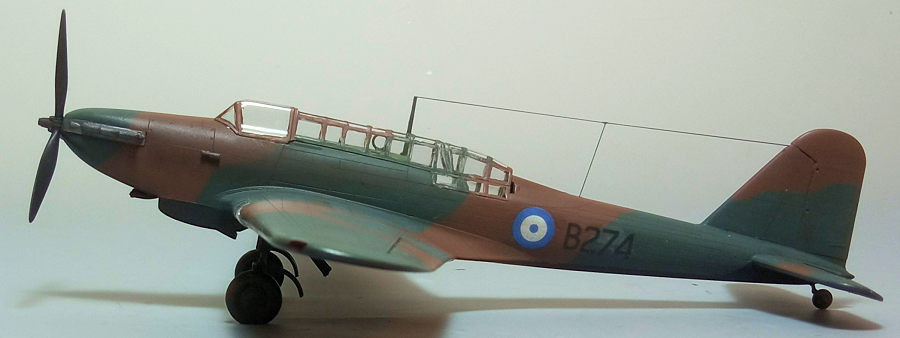
Azur/FRROM 1/72 Battle I
| KIT #: | FR0046 |
| PRICE: | $30.00 |
| DECALS: | Three options |
| REVIEWER: | Spiros Pendedekas |
| NOTES: |
| HISTORY |
The Battle was designed to specification P.27/32 as a two-seat day bomber to
replace the ageing Hawker Hart and Hawker Hind biplane bombers. The prototype
first flew on 10 March 1936. When the RAF began its pre-war rearmament programme,
production of the Battle was given top priority with a target of 2,419 aircraft
and an initial production order of 155 Battles under specification P.23/35. The
first of these aircraft was completed in June 1937 at Fairey's Stockport factory
and tested at its Manchester facilities. Production aircraft were powered by
Rolls Royce Merlin I, II, III and V engines and were given a Mark number
depending on the engine version fitted (e.g. the Battle Mk II was fitted with a
Merlin II engine). The Austin Motors factory (known as the Shadow Factory) at
Longbridge built 1,029 aircraft to the P.32/36 specification.
The Battle's standard
bomb load consisted of four 220 lb (110 kg) bombs in wing pockets, while 500 lb
(110 kg) of bombs could be carried on underwing racks. Having replaced the
Hawker Hart and Hind in RAF service when they entered service in 1937, the
Battle was already considered obsolete as fighter technology had surpassed the
aircraft's performance and superiority over the biplanes it replaced. A total of
2,185 Fairey B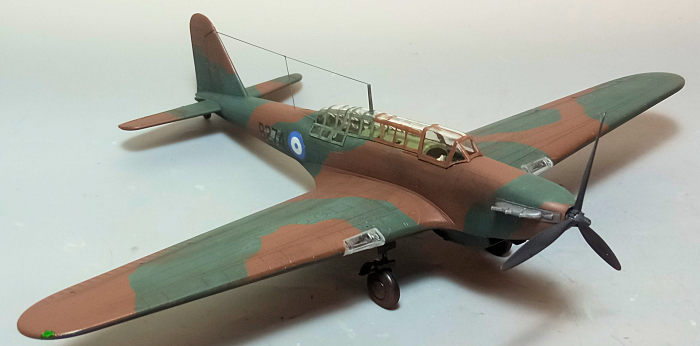 attles
were built, 1,156 by Fairey and 1,029 by the Austin Motor Company. An additional
18 were built under license by the Belgian Avions Fairey, for service with the
Belgian Air Force.
attles
were built, 1,156 by Fairey and 1,029 by the Austin Motor Company. An additional
18 were built under license by the Belgian Avions Fairey, for service with the
Belgian Air Force.
The Hellenic Air Force received 11 Fairey Battles in March 1940, from an initial batch of twelve aircraft, as the twelfth aircraft was lost along with the ship carrying it when it was sunk by a torpedo. The Battles were provided by the British in exchange for the 12 Blenheim IVs that were seized at the outbreak of the war. These machines were used by the 33rd Bombardment Squadron during the Greco-Italian War in the Albanian theatre, with a moment of distinction in their operational history being the bombing of Gjirokastra airfield on 14 November 1940, where 12 Italian aircraft were destroyed.
As a concluding remark, despite its promising design, for the British the Battle did not deliver the desired results and was considered outdated and vulnerable to German fighters, but one has to take into account the fact that aviation technology was galloping by the time the machine was designed and put into production. Still, in Greek hands it proved capable and technologically superior to the aging Bre XIX and Potez 25 which it replaced in the light bombing role. So, in a way, the Battle found its niche in Greek service. All Greek Battles were destroyed during the German invasion by air and ground.
| THE KIT |
 Azur came
in 2024 with their brand new 1/72 Fairey Battle, which was offered in four
editions (one of them being a Special Hobby) with different markings. The
specific kit is the “In Belgium” edition and was a present from my good friend
Bernard Sobczyk.
Azur came
in 2024 with their brand new 1/72 Fairey Battle, which was offered in four
editions (one of them being a Special Hobby) with different markings. The
specific kit is the “In Belgium” edition and was a present from my good friend
Bernard Sobczyk.
Clearly the best 1/72 Battle on the market as of 2026, with accurate shapes of parts, sharp molding, finely recessed panel lines, plenty of details for the scale, nice transparencies and excellent instructions and decals, it is as close to “mainstream” as a “limited run” kit can get and for a more in-depth of its contents you may look no further than its preview in the ever growing MM archives.
| CONSTRUCTION |
More or less following the instruction sequence,I started by attaching all the various stuff (more than 30 parts) that comprise the interior in each fuselage half, then joined the fuselage halves, leaving the sensitive rear wheel off and pushing my luck in hopes of being able to attach it at end stages. Basic cockpit color was a home brewed interior green resembling Hu78 Cockpit green. The various boxes, levers, the yoke and the instrument panel were painted black (I used the instrument decal on the latter), then dry brushed with silver and had a few switches and knobs randomly done by “pinning” red and yellow paint. The seat cushions were painted “leather” and seat belts were added from masking tape. Finally, the gun (stowed - a personal choice) and the ammo magazines were painted gunmetal. Clearly, the cockpit’s detail is superb as offered by the kit, especially for my “de rigeur” closed canopy attitude.
I then tackled the lower main wing half, where I successively attached the rear small main bay fillets, then the main bays, the leading edge located 3-piece landing light framings, the ventral transparency and the front main bay framing with the rear floor part on top of it. The landing light framings were painted steel. The sensitive main legs were supposed to be attached before gluing the bays to the lower wing half, but I left them off as they can undramatically be slipped in afterwards.
 The
upper wing halves were next attached to the lower wing half, with the completed
subassembly glued to the fuselage. The horizontal stabilizers were then attached
in position, while the nice separated elevators were left off, to be attached in
a drooped, more dynamic position (i.e. control stick left forward). The correct
ventral air intake for my version was attached at this time as well, where I
went for an “open” rear louvre, as it was more commonly seen on the ground. All
intake innards were painted black, with the inlet mesh dry brushed with silver.
The
upper wing halves were next attached to the lower wing half, with the completed
subassembly glued to the fuselage. The horizontal stabilizers were then attached
in position, while the nice separated elevators were left off, to be attached in
a drooped, more dynamic position (i.e. control stick left forward). The correct
ventral air intake for my version was attached at this time as well, where I
went for an “open” rear louvre, as it was more commonly seen on the ground. All
intake innards were painted black, with the inlet mesh dry brushed with silver.
This concluded basic assembly.Overall fit, while not “Tamiya”, was good, and construction was straightforward and undramatic, with some attention needed at the “usual” areas (like wing roots and air scoops), tackled by a couple of filling and sanding sessions.
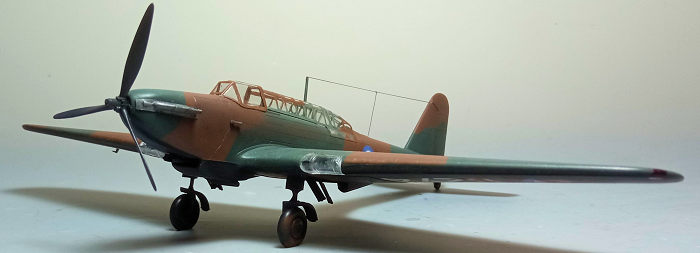
Greek Battles featured the classic British dark earth/ dark green topsides with totally black undersides, including the wheel bays and all landing gear parts. This was good news, as I could assemble and attach all landing gear parts and paint everything black, together with the undersides, especially due to the fact that the Battle’s landing gear is complex. So all landing gear parts were attached in position, an operation that took some patience, in order to reasonably align the 8 parts in total that comprise each landing gear. After all this, I masked the ventral window and took the bird to the paint shop!
| COLORS & MARKINGS |
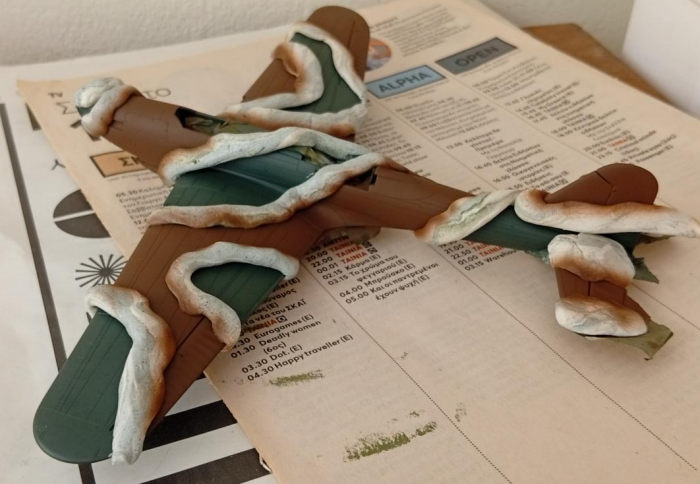 I
sprayed Hu85 satin Black at all undersides, including all aforementioned
attached landing gear parts, then masked everything off and applied the top camo,
using Hu91 and Model Master 2111 for the dark green and dark earth respectively.
I used my trusty Patafix tak strings for the demarcation lines, spraying at more
or less vertical angles, in order to create a tight yet not dead hard result. A
coat of Future prepared the bird for decals.
I
sprayed Hu85 satin Black at all undersides, including all aforementioned
attached landing gear parts, then masked everything off and applied the top camo,
using Hu91 and Model Master 2111 for the dark green and dark earth respectively.
I used my trusty Patafix tak strings for the demarcation lines, spraying at more
or less vertical angles, in order to create a tight yet not dead hard result. A
coat of Future prepared the bird for decals.
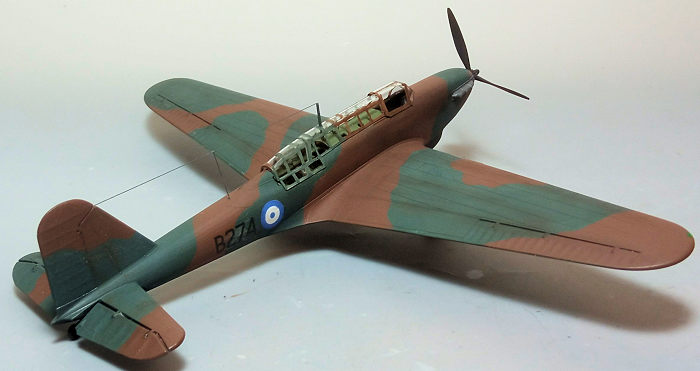
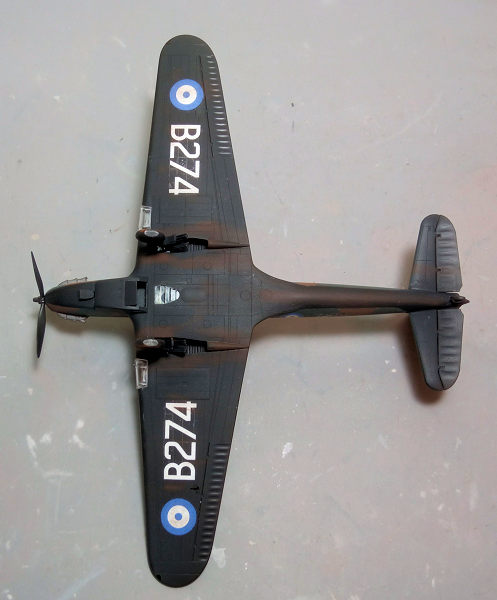
I used the kit decals, in order to depict Royal Hellenic Air Force’s B274 machine, belonging to 33 Squadron, flown by Cpt Pitsikas, as it stood in February 1940 in Kouklaina, Central Macedonia. Decals behaved nicely and I was very pleased with the opacity of the big white numbers applied on the undersides. Greek roundels are supposed to also be added on the top of the wings, but I didn’t use them, as sound research has shown that Greek Battles did not carry any. A coat of Future sealed the decals.
| FINAL CONSTRUCTION |
The main wheels were assembled and attached in position, with their rims painted satin black and the tires flat black. They were filed to look weighted. The tail wheel (which normally had to be fitted before joining the fuselage halves), had its mounting lugs shaved off and was inserted and secured with glue in position. All oleos of the otherwise al-black undercarriage were highlighted with a fine tip silver pen.
The correct for my version exhausts were assembled, painted Testors Burned metal and attached in position. The propeller was also assembled and attached. It was painted black, with its hub dry brushed with silver. Seasonal pics show not all planes featuring yellow tips, so I went for unpainted tips, as, to my eye, it gives a more dramatic appearance.
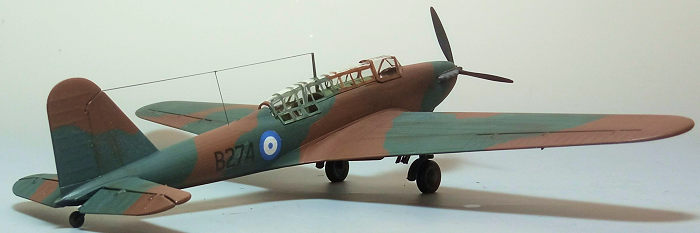 Time for
some weathering. Those planes, in relatively new condition, were intensively
used for a brief time in harsh conditions, operating from primitive, unprepared
airstrips They did not have time to chip, but were quite dirty overall, so I
mainly used brown and black dry pastels to simulate engine soot, dirt, grime and
the like, with a final matt coat giving the bird its final hue.
Time for
some weathering. Those planes, in relatively new condition, were intensively
used for a brief time in harsh conditions, operating from primitive, unprepared
airstrips They did not have time to chip, but were quite dirty overall, so I
mainly used brown and black dry pastels to simulate engine soot, dirt, grime and
the like, with a final matt coat giving the bird its final hue.
The top mounted antenna mast and the DF loop were attached in position. The transparencies had their well defined but gazillion in number frames hand painted. Unless you are, like Yours Truly is, a die hard glutton for punishment, do yourself the self explained favor and get a set of canopy masks. They were next attached in position with fit being quite good and the small gaps treated with white glue.
The tiny pitot tube was attached at the starboard wing undersides. Its body was painted black and its even tinier tip gunmetal. I used thin stretched sprue to simulate the antenna wire. Finally, the port and starboard wingtip lights were painted silver first with a blob of red and green clear paint on their tops respectively, before calling the Hellenic Battle done!
| CONCLUSIONS |
 As
envisaged in my preview, this is clearly the best 1/72 Battle on the market:
shape is accurate, molding is sharp, panel lines are finely recessed, details
are plenty for the scale (including the key areas of cockpit and landing gear),
transparencies are well done, instructions are wonderful and decals are nicely
printed.
As
envisaged in my preview, this is clearly the best 1/72 Battle on the market:
shape is accurate, molding is sharp, panel lines are finely recessed, details
are plenty for the scale (including the key areas of cockpit and landing gear),
transparencies are well done, instructions are wonderful and decals are nicely
printed.
Out of the box, a beautiful and detailed Battle will emerge. While the kit approaches “mainstream”, it still is “high end limited run” in nature, practically meaning paying attention to the latter, in order to achieve the former. While the construction is straightforward, it is not a fall together kit, with its relative complexity (presence of many small parts combined with high parts count) deeming it suitable for modelers who have a few kits under their belt.
If you look for an accurate and detailed 1/72 Battle and you are not a beginner, you may look no further than this very nice Azur offering.
Happy Modeling!
25 March 2021
Copyright ModelingMadness.com. All rights reserved. No reproduction in part or in whole without express permission.
If you would like your product reviewed fairly and fairly quickly, please contact the editor or see other details in the Note to Contributors.