| KIT #: | FR0046 |
| PRICE: | $30.00 |
| DECALS: | Three options |
| REVIEWER: | Spiros Pendedekas |
| NOTES: | Not a fall together kit |
| HISTORY |
The Fairey Battle is a British single-engine light bomber that was developed during the mid-1930s for the RAF as a monoplane successor to the Hawker Hart and Hind biplanes. Though featuring the same Merlin engine that powered the Hawker Hurricane and Supermarine Spitfire, it was much heavier and therefore much slower. Though a great improvement over the aircraft that preceded it, its relatively slow speed, limited range and inadequate defensive armament of only two .303 (7.7 mm) machine guns left it highly vulnerable to enemy fighters and anti-aircraft fire.
The Fairey Battle was used on operations early in the Second World War. During the "Phoney War" the type achieved the distinction of scoring the first aerial victory of an RAF aircraft in the conflict. From 10 to 14 May 1940, the Battles of the Advanced Air Striking Force suffered many losses, frequently in excess of 50 per cent of aircraft sorties per mission. By the end of 1940 the type had been withdrawn from front-line service and relegated to training units overseas.
| THE KIT |
 Azur
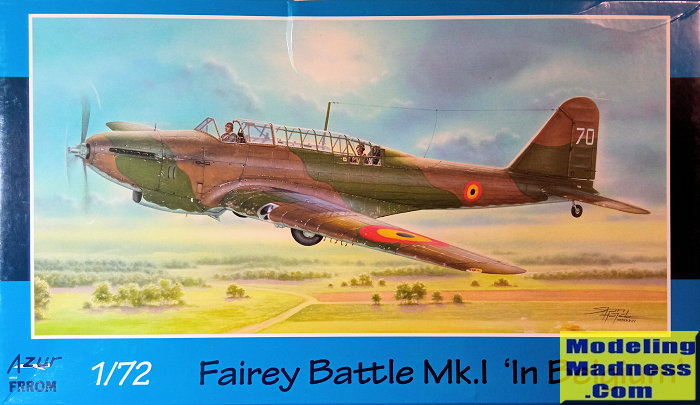
came in 2024 with their brand new 1/72 Fairey Battle, which was offered in four
editions (one of them being a Special Hobby) with different markings. The
specific kit is the “In Belgium” edition and was a present from my good friend
Bernard Sobczyk. The kit comes in a medium sized top opening good quality box,
featuring an attractive box art by artist Standa Hájek, depicting a Belgian
machine flying over Aeltre, during the Battle of Belgium in May 1940.
Azur
came in 2024 with their brand new 1/72 Fairey Battle, which was offered in four
editions (one of them being a Special Hobby) with different markings. The
specific kit is the “In Belgium” edition and was a present from my good friend
Bernard Sobczyk. The kit comes in a medium sized top opening good quality box,
featuring an attractive box art by artist Standa Hájek, depicting a Belgian
machine flying over Aeltre, during the Battle of Belgium in May 1940.
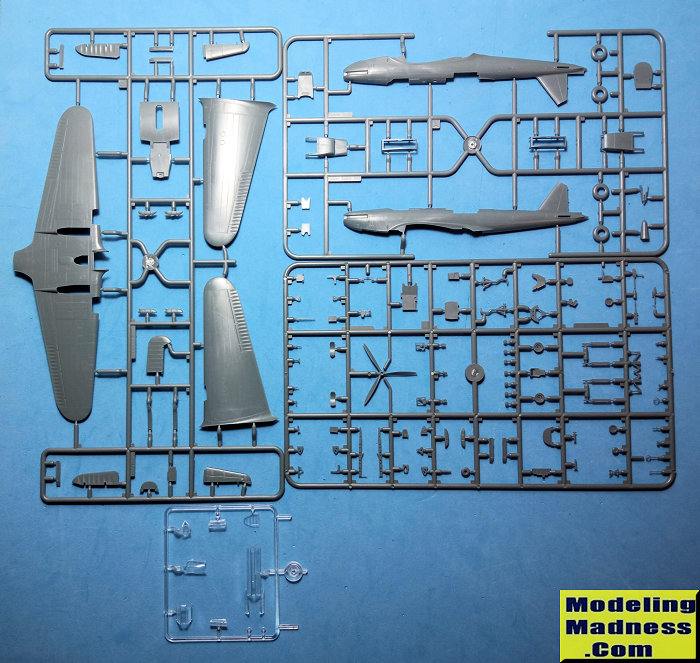
Upon opening the box, I was greeted with 121 medium gray styrene parts neatly arranged in three sprues. Molding is good with no flash, panel lines are finely recessed and external details, such as various fasteners and underwing fillets are nicely represented. Fabric representation is good and both the rudder and the elevators are separate, meaning they can be posed in a non neutral position if you so desire.
Cockpit is very well appointed for the scale with molded on sidewall ribbing and a ton of little bits (like levers and magazines) to be attached into. The instrument panel features raised instrumentation, on top of which a decal is to be attached. The distinctive landing gear is very well represented, as is the air intake and the equally distinctive landing lights located at the wing leading edges. The prop looks good as do the exhausts.
Transparencies are well molded and clear. Instructions are beautifully done, in the form of a 16-page color booklet, featuring a brief history of the type, a sprues map, a color cart, with the construction spread in 18 clear and concise steps.
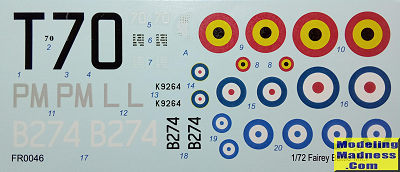 Three
schemes are provided, for a Belgian, a British and a Greek machine. All feature
dark earth/dark green topsides, while the undersides are gray at the Belgian
machine and black at the other two. Shades are given in Gunze codes and in
generic form. The decal sheet is sharply printed and expected to work well.
Three
schemes are provided, for a Belgian, a British and a Greek machine. All feature
dark earth/dark green topsides, while the undersides are gray at the Belgian
machine and black at the other two. Shades are given in Gunze codes and in
generic form. The decal sheet is sharply printed and expected to work well.
Instructions want you to first assemble the interior, including addition of the air inlet and outlet faces and of various bits onto the sidewalls, then trap everything between the fuselage halves. The correct exhausts for the version are then glued on (you may consider attaching them at later stages).
The landing gear is then assembled and attached from the innards of the underside wing half, followed by the leading edge located landing lights.The top wing halves then attached to the underwing half and the completed wing to the fuselage. The air inlet is then assembled and glued on, followed by the tail planes, the guns, the transparencies, the wheels and various other small stuff, ending a build of average complexity, mostly due to the relatively high number of parts and the minuscule size of a good number of them.
| CONCLUSIONS |
This is clearly the best 1/72 Battle on the market: shapes of parts look accurate, molding is sharp, panel lines are finely recessed, details are plenty for the scale (including the key areas of cockpit and landing gear), transparencies are well done, instructions are wonderful and decals are nicely printed.
While the kit is “mainstream” in every respect, the high parts count and the presence of many small parts deem it suitable for modelers who have a couple or more kits under their belt. In any case it is definitely a kit worth tackling.
Happy Modeling!
December 2025
Copyright ModelingMadness.com. All rights reserved. No reproduction in part or in whole without express permission.
If you would like your product reviewed fairly and fairly quickly, please contact the editor or see other details in the Note to Contributors.