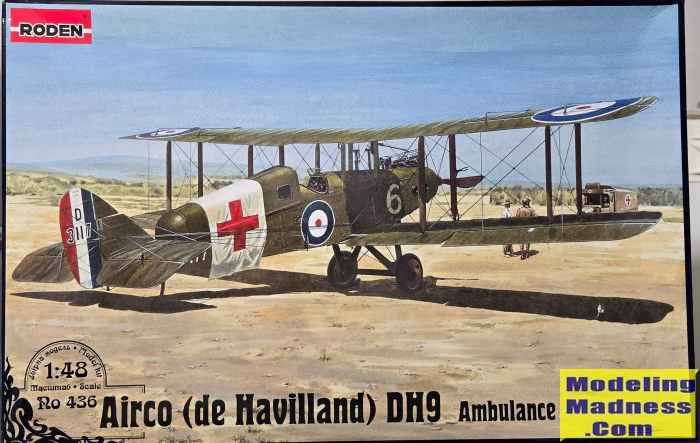
| KIT #: | 436 |
| PRICE: | raffle win |
| DECALS: | One option |
| REVIEWER: | Scott Van Aken |
| NOTES: |
| HISTORY |
The Airco DH.9 (from de Havilland 9) – also known after 1920 as the de Havilland DH.9 – is a British single-engined biplane bomber that was developed and deployed during the First World War.
The DH.9 was a development of Airco's earlier successful DH.4, with which it shared many components. These were mated to an all-new fuselage and the 230 hp BHP engine, which promised increased performance. Anticipating its usefulness, the type was ordered in very large numbers for Britain's Royal Flying Corps (RFC).
Upon entering service, the DH.9's performance was found to be unsatisfactory. The BHP engine was unreliable and failed to provide the expected power, which gave the DH.9 poorer performance than the aircraft it had been meant to replace. The performance deficit was blamed for the heavy losses they suffered over the Western Front. Postwar the type was widely used in areas where no air opposition was expected so the poorer performance was not a problem. The aircraft was also modified into commercial airliners and ambulances as well as cargo hauling.
| THE KIT |
 Roden
produced a full run of DH.9s in addition to their extensive DH.4 line.
It makes sense to do both types as so much of the airframe is the same
between the two aircraft. Though a rather simplistic way of stating
things, one only has to provide those specific bits germane to the type
being kitted.
Roden
produced a full run of DH.9s in addition to their extensive DH.4 line.
It makes sense to do both types as so much of the airframe is the same
between the two aircraft. Though a rather simplistic way of stating
things, one only has to provide those specific bits germane to the type
being kitted.
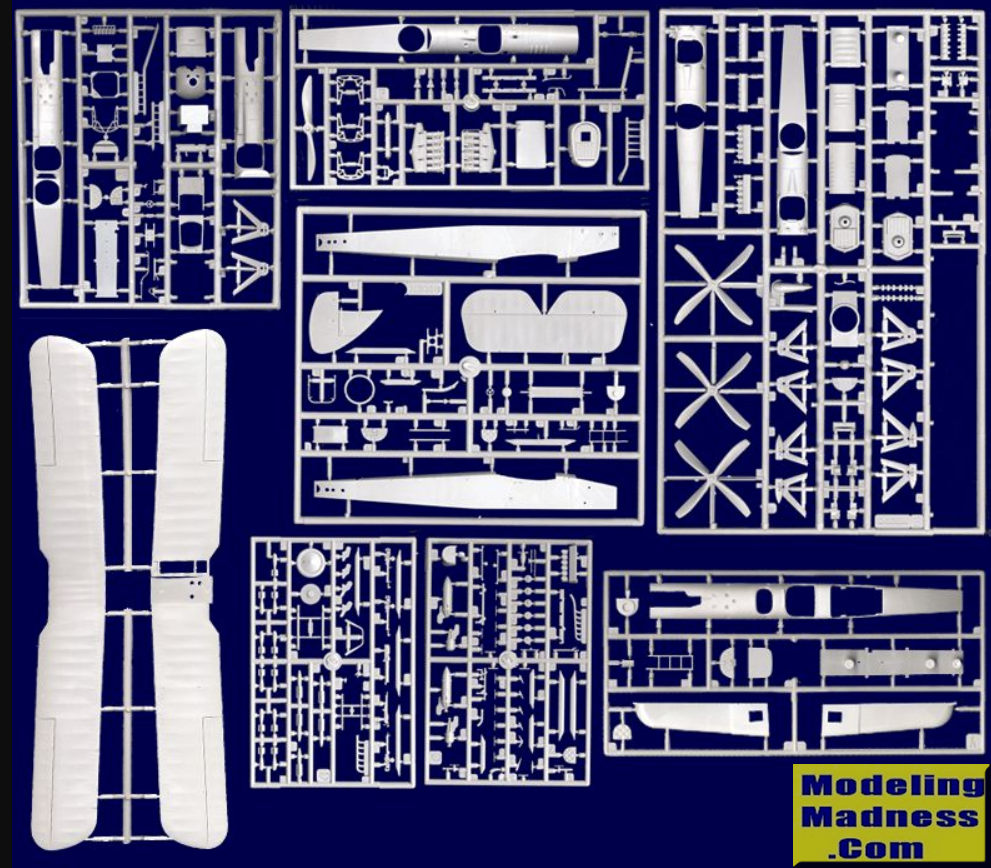
Well, Roden goes by the theory of 'include all the sprues that have the bits we need for this version' and that means a lot of spare parts. The ambulance version is a good one to kit as the type is interesting and appeals to those who like something a bit different.
Like other Roden WWI aircraft, this one includes a full engine and exhaust stystem. The fuselage is built of three major pieces. There is the side sections that also include the lower fuselage. The upper fuselage is a major difference from other DH.9s. This is the one that includes the enclosed section for two passengers. No in-flight service with this one, just a pair of wicker seats. There are actually four seats with another open seat right behind the very front one. Usually the pilot flew from the second seat, and that is where the control stick and rudder pedals are located. The instrument panel fits into the upper fuselage section. For the windscreen and passenger windows, an acetate sheet is included.
These aircraft have separate wing and interplane struts so
keeping everything level will be paramount to having a proper build. I
am sure many will devise a jig of some sort. The exterior boarding
ladder is included as are separate control surface bellcranks and the
lower wing skids. The instructions provide a complete rigging guide that
includes control surface rigging. It will make for a very busy, but very
cool looking model.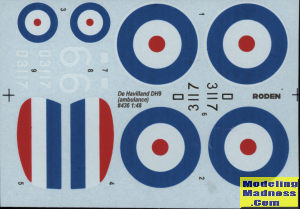
Instructions are well drawn with Vallejo paint references. Markings are provided for one version that is shown on the box art. That is for a plane from Z force, based in Somaliland in 1919-1920. The decal sheet is nicely printed, but one should take care with decals as Roden markings have a reputation for not sticking very well.
| CONCLUSIONS |
https://en.wikipedia.org/wiki/Airco_DH.9
O
ctober 2025
Copyright ModelingMadness.com. All rights reserved. No
reproduction in part or in whole without express permission from the editor.
If you would like your product reviewed fairly and fairly quickly, please
contact the editor or see other details in the
Note to
Contributors.