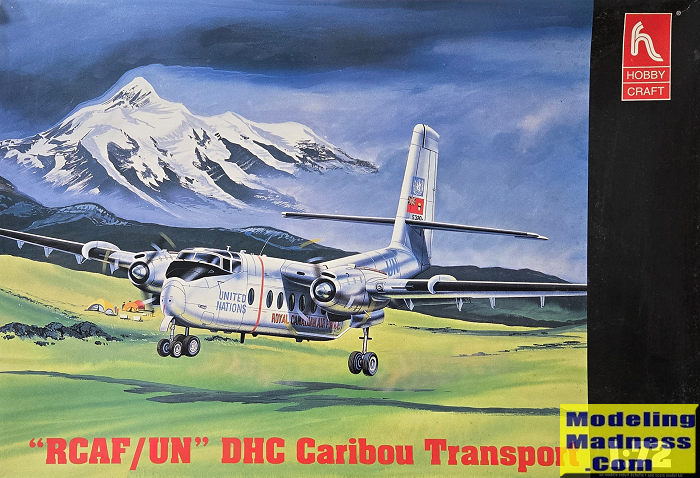
Hobbycraft 1/72 DHC-4 Caribou 'RCAF/UN'
| KIT #: | HC1334 |
| PRICE: | $ |
| DECALS: | Four options |
| REVIEWER: | Scott Van Aken |
| NOTES: | 1998 Release |
| HISTORY |
The De Havilland Canada (DHC) company's third short takeoff and landing (STOL) design was a big increase in size compared to its earlier DHC Beaver and DHC Otter, and was the first DHC design powered by two engines. The Caribou was similar in concept in that it was designed as a rugged STOL utility aircraft. The Caribou was primarily a military tactical transport that in commercial service found itself a small niche in cargo hauling. The United States Army ordered 173 in 1959 and took delivery in 1961 under the designation AC-1, which was changed to CV-2 Caribou in 1962 and later to C-7 when the USAF took over the Army's large fixed wing assets.
The majority of Caribou production was destined for military operators, but the type's ruggedness and excellent STOL capabilities requiring runway lengths of only 1200 feet (365 metres) also appealed to some commercial users. U.S. certification was awarded on 23 December 1960. Ansett-MAL, which operated a single example in the New Guinea highlands, and Amoco Ecuador were early customers, as was Air America (a CIA front in South East Asia during the Vietnam War era for covert operations). Other civil Caribou aircraft entered commercial service after being retired from their military users.
Today only a handful are in civilian use with other extant airframes converted using turboprop engines.
| THE KIT |
This kit was originally released in 1997 with two other reissues, one with new decals (this boxing). It was also reboxed by Ideal and Kitech. Since then, the tooling seems to have disappeared as it has not been available for well over 20 years. A web search turned up a number of them, all in the $125.00-$150.00 range so if you have one, might want to hold onto it unless you want make some $$ on the resale market.
I bought mine shortly after it was initially released, though I forget what I paid for it. Two of the three grey sprues were bagged while the fuselage halves were not. A clear sprue includes the cockpit and cabin transparencies. The cabin ones are gang molded which makes installation easy. There is no cabin detail, however, there are representations of the jump seat webbing on the decal sheet so you won't have to look into an empty cabin.
The cockpit is quite basic with two generic seat, control wheels, and instrument panel fitting into an L shaped cockpit housing. The horizontal flight surfaces are split into upper and lower halves with the featureless main gear wells molded into the lower wings. Engines are a flat rear section of cylinders with a relief forward section. This fits into the back of single piece cowlings. The cowlings are quite tight so you won't see much through the front. The props can have spinners attached and the box art plane is the one that needs it.
A separate nose gear well needs to be installed prior
to closing the fuselage halves. It would be a good idea to fill as much weight
in the nose as you can as this one will be a tail sitter. I'd estimate that
20-25 grams might be sufficient. All the landing gear is rather featureless, but
should be sturdy enough. The only really small parts are the engine exhaust and
a myriad of flap hinges. The kit includes various antennas and two ADF antenna
housings so check your reference images to see which are needed for your model.
One of the options has a radar nose so you'll n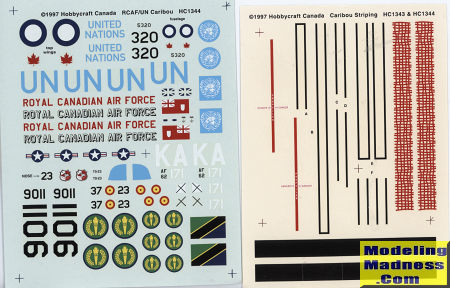 eed
to cut off the molded on nose to install that.
eed
to cut off the molded on nose to install that.
Instructions are typical of Hobbycraft in that they are basic but usable. No cockpit or gear well color info is provided, but that should be fairly easy to sleuth via the 'net. Four markings options are provided. The box art plane is a Canadian UN version in white with aluminum wings. A Tanzanian plane in overall white with red wing tips is next. A semi-desert scheme is on a Spanish AF plane with light grey wings. Finally a USAF C-7A, the one that needs the radar nose, in SEA camouflage with white outer wings. I'd check the 'net to verify some of these schemes just to be sure. The decal sheets are nicely printed, but due to their age, I'd clear coat them just in case. There have been aftermarket sheets produced for this kit, but availability might be spotty at best.
| CONCLUSIONS |
Again, this kit may be expensive to obtain in the current market and one can only hope that someone will reissue it. It is a fairly simple looking kit with a few fiddly areas, but I can assure you that the completed kit will look very nice when done.
| REFERENCES |
https://en.wikipedia.org/wiki/De_Havilland_Canada_DHC-4_Caribou
June 2025 Copyright ModelingMadness.com. All rights reserved. No
reproduction in part or in whole without express permission. If you would like your product reviewed fairly and fairly quickly, please
contact the editor or see other details in the
Note to
Contributors.