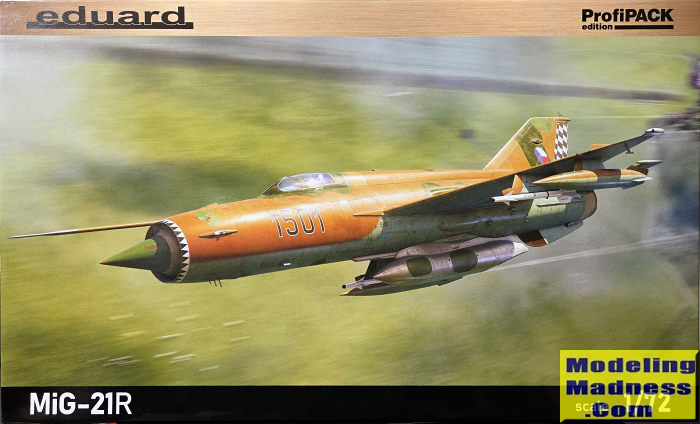
| KIT #: | 70147 |
| PRICE: | ~$35.00 |
| DECALS: | Five options |
| REVIEWER: | Scott Van Aken |
| NOTES: | 2026 boxing. Profipack edition. |
| HISTORY |
The Mikoyan-Gurevich MiG-21 (Russian: Микоян и Гуревич МиГ-21) (NATO reporting name "Fishbed") is a supersonic jet fighter aircraft, designed and built by the Mikoyan-Gurevich Design Bureau in the Soviet Union. It was popularly nicknamed "balalaika", from the aircraft's planform-view resemblance to the Russian stringed musical instrument or ołówek (English: pencil) by Polish pilots due to the shape of its fuselage. Early versions are considered second-generation jet fighters, while later versions are considered to be third-generation jet fighters. Some 50 countries over four continents have flown the MiG-21, and it still serves many nations a half-century after its maiden flight. The fighter made aviation records. At least by name, it is the most produced supersonic jet aircraft in aviation history, the most produced combat aircraft since the Korean War, and it had the longest production run of a combat aircraft (1959 to 1985 over all variants).
The MiG-21R was initially designated Izdeliye 03 to confuse outsiders, the MiG-21R's official "type" designation was Izdeliye 94R. The first production unit was rolled out in early 1966 and production continued until 1971. For recce missions, the MiG-21R could carry a Type D daylight PHOTINT pod, a Type N nighttime PHOTINT pod, a Type R general-purpose ELINT pod or a Type T pod housing a TV system, making the MiG-21R one of the first Soviet recce aircraft to make use of ELINT equipment. Small changes were made throughout the production run. Early-production units had the R11F2S-300 turbojet, which was replaced in later machines by the R13-300 powerplant. In the air-to-air role, the MiG-21R could carry two RS-2US or R-3S AAMs, and in the strike role it could be loaded with two UB-16-57UM or UB-32 rocket pods, two S-24 heavy unguided rockets or two bombs of up to 500kg weight (each). While many MiG-21 variants could be wired to carry the recce pod, most R models were based on the MiG-21PF with others upgraded to near MF specifications.
| THE KIT |
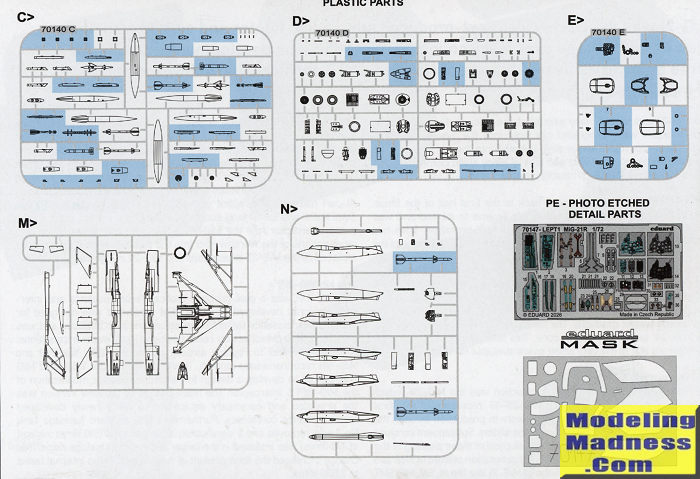 The
kit layout is very much like every 1/72 and 1/48 Eduard MiG-21 I have ever seen
or built. Since this is the Profipack version, there is photo etch and a mask
set. There are still decals for the instruments if you want or you can paint the
raised details. A seat harne
The
kit layout is very much like every 1/72 and 1/48 Eduard MiG-21 I have ever seen
or built. Since this is the Profipack version, there is photo etch and a mask
set. There are still decals for the instruments if you want or you can paint the
raised details. A seat harne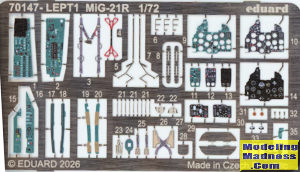 ss decal is also provided, in addition to the photo
etch version, which I appreciate. Some
MiG-21Rs had a black main instrument panel instead of the bluish-green version.
The rest of the interior bits are in the bluish-green shade. The p.e. fret also
includes the usual number of tiny bits, none of which will find their way into
my model.
ss decal is also provided, in addition to the photo
etch version, which I appreciate. Some
MiG-21Rs had a black main instrument panel instead of the bluish-green version.
The rest of the interior bits are in the bluish-green shade. The p.e. fret also
includes the usual number of tiny bits, none of which will find their way into
my model.
The kit has a separate spine and fin to deal with this variant with all the flight control surfaces separate. You can also install the nicely done landing gear after the airframe is painted if you so desire. All the small fuselage air scoops are separate pieces with engraved outlines showing where they fit. One of the options is the rear speed brake which can be posed raised or lowered. Another option are a pair of RATO units. These are butt joins. Another option is an open or closed canopy and you get separate parts depending on which you use. You are provided a goodly choice of missiles, tanks, and bombs. Three different recce pods are also included. A loadout diagram is provided. Canopy and dielectric masks are included as is the norm with Profipack kits.
The
instruction booklet is well done with Gunze and Mission Models paint references.
This one provides five markings options. One is the box art special scheme from
the Czech Air Force in 1994. An overall silver version from the Yugoslav Air
Force in 1971 is next. Third we have a c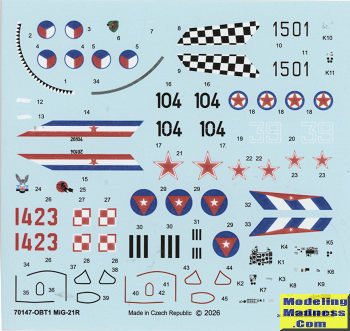 amouflaged Soviet plane as operated in
Afghanistan in tan, brown, and two shades of green over light blue from 1981.
Fourth, in overall silver is a Polish Air Force version from the early 1980s.
Finally a Cuban Air Force plane in green and medium blue over light grey from
the 1980s. Not shown is a large stencil sheet in both black and
blue. A complete stencil guide is provided. Both the decal sheets are nicely
printed and in register.
amouflaged Soviet plane as operated in
Afghanistan in tan, brown, and two shades of green over light blue from 1981.
Fourth, in overall silver is a Polish Air Force version from the early 1980s.
Finally a Cuban Air Force plane in green and medium blue over light grey from
the 1980s. Not shown is a large stencil sheet in both black and
blue. A complete stencil guide is provided. Both the decal sheets are nicely
printed and in register.
| CONCLUSIONS |
As you can probably tell, I'm building a collection of Eduard 1/72 MiG-21s. I have only built the 1/48 version but I expect the smaller scale ones to be very similar. I really like that the decals include the sealer that goes around the canopy and windscreen in two different colors.
https://en.wikipedia.org/wiki/List_of_Mikoyan-Gurevich_MiG-21_variants
May 2026
Copyright ModelingMadness.com. All rights reserved. No reproduction in
any form without express permission from the editor.
If you would like your product reviewed fairly and fairly quickly, please
contact
the editor or see other details in the
Note to
Contributors. Back to the Main Page
Back to the Review
Index Page
Back to the Previews Index Page