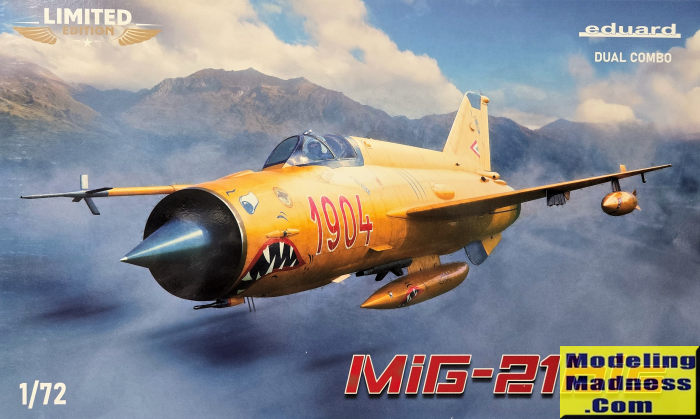
Eduard 1/72 MiG-21bis Dual Combo
| KIT #: | 2151 |
| PRICE: | $52.00 |
| DECALS: | Ten options |
| REVIEWER: | Scott Van Aken |
| NOTES: | Profipack. |
| HISTORY |
The Mikoyan-Gurevich MiG-21 (Russian: Микоян и Гуревич МиГ-21; NATO reporting name "Fishbed") is a supersonic jet fighter aircraft, designed by the Mikoyan-Gurevich Design Bureau in the Soviet Union. It was popularly nicknamed "balalaika", from the aircraft's planform-view resemblance to the Russian stringed musical instrument or ołówek (English: pencil) by Polish pilots due to the shape of its fuselage. Early versions are considered second-generation jet fighters, while later versions are considered to be third-generation jet fighters. Some 50 countries over four continents have flown the MiG-21, and it still serves many nations a half-century after its maiden flight. The fighter made aviation records. At least by name, it is the most-produced supersonic jet aircraft in aviation history (nearly 11,500 examples according to some sources) and the most-produced combat aircraft since the Korean War. It also had the longest production run of a combat aircraft (1959 to 1985 over all variants).
Because of all the conflicts in which it has been involved, some wags say it is the most shot down supersonic aircraft in history. While your editor thinks that may be more true for the F-4 or F-105 due to the intense ground fire in Vietnam, it may be that the MiG-21 has been shot down in air to air combat more than any other supersonic jet.
The MiG-21bis is the ultimate development of
the MiG-21, fitted with the Tumanskiy R25-300
turbojet engine and a great number of other advances over previous types.
Those MiG-21bis for the Soviet PVO (Air Defence Force) were equipped with
the Lazur GCI system (NATO: "Fishbed-L"), while those for the Soviet Air
Force were fitted with the Polyot ILS system (NATO: "Fishbed-N"). Though the
type is now out of service with many nations, some are still using upgraded
aircraft, which proves to be a more economical option to brand new 4th
generation aircraft.
| THE KIT |
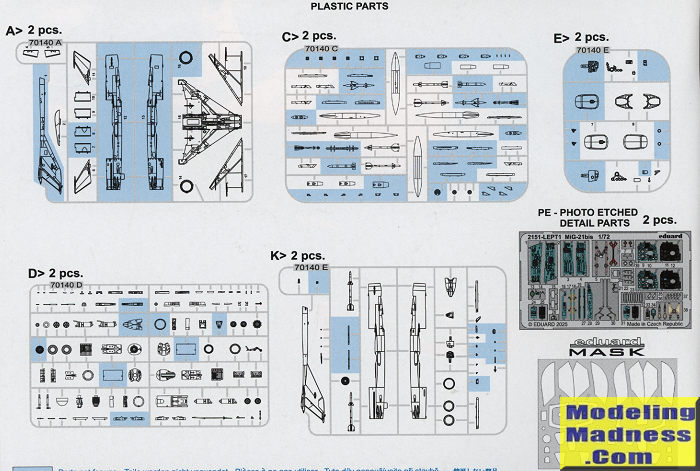 Having
pretty well covered 1/48 with the MiG-21 family as well as a series in 1/144,
a few years ago, Eduard finally decided to cover 1/72 scale. The wait has been
worth it. Typical of Eduard, the molding is quite good with a number of parts
not used in this boxing. This 2025 release includes two profipack kits with a
variety of markings options.
Having
pretty well covered 1/48 with the MiG-21 family as well as a series in 1/144,
a few years ago, Eduard finally decided to cover 1/72 scale. The wait has been
worth it. Typical of Eduard, the molding is quite good with a number of parts
not used in this boxing. This 2025 release includes two profipack kits with a
variety of markings options.
Having a separate upper spine with fin will allow pretty much all the sprues to be used with earlier and later versions, changing out very few other parts in the process. While this does make for more economical use of sprues, it adds to the 'fiddliness' of the kit, a trait rather common with Eduard releases.
Since this is a Profipack release, it comes with a nice color photo etch
set, much of what is used in the cockpit in terms of instrument panels and you
are provided a 'blank' when using the p.e. Otherwise, you can use the raised
detail plastic parts and put decals atop them. 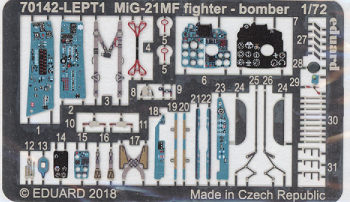 For
those who don't like p.e., this would be a good option as would waiting for the
weekend editions which won't have photo etch. As you can see from the sprues,
there is a sprue with unused fuselage pieces. This is to take care of the
differences between the other variants and the bis.
For
those who don't like p.e., this would be a good option as would waiting for the
weekend editions which won't have photo etch. As you can see from the sprues,
there is a sprue with unused fuselage pieces. This is to take care of the
differences between the other variants and the bis.
There is no 'tub' for the cockpit with the side walls and bulkheads being added. The nose gear well is part of the cockpit assembly and needs the side walls attached. There is a diagram that shows all these bits in place so you can be sure you have it properly aligned. The main gear well is also four pieces and you build up that as well as the five piece exhaust before assembling the fuselage halves. When you do assemble the halves, you'll find that it comes with a separate ring inside the intake so you can paint and install the radome at the end of the construction process when the airframe is painted.
The lower wing is one piece and includes the lower fuselage. Before attaching the upper wing halves, you are to install the landing lights along with a number of other clear bits that are to be painted various colors. Masking these will not be all that easy and frankly, these are something I've not seen before. Then the wing and spine/fin are attached along with the windscreen and intake ring. The various small engine scoops and the tailplanes are then glued on.
Even though the flaps and ailerons are separate, these were rarely deflected when the plane was on the ground so positioning them up is the norm. You are provided with two flap options that are the same save for one additional panel line on one set. Wheel hubs are separate from the tire on both the nose and main tire. Gear is very nicely molded with separate oleo scissors and brake lines.
 The
forward speed brakes are molded closed, but you can pose the aft one lowered.
You are provided with a pair of rocket take off units if you wish to add them.
It isn't until near the end of the build that Eduard has you assemble the seat
and there are quite a few p.e. bits for the seat harness. The canopy can be
posed open or closed and there are tabs for the open option that have to be cut
off for the closed canopy. There are tiny little p.e. bits for the nose pitot
probe.
The
forward speed brakes are molded closed, but you can pose the aft one lowered.
You are provided with a pair of rocket take off units if you wish to add them.
It isn't until near the end of the build that Eduard has you assemble the seat
and there are quite a few p.e. bits for the seat harness. The canopy can be
posed open or closed and there are tabs for the open option that have to be cut
off for the closed canopy. There are tiny little p.e. bits for the nose pitot
probe.
Lots of things for under wings with two different styles of fuel tanks and a nice collection of missiles and rocket pods. I would have thought perhaps some iron bombs would have been nice for the fighter-bomber boxing, but that was not to be. All of the various pylons are butt joined.
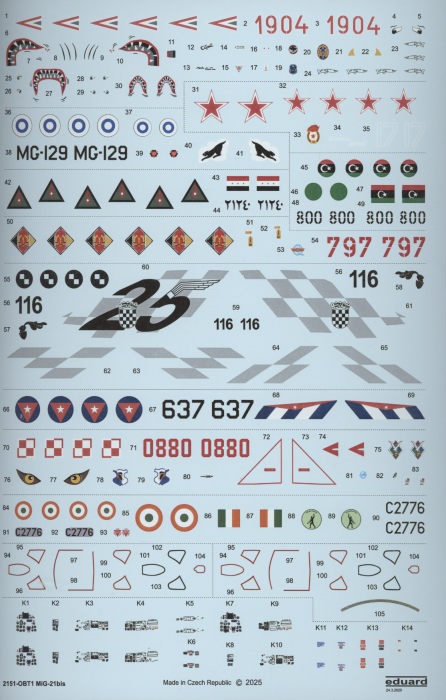
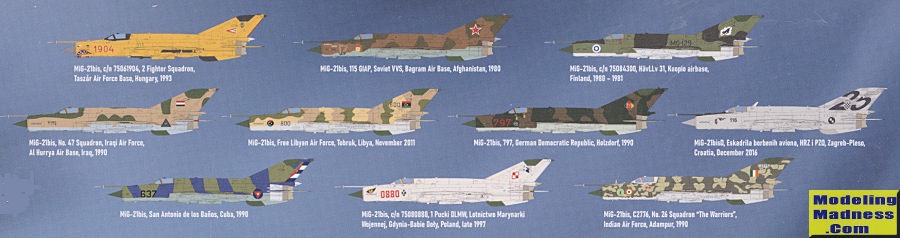
As mentioned earlier, the kit comes with a variety of markings options. Ten to be exact with no duplicate nations. Though some of these nations have been covered in other boxings, the specific aircraft are unique to this one. There are aircraft from Hungary, the Soviet Union, Finland, Iraq, Libya, East Germany, Slovakia, Cuba, Poland and India. You would think that there would be a Czech version, but apparently the Czechs never flew the bis version. The decals are superbly printed and the set comes with two large data set decal sheets (not shown) of which there is a detailed placement guide in the instruction booklet. A fairly neat addition are the seals around the windscreen and the canopy. These are in both red and black. Paint info is provided with Gunze and generic paint options.
| CONCLUSIONS |
There are a number of companies who do various versions of the MiG-21. Prior to this series of kits, Fujimi was frequently mentioned as the best. However, Fujimi did not realize the difference in the variations so all of their boxings used the same basic tooling. Before that, KP was the mainstream producer of MiG-21s. There are others, mostly short run. Eduard has now what most consider the best. They look like downsized 1/48 kits so I expect that to be the case when I get around to building this one.
| REFERENCE |
http://en.wikipedia.org/wiki/MiG-21#Variants
April 2026 Copyright ModelingMadness.com.
All rights reserved. No reproduction in part or in whole without express
permission. If you would like your product reviewed fairly and
fairly quickly, please
contact
the editor or see other details in the
Note to
Contributors.