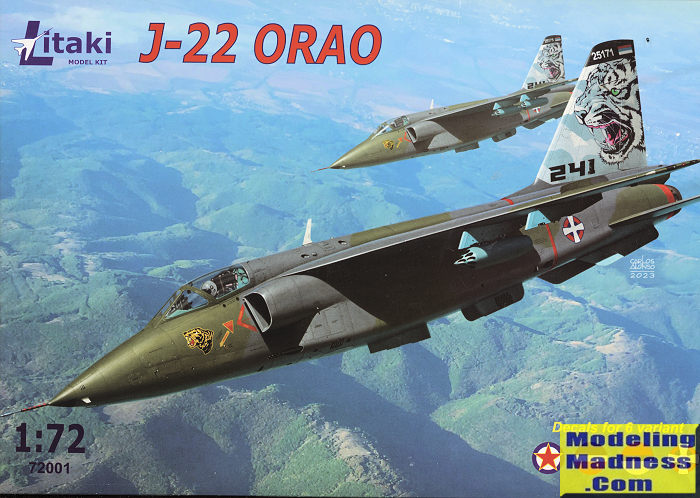
Litaki 1/72 J-22 Orao
| KIT #: | 72001 |
| PRICE: | $39.99 from Ukraine plus shipping. |
| DECALS: | Six options |
| REVIEWER: | Scott Van Aken |
| NOTES: | 2025 tooling |
| HISTORY |
The Soko J-22 Orao (Serbian Cyrillic: Oрао, lit. 'eagle') is a Yugoslavian/Serbian twin-engined, subsonic ground-attack and aerial reconnaissance aircraft. It was developed and built in collaboration by SOKO in Yugoslavia and by Avioane Craiova in neighbouring Romania, being known in the latter as the IAR-93 Vultur.
The Orao was designed as either a single-seat main attack version or as a combat-capable twin-seat version, the latter being principally intended for advanced flight- and weapons-training duties. It was developed as a joint Yugoslav-Romanian project, known as YuRom, during the 1970s. Early ambitions to produce a supersonic fighter were scuppered by Britain's unwillingness to permit the desired engine to be license-produced in Eastern Europe. Further difficulties in fitting an afterburner to the older Rolls-Royce Viper also hindered development and the performance of early-build aircraft.
First flying during November 1974, the resulting aircraft would equip the air forces of both Romania and Yugoslavia, as well as several of Yugoslavia's successor states. On 22 November 1984, the Orao became the first Yugoslav-designed aircraft to exceed Mach 1, albeit achieved while in a shallow dive. During the 1990s, the type saw action during the Yugoslav Wars, typically flying ground-attack missions in Croatia, Bosnia and Herzegovina, and Kosovo. As of July 2019, the Serbian Air Force and Air Defence was the only entity still operating the type.
| THE KIT |
 Litaki
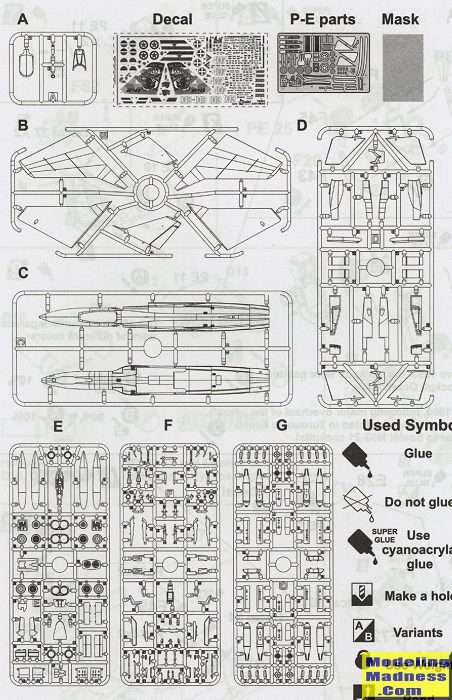
states that this is a multi-media short run kit and I believe them. Short run
kits frequently rely on p.e. and/or resin for small details and this one uses
p.e. The kit also comes with a canopy mask, which I appreciate and wish more
kits featured this.
Litaki
states that this is a multi-media short run kit and I believe them. Short run
kits frequently rely on p.e. and/or resin for small details and this one uses
p.e. The kit also comes with a canopy mask, which I appreciate and wish more
kits featured this.
You are provided the option of doing either an early (non-afterburning) or later aircraft. There are the appropriate parts for both options included along with some others that are not mentioned in the instructions. These might be for a later boxing with the Romanian plane.
A fair amount of p.e. is used in the cockpit for the seats, instrument panel and side consoles. You will also find decals provided which the instructions imply fit atop the p.e. Instructions then move on to subassemblies such as the gear wells, exhaust, and intakes. These items are then added to the fuselage, some before and others after assembly. An interesting feature is that the fuselage is split into top and bottom sections, something a bit different from the norm. The wings and lower fuselage have dimples for you to drill out if you want to install pylons or the chaff/flare dispensers used on later airframes.
Wheels are all left and right halves and the landing gear is fairly complex. This is because the plane was designed to operate from unimproved surfaces. I personally would not install these until after the airframe is painted, but the instructions have you do it right away. There are speedbrakes that can be posed open or closed. Also provided are main gear doors that can also be posed up or down. Like many more modern jets, these doors recycled with the gear so that only a single small door was open when the gear was extended.
For things under wings you have a pair of drop tanks, four bombs, four small rocket pods, and four large rocket pods. You also have fuselage mounted guns and the aforementioned flare/chaff dispensers, these latter items fitting under the rear fuselage.
 Instruction
booklet is well done and provides paint info in Mr. Color, MiG, AK, and Tamiya
references. A loadout diagram is also provided. Note that if the wing tanks are
both used, there is nothing for the fuselage pylon so you might want to decide
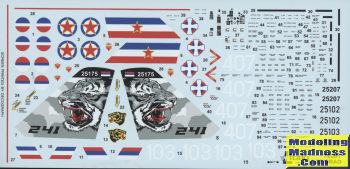
your loadout before opening those holes. Six markings options are provided and
all are shown on a large, full color painting and decaling sheet. All of the
options are in dark green and aircraft grey over light blue. Option five
included an additional grey-green shade for the upper surface. The first two are
for Yugoslav aircraft and these use the early options. The rest are for Serbian
planes that show how the insignia changed over the war years and post war. The
third is from 1998, the fourth from 2006 while the last two have the current
insignia from 2007 and 2021. The 2021 scheme is the box art plane with the
special tail markings for 241 Squadron. The decal sheet is nicely printed and
includes a lot of stencils. A full stencil placement diagram is provided.
Instruction
booklet is well done and provides paint info in Mr. Color, MiG, AK, and Tamiya
references. A loadout diagram is also provided. Note that if the wing tanks are
both used, there is nothing for the fuselage pylon so you might want to decide
your loadout before opening those holes. Six markings options are provided and
all are shown on a large, full color painting and decaling sheet. All of the
options are in dark green and aircraft grey over light blue. Option five
included an additional grey-green shade for the upper surface. The first two are
for Yugoslav aircraft and these use the early options. The rest are for Serbian
planes that show how the insignia changed over the war years and post war. The
third is from 1998, the fourth from 2006 while the last two have the current
insignia from 2007 and 2021. The 2021 scheme is the box art plane with the
special tail markings for 241 Squadron. The decal sheet is nicely printed and
includes a lot of stencils. A full stencil placement diagram is provided.
.
| CONCLUSIONS |
It is great that a kit of this plane is available. Probably will take some modeling skill to build, but worth it to have one in my collection. Litaki also does a two seater if you are so inclined. According to the advert on the back of the instructions, a 1/48 and 1/144 version are in the works. I hope this sells well so they can do other Yugoslav jets from this era.
| REFERENCE |
https://en.wikipedia.org/wiki/Soko_J-22_Orao
August 2025 Copyright ModelingMadness.com.
All rights reserved. No reproduction in part or in whole without express
permission. If you would like your product reviewed fairly and
fairly quickly, please
contact
the editor or see other details in the
Note to
Contributors.