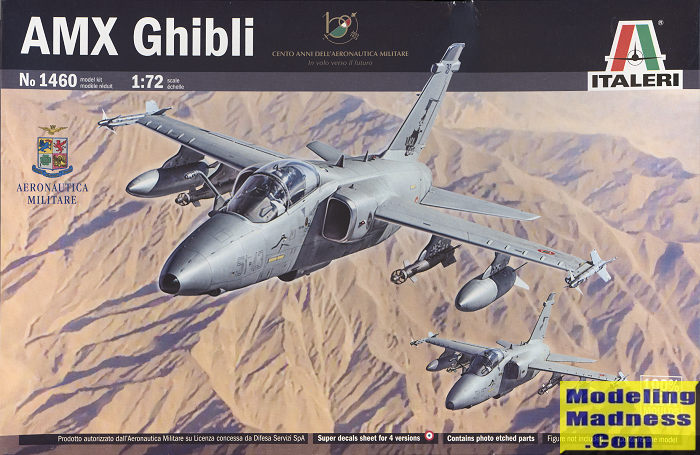
Italeri 1/72 AMX 'Ghibli'
| KIT #: | 1460 |
| PRICE: | $28.73 delivered |
| DECALS: | Four options |
| REVIEWER: | Scott Van Aken |
| NOTES: | 2023 release |
| HISTORY |
During the early 1970s, Italian manufacturer Aermacchi conducted a design study on a prospective light ground-attack aircraft, which was given the designation of MB-340. In 1977, the Italian Air Force issued a requirement for 187 new-build strike fighters, which were to replace its existing Aeritalia G.91 in the close air support role.
In 1978, both Aeritalia and Aermacchi joined to engage on a single aircraft. During October of the same year the Rolls Royce “Spey” was chosen by the Aeronautica Militare and the two companies started the real development of the AMX that was widely based on the Aeritalia Model 3-20 project.
In 1980, the Brazilian government announced that they intended to participate in the program in order to provide a replacement for the Aermacchi MB-326 used by the Brazilian Air Force. As a result of a memorandum between Italy and Brazil for the aircraft's joint development in 1981, AMX International, an Italian-Brazilian joint venture, was formed to develop, manufacture, and market the aircraft.
The type were retired from the Italian Air Force in 2024. It is still in operational service with Brazil and I would be surprised if some of the excess Italian airframes don't wind up in Brazil for spares. A total of 230 were built.
| THE KIT |
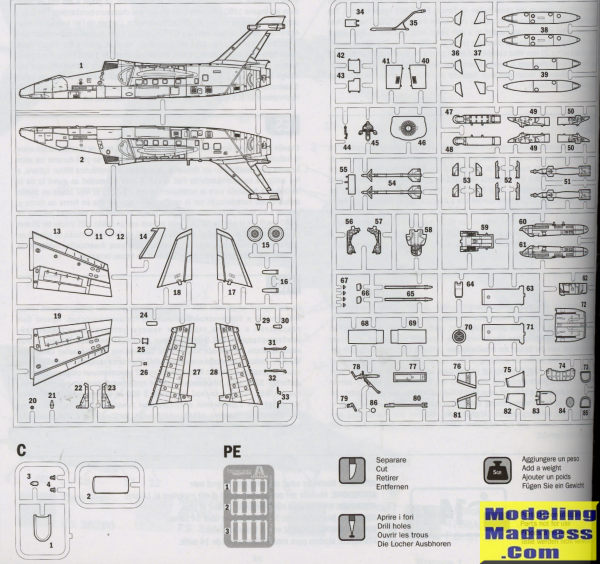 This
one is typical of modern Italeri kits with nicely engraved exterior detailing
and a well done interior with decals for the instruments and seat harness.
Partial intakes (outer walls) lead to the first compressor stage. Main gear and
nose gear are shown to be completely built before attaching them to the
fuselage. It appears that the gear can be left off until after painting, but I
would not guarantee it. Various holes need to be opened during the build
including some for the fin that is only applicable to one of the four markings
options.
This
one is typical of modern Italeri kits with nicely engraved exterior detailing
and a well done interior with decals for the instruments and seat harness.
Partial intakes (outer walls) lead to the first compressor stage. Main gear and
nose gear are shown to be completely built before attaching them to the
fuselage. It appears that the gear can be left off until after painting, but I
would not guarantee it. Various holes need to be opened during the build
including some for the fin that is only applicable to one of the four markings
options.
When you close the fuselage halves, 5 grams of weight are needed to prevent tail sitting. There looks to be sufficient space for this. Wings are upper and lower halves with engine intakes each three pieces. Interestingly, there are two different nose caps. Gear doors are nicely done and should fit nicely.
There is a p.e. fret and this is for a variety of small
panels atop the fuselage. The kit also has a goodly number of scoops and
antennas that will need to be added. For things under wings, there are two
pylons per wing and a centerline pylon. The latter holds one of two different
pods; either a
 Litening or
Orpheus pod for marking laser guided bombs. Speaking of which you get two of
those along with a pair of fuel tanks for under the wings. There are also
wingtip rails for the Sidewinders. Finally, there is a separate windscreen and
canopy so you can pose the canopy open if you wish.
Litening or
Orpheus pod for marking laser guided bombs. Speaking of which you get two of
those along with a pair of fuel tanks for under the wings. There are also
wingtip rails for the Sidewinders. Finally, there is a separate windscreen and
canopy so you can pose the canopy open if you wish.
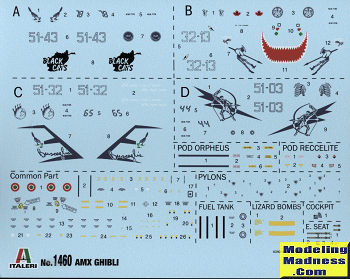
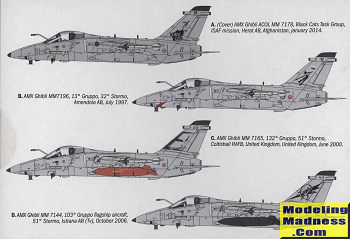
Instructions are well done with colors provided via Italeri or FS paints. Four options are provided, all of them overall FS 36280 dark grey. Almost all of these aircraft were with the 51st Stormo and so three of the options are for that unit, including one that operated in Afghanistan in 2011. The fourth is with the 32nd Stormo in 1997 and that one has the sharkmouth. Decals are by Cartograf so you know the quality is there.
| CONCLUSIONS |
Not sure how I missed this one when it came out as I like the AMX. Many years ago I built a very short run kit of this which actually survived several moves before finally succumbing. I was fairly surprised at the high cost of this, but realized that it was imported by MRC which has always jacked up the price of what it brings in. Were it not for the additional shipping and tariff costs, I'd have ordered one from overseas.
| REFERENCES |
https://en.wikipedia.org/wiki/AMX_International_AMX
July 2026 Copyright ModelingMadness.com. All rights reserved. No
reproduction in part or in whole without express permission from the editor. If you would like your product reviewed fairly and fairly quickly, please contact the editor or see other details in the
Note to
Contributors.