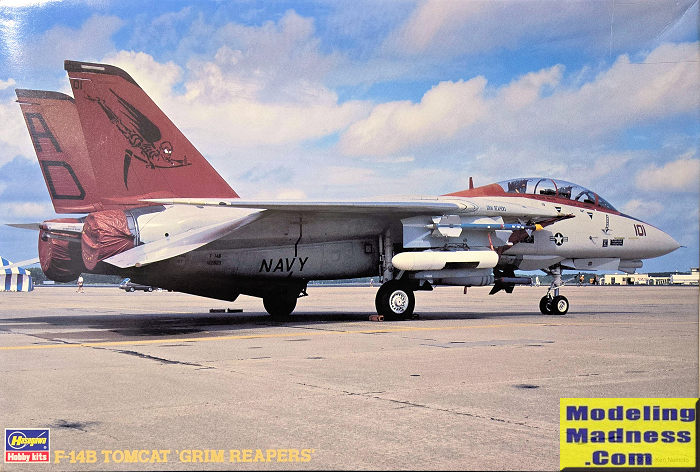
| KIT #: | 04073 |
| PRICE: | 2200 yen when new |
| DECALS: | One option |
| REVIEWER: | Scott Van Aken |
| NOTES: | 1996 Limited Edition |
| HISTORY |
The F-14 received its first of many major upgrades in March 1987 with the F-14A Plus (or F-14A+). The F-14A's TF30 engine was replaced with the improved F110-GE-400 engine. The F-14A+ also received the state-of-the-art ALR-67 Radar Homing and Warning (RHAW) system. Many of the avionics components, as well as the AWG-9 radar, were retained. The F-14A+ was later redesignated F-14B on 1 May 1991. A total of 38 new aircraft were manufactured and 43 F-14A were upgraded into B variants. In the late 1990s, 81 F-14Bs were upgraded to extend airframe life and improve offensive and defensive avionics systems. The modified aircraft became known as F-14B (Upgrade).
| THE KIT |
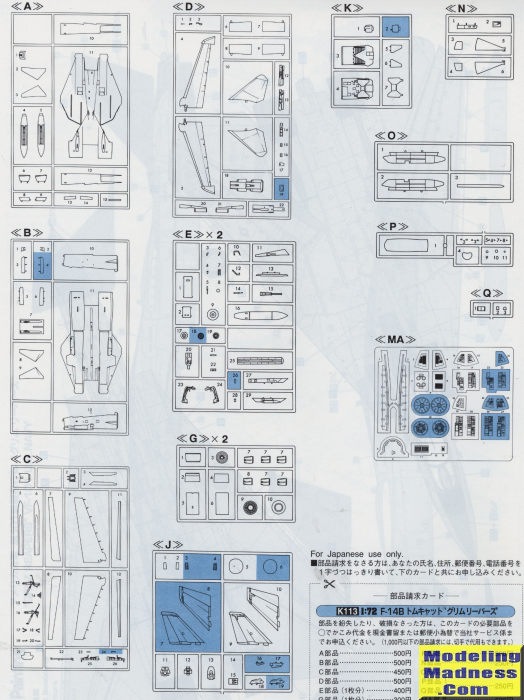 Hasegawa
has reboxed the Tomcat at least three or four dozen times, judging by my slowly
growing collection of F-14 kits. It was natural that they'd get the most out of
what has to have been an expensive molding, judging by the plethora of small
parts and inserts that come with the kits. There are so many parts that the box
is actually bulging in an attempt to keep them from escaping. You can see the
number of bits and pieces from the sprues image. In many ways, this is just a
smaller version of the larger and equally impressive 1/48 F-14 that Hasegawa has
produced. Typical of Hasegawa, the kit came with all those sprues in two bags.
Hasegawa
has reboxed the Tomcat at least three or four dozen times, judging by my slowly
growing collection of F-14 kits. It was natural that they'd get the most out of
what has to have been an expensive molding, judging by the plethora of small
parts and inserts that come with the kits. There are so many parts that the box
is actually bulging in an attempt to keep them from escaping. You can see the
number of bits and pieces from the sprues image. In many ways, this is just a
smaller version of the larger and equally impressive 1/48 F-14 that Hasegawa has
produced. Typical of Hasegawa, the kit came with all those sprues in two bags.
As demanded, the panel lines are engraved and the kit offers the ability to have the flaps and slats deployed. In fact, to do it otherwise will require a bit of surgery to be done on the slat tracks. You can also position the glove vanes open or closed. Again, some surgery is needed for the closed position. All F-14s had them wired in the closed position after it was realized that they didn't really do anything and were an additional maintenance hassle. You also have the ability to have the speed brakes and entrance steps/ladder open or closed, and two different tails, though one set is not for this particular boxing. So much has the F-14 been modified and updated over the years that you really need to have photographs of the aircraft that you are modeling to get everything right.
This kit comes with a small fret of etched metal.
These bits are for the interior, canopy and exhaust. Part of the new bits in
this kit are the later F110 exhaust cans. The new bits are on the G sprue. The metalwork is very well
done and should really enhance your Tomcat. For this kit, they supply a set of
instructions for an early F-14B boxing with an addendum sheet. Any weapons will need to come from another source, such as
Hasegawa's weapons set.
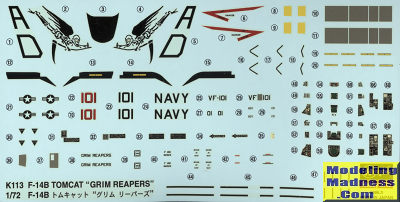
The instructions are very well done as you would expect. They offer color callouts based on Gunze paint as is the norm with Hasegawa over the last decades. For markings, we have one option, which is the box art plane from VF-101, which is a training squadron for the F-14. This one is in the Tactical Paint Scheme with red fins and a red surround of the cockpit. Decals are nicely done, but old so you might want to consider an aftermarket set.
| CONCLUSIONS |
So there you have it. Despite being over 30 years old, the Hasegawa Tomcat is still an excellent kit and well worth the effort of building. I dare say that Hasegawa has boxed dozens of of these kits, each with little more than different decals.
| REFERENCES |
https://en.wikipedia.org/wiki/Grumman_F-14_Tomcat
January 2026 Copyright ModelingMadness.com. All rights reserved. No
reproduction in part or in whole without express permission from the editor. If you would like your product reviewed fairly and fairly quickly, please
contact
the editor or see other details in the
Note to
Contributors.