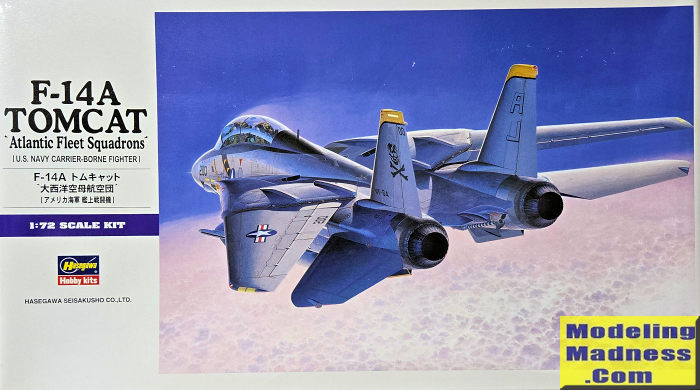
| KIT #: | 00544 |
| PRICE: | ~$30-35.00 srp in US |
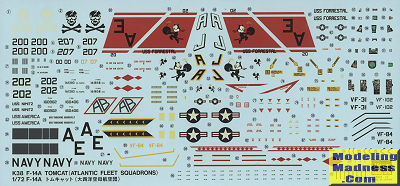
| DECALS: | Four options |
| REVIEWER: | Scott Van Aken |
| NOTES: | 2000 base boxing |
| HISTORY |
The Grumman F-14 Tomcat is a supersonic, twin-engine, two-seat, variable-sweep wing fighter aircraft. The Tomcat was developed for the United States Navy's Naval Fighter Experimental (VFX) program following the collapse of the F-111B project. The F-14 was the first of the American teen-series fighters, which were designed incorporating the experience of air combat against MiG fighters during the Vietnam War.
The F-14 first flew in December 1970 and made its first deployment in 1974 with the U.S. Navy aboard USS Enterprise (CVN-65), replacing the McDonnell Douglas F-4 Phantom II. The F-14 served as the U.S. Navy's primary maritime air superiority fighter, fleet defense interceptor and tactical aerial reconnaissance platform. In the 1990s, it added the Low Altitude Navigation and Targeting Infrared for Night (LANTIRN) pod system and began performing precision ground-attack missions.[
In the 1980s F-14s were used as land-based interceptors by the Islamic Republic of Iran Air Force during the Iran–Iraq War, where they saw combat against Iraqi warplanes. Iranian F-14s reportedly shot down at least 160 Iraqi aircraft during the war, while only 12 to 16 Tomcats were lost; at least half of these losses were due to accidents.
The Tomcat was retired from the U.S. Navy's active fleet on 22 September 2006, having been supplanted by the Boeing F/A-18E/F Super Hornet. The F-14 remains in service with the Islamic Republic of Iran Air Force, having been exported to Iran in 1976, when the U.S. had amicable diplomatic relations with Iran. While most US F-14s have been scrapped to prevent parts from making to Iran, there are quite a few in museums.
| THE KIT |
 This
is the base boxing of the second generation Hasegawa 1/72 F-14A. Base boxings are those that are frequently
reissued so are not to be confused with the limited edition versions which are a
one shot. The base boxings all have white boxes, so they are easy to spot. These
kits are still fairly expensive in the US at retail prices, but if you don't
mind the additional cost of shipping and perhaps tariffs, the kit can be found
from Japan for under $20.
This
is the base boxing of the second generation Hasegawa 1/72 F-14A. Base boxings are those that are frequently
reissued so are not to be confused with the limited edition versions which are a
one shot. The base boxings all have white boxes, so they are easy to spot. These
kits are still fairly expensive in the US at retail prices, but if you don't
mind the additional cost of shipping and perhaps tariffs, the kit can be found
from Japan for under $20.
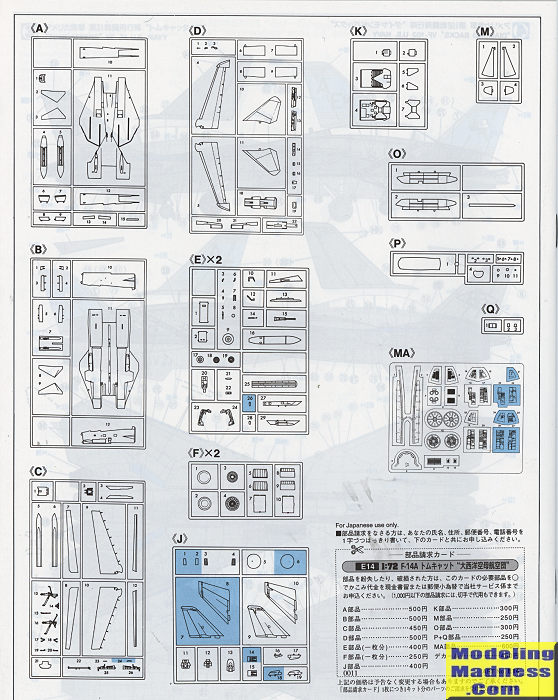
There are so many parts that the box is actually bulging in an attempt to keep them from escaping. You can see the number of bits and pieces from the image above. In many ways, this is just a smaller version of the larger and equally impressive 1/48 F-14 that Hasegawa has produced. Typical of Hasegawa, the kit came with all those sprues in two bags. As a result, there were a number of parts broken off the sprues and the bits have numerous scratches on them.
As demanded, the panel lines are engraved and the kit offers the ability to have the flaps and slats deployed. In fact, to do it otherwise will require a bit of surgery to be done on the slat tracks. You can also position the glove vanes open or closed. Again, some surgery is needed for the closed position. All F-14s had them wired in the closed position after it was realized that they didn't really do anything and were an additional maintenance hassle. You also have the ability to have the speed brakes and entrance steps/ladder open or closed, and two different tails, though one set is not for this particular boxing. So much has the F-14 been modified and updated over the years that you really need to have photographs of the aircraft that you are modeling to get everything right.
As required by its price, this kit comes with a small fret of
etched metal. These bits are for the interior, canopy and exhaust. The metalwork
is very well done and should really enhance your Tomcat. For this kit, they
supply the standard F-14A instruction sheet and an addendum sheet that shows the
D model differences The instructions are
very well done as you would expect. They offer color callouts based on Gunze
paint as is the norm with Hasegawa over the last decades. Every option and
difference between the aircraft on the decal sheet is given so that you can do a
proper job of things.
| CONCLUSIONS |
Until Tamiya releases a 1/72 Tomcat, this can still be considered among the best out there. I've not built the Hobby Boss, Fine Molds, or Academy Tomcat so cannot comment on those.
May 2025
Copyright ModelingMadness.com. All rights reserved. No reproduction in any form without express permission from the editor.
If you would like your product reviewed fairly and fairly quickly, please contact the editor or see other details in the Note to Contributors.
Back to the Main Page Back to the Review Index Page Back to the Previews Index Page