| KIT #: | 00382 |
| PRICE: | 2800 yen when new |
| DECALS: | One option |
| REVIEWER: | Scott Van Aken |
| NOTES: | 2000 Limited Edition |
| HISTORY |
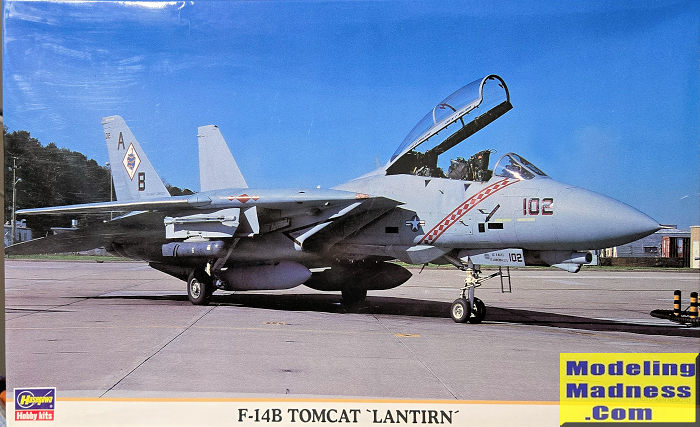
The Lantirn system was a targeting and navigation system that was developed for the USAF's F-16 and F-15E, consisting of two pods. Until the early 1990s, the F-14 Tomcat didn't have clearance to drop bombs even though all Tomcats were built with a Stores Management System (SMS) that included air-to-ground options as well as rudimentary software in the AWG-9. Early flight clearance work to clear the aircraft for air-to-ground were suspended due to development delays with the F-14 and it being shifted away from the air to ground mission. At the time, the Tomcat was so expensive (and lacked proper defensive electronic countermeasures (DECM) and radar homing and warning (RHAW) for overland operations) that the Navy did not want to risk it in the air-to-ground role. However, the TARPS mission had proven the Tomcat was survivable overland and upgrades to the Tomcat's DECM, expendables and RHAW gear were developed to increase its survivability. With the end of the Cold War and de-emphasis on the Fleet Air Defense mission, NAVAIR had renewed flight clearance work before Desert Storm so the F-14 could carry gravity bombs as well as laser-guided bombs if the target was lased by another jet (first Tomcat LGB drop in combat was made by VF-41 in 1995 during operations over Bosnia with an A-6 Intruder providing the requisite target illumination). Meanwhile, the decision had been made by Chief of Naval Operations (OPNAV) to retire the A-6 altogether and allow the F-14 Block 1 Strike variant to take over as the precision strike platform for the air wing. However, the $1.6B Block 1 Strike program was canceled in budgetary cuts by 1994 with only enough funding to integrate the JDAM, which was years away. In late 1994, an unsolicited proposal from Martin Marietta was initiated to demonstrate how a USAF LANTIRN targeting pod could be rapidly integrated onto the Tomcat. This effort was done under the auspices of Commander, Naval Air Forces Atlantic Fleet (COMNAVAIRLANT) using a fleet aircraft to integrate the digital 1553-based pod on an analog F-14B. In March 1995 a VF-103 fleet aircraft successfully dropped the first laser-guided training rounds (LGTR) and quickly laser-guided bombs (LGB). Due to the early success and interest from Fleet Commanders, NAVAIR began to procure pods and control units for deployment, resulting in VF-103 receiving the first LANTIRN pod June 14, 1996 in time for its upcoming deployment.
For more information, visit the reference link.
| THE KIT |
 Hasegawa
has reboxed the Tomcat at least three or four dozen times, judging by my slowly
growing collection of F-14 kits. It was natural that they'd get the most out of
what has to have been an expensive molding, judging by the plethora of small
parts and inserts that come with the kits. There are so many parts that the box
is actually bulging in an attempt to keep them from escaping. You can see the
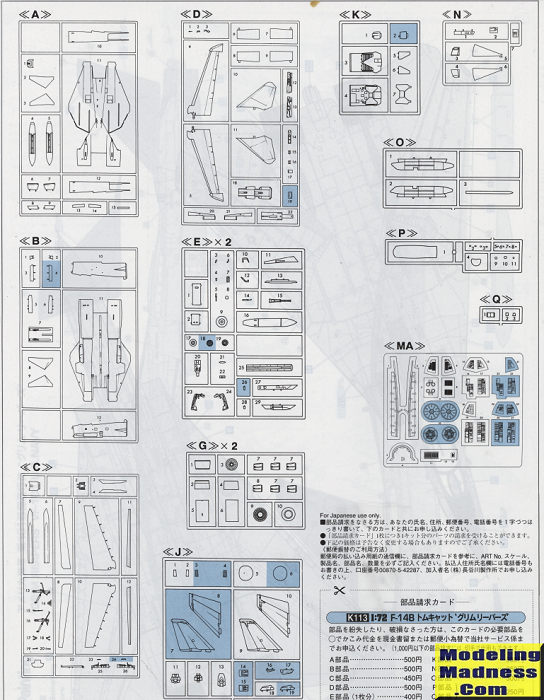
number of bits and pieces from the sprues image. In many ways, this is just a
smaller version of the larger and equally impressive 1/48 F-14 that Hasegawa has
produced. Typical of Hasegawa, the kit came with all those sprues in two bags.
Hasegawa
has reboxed the Tomcat at least three or four dozen times, judging by my slowly
growing collection of F-14 kits. It was natural that they'd get the most out of
what has to have been an expensive molding, judging by the plethora of small
parts and inserts that come with the kits. There are so many parts that the box
is actually bulging in an attempt to keep them from escaping. You can see the
number of bits and pieces from the sprues image. In many ways, this is just a
smaller version of the larger and equally impressive 1/48 F-14 that Hasegawa has
produced. Typical of Hasegawa, the kit came with all those sprues in two bags.
As demanded, the panel lines are engraved and the kit offers the ability to have the flaps and slats deployed. In fact, to do it otherwise will require a bit of surgery to be done on the slat tracks. You can also position the glove vanes open or closed. Again, some surgery is needed for the closed position. All F-14s had them wired in the closed position after it was realized that they didn't really do anything and were an additional maintenance hassle. You also have the ability to have the speed brakes and entrance steps/ladder open or closed, and two different tails, though one set is not for this particular boxing. So much has the F-14 been modified and updated over the years that you really need to have photographs of the aircraft that you are modeling to get everything right.
This kit comes with a small fret of etched metal.
These bits are for the interior, canopy and exhaust though not all are
appropriate for this variant. Part of the bits in
this kit are the later F110 exhaust cans. These bits are on the G sprue. As
expected, there is a Z sprue that has the Lantirn pod and pylon along with some
other pods that are not appropriate for this kit. Any air to air weapons will need to come from another source, such as
Hasegawa's weapons set.
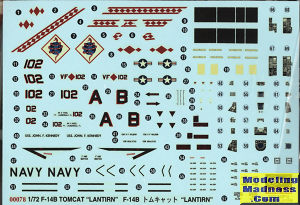
The instructions are very well done as you would expect. They offer color callouts based on Gunze paint as is the norm with Hasegawa over the last decades. You get the standard F-14B instructions with a separate addendum sheet for the Lantirn pod and for the decal markings. This kit only has the box art markings option for a VF-102 plane in the tactical paint scheme. The decals are nicely printed and even after 25 years, should still be viable.
| CONCLUSIONS |
So there you have it. Despite being over 30 years old, the Hasegawa Tomcat is still an excellent kit and well worth the effort of building.
| REFERENCES |
https://en.wikipedia.org/wiki/LANTIRN
October 2023 Copyright ModelingMadness.com. All rights reserved. No
reproduction in part or in whole without express permission from the editor. If you would like your product reviewed fairly and fairly quickly, please
contact
the editor or see other details in the
Note to
Contributors.