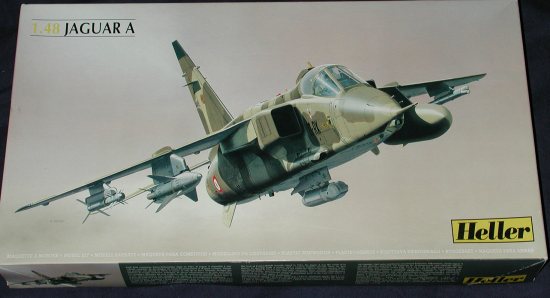
Heller 1/48 Jaguar A
|
KIT # |
428 |
|
PRICE: |
@$25.00 when I bought it |
|
DECALS: |
Two aircraft |
|
REVIEWER: |
|
|
NOTES: |
|
HISTORY |
Produced to meet a 1965 joint Anglo-French specification for an advanced trainer/tactical support aircraft, the SEPECAT Jaguar was transformed into a potent fighter-bomber with sophisticated nav/attack systems for the low-level all-weather attack role. The first of eight Jaguar prototypes made its maiden flight on 8 September 1968. India's sizeable Jaguar fleet includes 15 two-seat Jaguar IT operational trainers. Ten have been assembled under license.
The RAF received 200 Jaguars, comprising 165 single-seat GR.Mk Is (with chisel laser noses) and 35 T.Mk 2 trainers. The latter have the full nav/attack avionics suite but no lasers. Delivered in 1973-78, GR.Mk ls were tasked with nuclear strike, reconnaissance and conventional strike. Recce aircraft carry a centerline pod containing five cam-eras and an IR linescan. The GR.Mk 1A upgrade added a FIN1064 INS, AN/AILE-40 flare dispensers, Phimat flare pods and jamming pods to 75 single-seaters. Fourteen trainers were similarly upgraded as T.Mk 2As. For Operation Granby in 1991 Jaguars also used CRV-7 rockets and CBU-87 cluster bombs.
The Armee de I'Air's 160 single-seat Jaguar As have generally less capable avionics than RAF Jaguars, but remain effective strike aircraft. Various systems have been added including TAV-38 or ATILIS laser designators and the OMERA 40 camera. The 40 cannon-armed Jaguar E trainers lack a full nav/attack avionics fit. Initial deliveries were made from January 1972, and some Jaguar As were tasked with pre-strategic nuclear-strike with AN 52 weapons (withdrawn in 1991). The surviving 85 Jaguar As now undertake tactical support/ground-attack missions. AA Jaguars have seen action in Mauritania, Chad and the Gulf. The type has since been retired from both air forces.
|
THE KIT |
The kit itself is quite similar to the Buccaneer, Tornado and Lightning kits
produced by Airfix at the time in
that it is engraved panel lines, but the engraving is not only a bit deep, but
also a bit 'soft'. By that, I mean that the edges of the panel lines are more
rounded than a square corner as you see on Hasegawa or Tamiya kits. The plastic
is a bit softer as well. This bothers some builders, but personally, it isn't
that big a deal.
The kit has a full cockpit with decals for instruments. The canopy can be
displayed open or closed as can the speed brakes. In fact, if you look at the
photos I've included of the two aircraft on the decal sheet, you'll see that
these are generally open on the ground. That is not always the case for the gear
doors, but it is a bit unusual for most of them to be open. In fact, the kit is
molded with most of the gear doors closed. The parts themselves have varying
levels of ejector pin marks including the gear legs and the wheels so clean-up
is a necessity. There are sink marks on the lower fuselage opposite the
alignment pins and on a couple of other thick bits. No flash was found as this
isn't exactly an old mold.
There are plenty of 'things under wings' with this one as is typical for
Jaguars. You'll have to forgive me my lack of French munitions and systems, but
here's what you can stick on: A large fuel tank or FLIR pod on the
centerline. On the inner stations can be what looks like an anti-ship missile
and a fuel tank or a pair of dual bomb racks. For the outer stations are either
a Magic missile and ECM pod or a flare/chaff dispenser and some other ECM pod of
some sort. There is also some sort of system close into the fuselage under the
wings that can be installed. Confusing? Sorry, but that's all I know as none of
this stuff is named.
Thanks to Kurt Plummer, here is what all that weapons stuff is (perhaps more
than you wanted to know, but better more than nothing):
RP-36 1200 litre (265 imp gallon) tank. Standard French and British tanks
with the French also basing upon it a couple of recce pods.
The Magic is the R550-2, and the bombs themselves are SAMP-250's. 250
kilograms = 550lbs, more or less like our Mk.82 although without the more
advanced Aero-1 ogival aerodynamics. I forget what SAMP 'speaks like' in French
but it comes out 'Society of Aeronautical Military Production' or close. Their
semi-privatized equivalent to our China Lake combined with say Raytheon or
Lockheed Missiles and Space on a joint-venture but government owned basis.
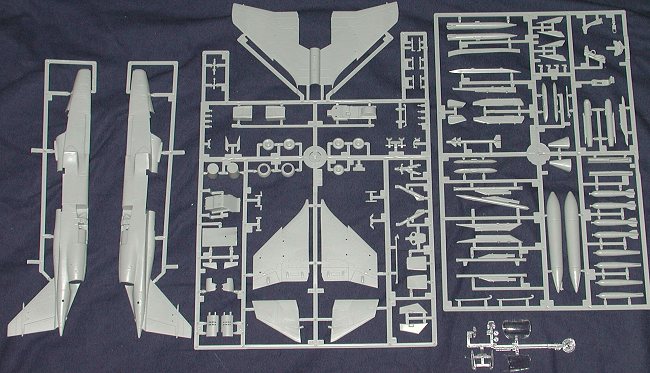 The Jaguar has been kitted before by Heller, but in a very old 1/50 scale. Most
of those I've know who have built this kit are currently under professional
care. This was followed by a nearly as bad ESCI kit. Finally, about 25 years or
so back, Airfix and Heller did a joint build. Airfix did the Jaguar GR.1 and Heller
did this Jaguar A. A bit more than half the kit is the same for both variants,
with a large sprue carrying the specific different parts for the version being
kitted. At least, that's the way it looks to me.
The Jaguar has been kitted before by Heller, but in a very old 1/50 scale. Most
of those I've know who have built this kit are currently under professional
care. This was followed by a nearly as bad ESCI kit. Finally, about 25 years or
so back, Airfix and Heller did a joint build. Airfix did the Jaguar GR.1 and Heller
did this Jaguar A. A bit more than half the kit is the same for both variants,
with a large sprue carrying the specific different parts for the version being
kitted. At least, that's the way it looks to me.
ATLIS II (Autopointeur, télévision, laser, illumination au sol: Automatic
Tracking Television Laser Illumination, Air to Surface). TV=day only pod with
laser designation and ranging capabilities for
integration with smart weapons. Originally a Martin Marietta project,
'internationalized' after the USAF selection of ASQ-153 Pave Spike. Though an
older system, the 'eyelid' doors are preferred for their ability to protect the
optics while allowing fast-activation (no ball-roll articulation problems or
lag) and during daylight the resolution range is actually better than most first
and some second generation FLIR based systems.
AS-30L. The original AS-30 was indeed a command guided Air To Surface weapon (sorta
like Bullpup) intended for coastal antishipping work but this version works in
concert with the ATLIS pod like a powered LGB (or AGM-65E Laser) for attacks on
hard targets largely overland. Hence
30-'Laser' and the birdie on the nose. Used with some notoriety in French
attacks on hardened weapons igloos with potential chem fallout from MASSIVE
secondary explosions during Desert Warm 1. Powerful (Mach 1.3+) boost to
penetration and warhead effects but exceptionally
shortranged at around 7-8nm in comparison with most (EO or I2R) standoff PGM of
a similar weight class (1,200lbs) which are usually up around 15-20nm at least.
ALKAN L1010 Vertical Ejector Racks. Even as our own services are only now
coming to more fully realize, the French have long known that 2 weapons load
easier, clear the ground better, come off cleaner and have lower tunnel drag
than 3 on a TER. For them it was more a matter of
accomodating the 2,500lb weight limits on the Jaguar inner pylons however.
ALKAN 5020 EXCM scab launchers. Originally intended to dispense grenades from a
fixed carriage, low altitude, pass condition (as indeed were some of our own
early 'SUU-CBUs'); this is now primarily a decoy launcher of 7X18 launcher
groups or what we would call 'buckets' for
expendable countermeasures. In theory, it allows the Jaguar to be operated as a
point defense interceptor with full Magic loads under the outer pylons without
losing all defensive countermeasures but more commonly it is the flare other
half of the Phimat podded chaff system.
THOMSON CSF EXTERNAL EW PODS:
Large Chisel Nose without Shark Fins= DB-3141 or 3163 Remora. Narrow band I/J
band pods with single or dual transmitter/receiver chains and shop level
reprogramming of database/techniques. Approximately 220lbs.
Bugeye= TVM-015 Barem. Standard French 'home pod'. Much smaller 'all digital'
pod using superhet receiver to drive multiple TWT in a modular format for on the
fly (hands off) response to a dense signal spectrum. Roughly 160lbs.
Small Chisel Nose with Shark Fins= (ESD) Barex export jammer pod. Incorporates
much of the government driven Barem technology but uses flightline
reprogrammable 'top ten' threat list rather than active power management and
technique response control. Adds independent threat warning to effectively
provide RWR to non-equipped aircraft and secondary (pilot manageable) techniques
control through one of six strategy options. Lightest of all pods.
Barracuda= Newer, multiband support jammer pod, and export version of the
French (developmental) Basilisk. With as many as 20 simultaneous threats and
automatic or manual techniques control.
 Instructions are the typical
Airfix booklet format with lots of large images for the construction steps,
colors in Humbrol paint numbers with no generic name (curse them!!), and
warnings in a zillion languages. Markings are for two planes, both of which I
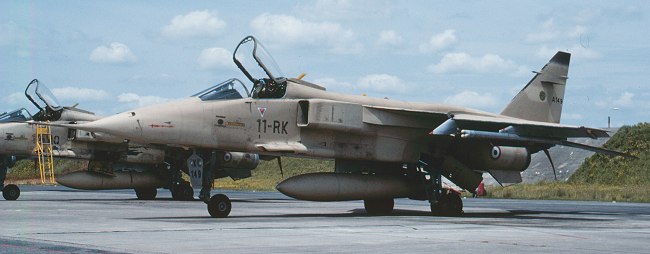
have photographs of in my slide collection. First is the box art plane from EC
3/11 'Vosges'. This particular plane is shown in a rather unusual mixture of the
two desert schemes applied to French planes. Now would be a good time to mention
that there are three general paint schemes for French Jaguars. One is the
standard
Instructions are the typical
Airfix booklet format with lots of large images for the construction steps,
colors in Humbrol paint numbers with no generic name (curse them!!), and
warnings in a zillion languages. Markings are for two planes, both of which I
have photographs of in my slide collection. First is the box art plane from EC
3/11 'Vosges'. This particular plane is shown in a rather unusual mixture of the
two desert schemes applied to French planes. Now would be a good time to mention
that there are three general paint schemes for French Jaguars. One is the
standard 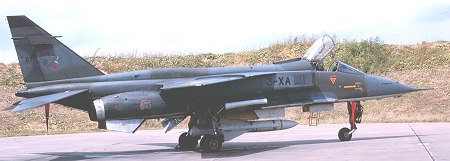 Green/Grey over Silver
'European' scheme. Then there is the two lighter brown colors called 'Arabie'
for Arabian. Then there is the light tan with a darker brown called 'Tchad' for
those planes used in Chad during their war with Libya. This kit shows an option
that has a mixture of all three desert colors in a non-standard pattern, though
my slides of A149 (11-RK) only show the lighter 'Arabie' colors. This
color was also used on planes partaking in Desert Storm. The other
Green/Grey over Silver
'European' scheme. Then there is the two lighter brown colors called 'Arabie'
for Arabian. Then there is the light tan with a darker brown called 'Tchad' for
those planes used in Chad during their war with Libya. This kit shows an option
that has a mixture of all three desert colors in a non-standard pattern, though
my slides of A149 (11-RK) only show the lighter 'Arabie' colors. This
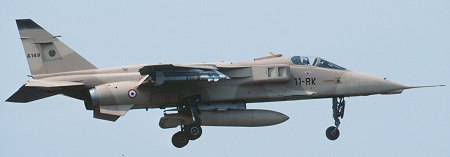
color was also used on planes partaking in Desert Storm. The other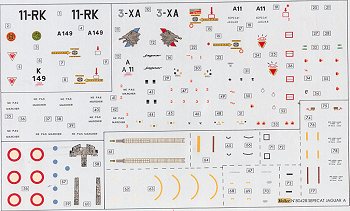 plane is from EC 3/3 'Ardennes' and is in the 'European' scheme. My slide shows
it heavily 'zapped' during an exercise, as you can see by the partially obscured
fuselage roundel. Generally both schemes are painted in the same pattern so if
you want to do the EC 3/11 aircraft, then you can use the 'European' scheme
guide and the photos I've so kindly provided for you! The decals are typical for
current Airfix/Heller kits. They are a bit thick and not terribly crisp but
should work rather well and should succumb to decal solvents without too much
fuss. I'm sure there are aftermarket decals for this kit, but I don't know who
does any for French planes. I do understand that there are a few aftermarket
bits such as a cockpit for the French version.
plane is from EC 3/3 'Ardennes' and is in the 'European' scheme. My slide shows
it heavily 'zapped' during an exercise, as you can see by the partially obscured
fuselage roundel. Generally both schemes are painted in the same pattern so if
you want to do the EC 3/11 aircraft, then you can use the 'European' scheme
guide and the photos I've so kindly provided for you! The decals are typical for
current Airfix/Heller kits. They are a bit thick and not terribly crisp but
should work rather well and should succumb to decal solvents without too much
fuss. I'm sure there are aftermarket decals for this kit, but I don't know who
does any for French planes. I do understand that there are a few aftermarket
bits such as a cockpit for the French version.
|
CONCLUSIONS |
At the time, this was the best 1/48 Jaguar on the market. The new Airfix kit surpasses this one in most all respects, but doesn't make this one obsolete by any means. If you can handle the soft panel lines and a lower level of detail, then will make a nice model for your modern day jet collection.
July 2025
If you would like your product reviewed fairly and quickly, please contact the editor or see other details in the Note to Contributors.