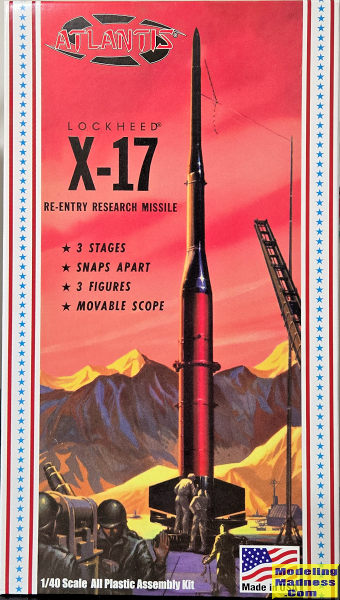
Atlantis 1/40 Lockheed X-17 Rocket
| KIT #: | H1810 |
| PRICE: | ~$23.00 |
| DECALS: | One option |
| REVIEWER: | Scott Van Aken |
| NOTES: | 1957 tooling. 2025 release. |
| HISTORY |
The Lockheed X-17 was a three-stage solid-fuel research rocket to test the effects of high mach atmospheric reentry. The first stage of the X-17 carried the rocket to a height of 17 miles (27 km) before burning out. The rocket would then coast on momentum to about 100 miles (160 km) before nosing down for reentry. The second stage engine would then fire before jettisoning and igniting the third and final stage. On April 24, 1957, an X-17 reached a speed of 9,000 miles per hour (14,000 km/h) at Patrick AFB. Ultimately the X-17 would be traveling towards Earth at up to Mach 14.5. Data collected from these events is why the nose cones on Atlas, Titan, and later ICBMs is rounded.
The X-17 was also used as the booster for the Operation Argus series of three high-altitude nuclear tests conducted in the South Atlantic in 1958.
The rocket engine used by the rocket is called 1.5KS35000, a solid propellant rocket engine designed by Thiokol. It was used in at least 23 launches.
| THE KIT |
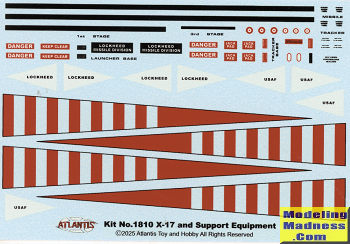 The kit
itself is molded in white and OD with the white for the missile and the OD
for the launch base along with the figures and other small equipment
(specifically a theodolite). According to the instructions, the rocket
stages simply snap together, adding some play value to the kit, which was a
fairly important feature to kits back then.
The kit
itself is molded in white and OD with the white for the missile and the OD
for the launch base along with the figures and other small equipment
(specifically a theodolite). According to the instructions, the rocket
stages simply snap together, adding some play value to the kit, which was a
fairly important feature to kits back then. | CONCLUSIONS |
I have built some of these '50s kits in the past and I can tell you that if you treat them as short run kits, they will go together with minimal fuss. I was quite impressed at how clean the sprues were. There is no flash and sink areas are limited to the fairly thick figures.
| REFERENCES |
https://en.wikipedia.org/wiki/Lockheed_X-17
June 2026
Copyright ModelingMadness.com. All rights reserved. No reproduction in part or in whole without express permission.
If you would like your product reviewed fairly and fairly quickly, please contact the editor or see other details in the Note to Contributors.