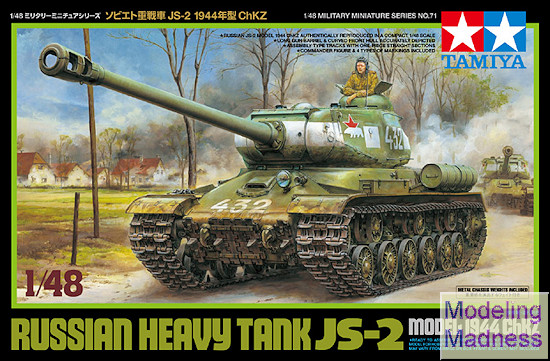
Tamiya 1/48 JS-2 model 1944
| KIT #: | 32571 |
| PRICE: | $38.00 SRP |
| DECALS: | Four options |
| REVIEWER: | Scott Van Aken |
| NOTES: |
| HISTORY |
FirsThe IS Tank (IS in Cyrillic "ИС", meaning the Joseph Stalin or Iosif Stalin in Cyrillic "Ио́сиф Ста́лин") was a series of heavy tanks developed as a successor to the KV-series by the Soviet Union during World War II. It was named after Soviet leader Joseph Stalin. The heavy tank was designed with thick armour to counter the German 88 mm guns, and carried a main gun that was capable of defeating the German Tiger and Panther tanks. It was mainly a breakthrough tank, firing a heavy high-explosive shell that was useful against entrenchments and bunkers. The IS-2 was put into service in April 1944, and was used as a spearhead in the Battle of Berlin by the Red Army in the final stage of the Battle of Berlin.
Early IS-2s can be identified by the 'stepped' front hull casting with its small, opening driver's visor. The early tanks lacked gun tube travel locks or anti-aircraft machine guns, and had narrow mantlets. According to Steven Zaloga, the IS-2[ and Tiger I could knock each other out in normal combat distances below 1000 m. At longer ranges the performance of each respective tank against each other was dependent on the crew and combat situation.
Later on, with the aforementioned late-1944 modernization, the stepped hull front was replaced with a single plate of 120 mm thickness angled at 60 degrees. Some sources called it IS-2m, but it is distinct from the official Soviet designation IS-2M for a 1950s modernization. Other minor upgrades included the addition of a travel lock on the hull rear, wider mantlet, and, on very late models, an antiaircraft machine gun.
In the mid-1950s, the remaining IS-2 tanks (mostly model 1944 variants) were upgraded to keep them battle-worthy, producing the IS-2M, which introduced fittings such as external fuel tanks on the rear hull (the basic IS-2 had these only on the hull sides), stowage bins on both sides of the hull, and protective skirting along the top edges of the tracks.
| THE KIT |
 Tamiya has a well-earned reputation for providing kits that are not only accurate, but also relatively easy to build. This extends to their 1/48 offerings, of which I have built several over the years. Many of these kits come with cast metal chassis or other methods of adding weight. I'm not sure what the reason might be for this other than the possibility that heavier models don't slide from shelves so easily during earthquakes. Whatever the case, this feature certainly does add some heft to the completed model. In this case, there are four cylindrical weights to be trapped in plastic caps and cemented to the chassis floor.
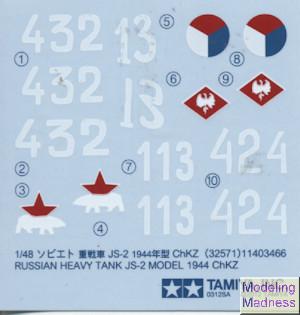 Instructions are well drawn with 14 construction steps and list of parts not used. All paint information is with Tamiya colors. Four markings options are provided, all in olive green. I should mention that the paint color recommended is from their spray paint line. The box art tank requires the white bands to e painted by the modeler. Another Soviet option has thinner bands and both are from Berlin in 1945. For those not wanting to paint white bands, a Czech tank from Prague in May 1945 and a Polish tank from Germany in April 1945 are also included. The decal sheet is very nicely done and Tamiya has choses semi-colorful options.
 | CONCLUSIONS |
This is another fine Tamiya 1/48 AFV kit. While it has quite a few more parts than some of their other kits, the end result will be a very nice model of a large, heavy tank that was used well into the post war years.
| REFERENCES |
https://en.wikipedia.org/wiki/IS_tank_family#IS-2
January 2016 Copyright ModelingMadness.com Thanks to your now empty-walleted editor for the preview kit. If you would like your product reviewed fairly and fairly quickly, please contactthe editor or see other details in the