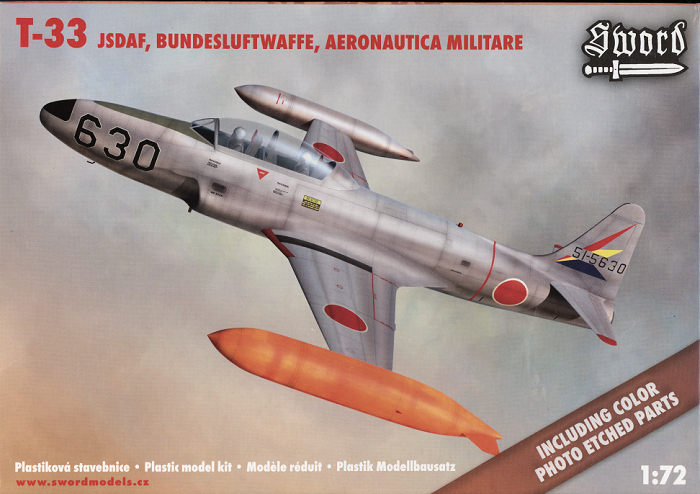
Sword 1/72 T-33
| KIT #: | 72028SE |
| PRICE: | $25.00 when new |
| DECALS: | Three Options |
| REVIEWER: | Scott Van Aken |
| NOTES: | Multi-media kit with photo etch and resin parts |
| HISTORY |
The T-33 (aka "T-Bird") was developed from the Lockheed P-80/F-80 by lengthening the fuselage by slightly over three feet and adding a second seat, instrumentation and flight controls. It was initially designated as a variant of the P-80/F-80, the TP-80C/TF-80C.
Design work for the Lockheed P-80 began in 1943 with the first flight on 8 January 1944. Following on the Bell P-59, the P-80 became the first jet fighter to enter full squadron service in the United States Army Air Forces. As more advanced jets entered service, the F-80 took on another role - training jet pilots. The two-place T-33 jet was designed for training pilots already qualified to fly propeller-driven aircraft.
Originally designated the TF-80C, the T-33 made its first flight on 22 March 1948 with US production taking place from 1948 to 1959. The US Navy used the T-33 as a land-based trainer starting in 1949. It was designated the TV-2, but was redesignated the T-33B in 1962. The Navy operated some ex-USAF P-80Cs as the TO-1, changed to the TV-1 about a year later. A carrier-capable version of the P-80/T-33 family was subsequently developed by Lockheed, eventually leading to the late 1950s to 1970s T2V-1/T-1A SeaStar. A total of 6,557 Shooting Stars were produced, 5,691 by Lockheed.
| THE KIT |
 This
is the fourth or perhaps fifth Shooting Star variant that Sword has produced in
1/72 scale. I built the F-80C kit and found it to be generally well done and
while perhaps not for the
This
is the fourth or perhaps fifth Shooting Star variant that Sword has produced in
1/72 scale. I built the F-80C kit and found it to be generally well done and
while perhaps not for the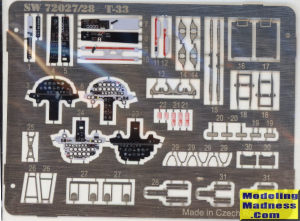 bare beginner, is a well executed kit. You'd think that there would be many of
the same sprues from kit to kit, but this has generally not been the case.
bare beginner, is a well executed kit. You'd think that there would be many of
the same sprues from kit to kit, but this has generally not been the case.
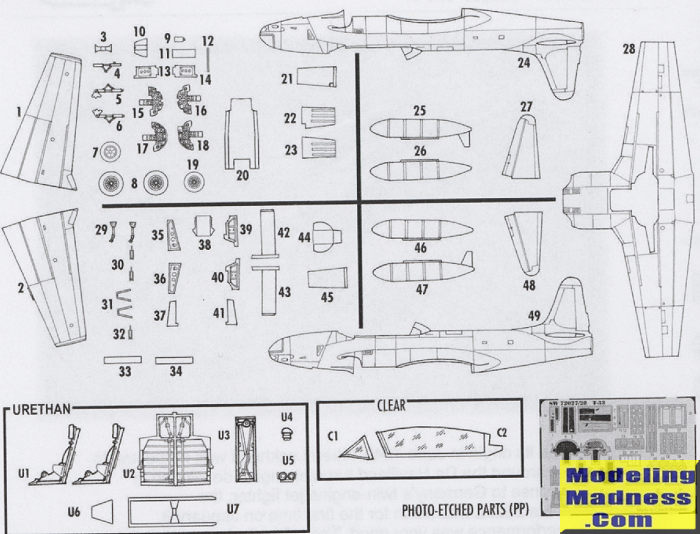
The T-33 requires new fuselage halves, new wing tip tanks, new interior and canopy. Sword does the multi-media approach with resin for the seats, wheel wells and a few other bits. Photo etch is used for most of the interior details, including instrument panels and for landing gear retraction struts, speed brake detailing, and oleo scissors to name a few. The etched set is in color, which is very nice.
The intake design is probably going to cause the most
difficulty with builders. It is split into upper and lower
sections with the lower section being incorporated into the lower wing. It makes
for a som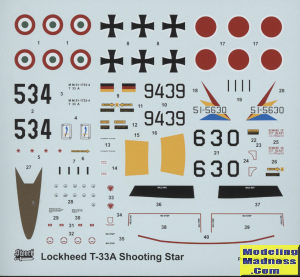 ewhat difficult seam to fill and truly, you'll need either super glue
or thin card to get a clean intake lip. There are no real options as the T-33
was pretty much the same no matter who flew it. The Canadians did have a larger
engine that requires an additional exhaust port on the aft fuselage. This is
something that some decal sheets offer as a decal or you can drill this out.
ewhat difficult seam to fill and truly, you'll need either super glue
or thin card to get a clean intake lip. There are no real options as the T-33
was pretty much the same no matter who flew it. The Canadians did have a larger
engine that requires an additional exhaust port on the aft fuselage. This is
something that some decal sheets offer as a decal or you can drill this out.
The kit offers three decal options. The box art plane is from the Sotai Headquarters Squadron. It is in aluminum with orange and black tip tanks. An Italian version from Camerai is in the same scheme. Finally, in a camouflage scheme of dark grey and dark green over light grey is a plane from Erding. Decals are very nicely printed by Techmod and include nose anti-glare panel and wing walk panels. Kit instructions are typical Sword and offer generic color references.
| CONCLUSIONS |
Overall, it is a very nice kit for this most important aircraft. Flown by literally dozens of nations, many are still extant as war birds and some may still be in military use. With some thoughtful building, it will make into an excellent replica for your display shelves.
| REFERENCES |
July 2025
Copyright ModelingMadness.com. All rights reserved. No reproduction in any form without express permission from the editor.
If you would like your product reviewed fairly and fairly quickly, please contact the editor or see other details in the Note to Contributors.