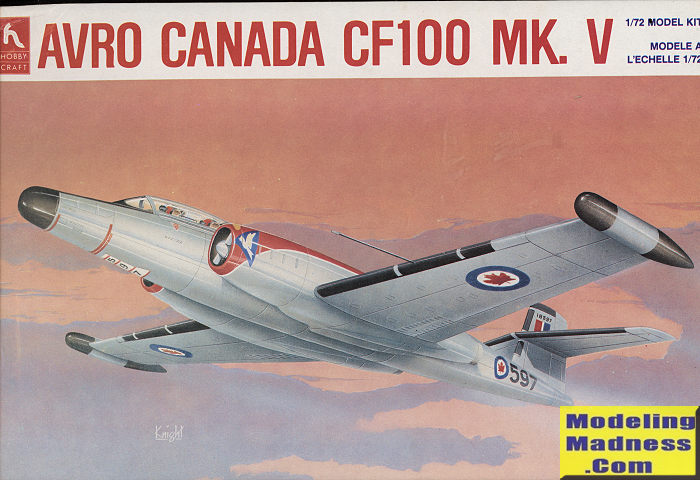
Hobbycraft 1/72 CF-100 Mk.V
| KIT #: | 1394 |
| PRICE: | $ |
| DECALS: | Two options |
| REVIEWER: | Scott Van Aken |
| NOTES: |
| HISTORY |
Work commenced in October 1946 in response to a Royal Canadian Air Force (RCAF) specification calling for a new jet-powered interceptor/fighter aircraft suitable for long-distance patrol missions and all-weather operations. On 19 January 1950, the CF-100 Mark 1 prototype, 18101, conducted its maiden flight, powered by a pair of Rolls-Royce Avon RA 3 turbojet engines. Both pre-production and production series aircraft were powered by the domestically-developed Avro Orenda engine instead. Flight testing proved the CF-100 to possess a relatively short takeoff run and a high climb rate, making it well suited to its role as an interceptor. On 18 December 1952, Squadron Leader Janusz Żurakowski, the Avro company chief development test pilot, took the CF-100 Mk 4 prototype up to Mach 1.10 in a dive from 14,000 m (45,000 ft), making the type the first straight-winged jet aircraft to achieve controlled supersonic flight. The CF-100 was the only mass produced Canadian-developed fighter aircraft.
| THE KIT |
Released in the late 1980s, this was one of Hobbycraft's first kits. In addition to this Mk.V kit, a Mk.IV was also produced. The kit has somewhat soft and somewhat large engraved detailing. It is also somewhat simplified. For instance, the cockpit tub has no side consoles and is basically a place for the two generic looking seats and pilot's control stick. Two crew members are provided to fill those seats. There is a main instrument panel that is just a blank part with no detail. No instrument decal is provided. This fits into the upper fuselage half
The lower half has two engine faces that fit onto the intake on either side. Two exhaust pieces also fit onto this section. A main gear bay that is also devoid of detail fits onto the lower fuselage section. 5 grams of weight is required to prevent tail sitting before the fuselage halves are glued together. Wings are upper and lower pieces with the lower section being smaller and fitting within the upper piece.
The rear fuselage is a separate piece and the one-piece tailplane slots into this. There is no key for ensuring alignment so one must take care when attaching this. Right and left wing attach to the fuselage via a simple peg so it is important to ensure proper alignment on this as well. A pair of air scoops fit atop the fuselage and before attaching the single piece canopy, the clear blast shield for the rear seater needs to be glued in place. While a pair of tanks for the wing are on the sprues, the instructions only show the wing tip rocket podsLanding gear is quite basic with minimal detail. Once these are attached, the gear doors need to be cut and then glued in place. Conversely, one could do this in flight by omitting the landing gear. The last items are attaching the rocket pods and the pitot.
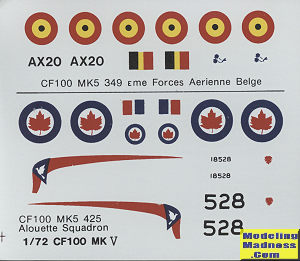 Instructions are adequate and the parts are all named. No cockpit or wheel
well color information is supplied so head to the 'net to figure that out. Two
markings options are provided. One is the box art plane from 425 squadron in
unpainted metal with black used on the leading edges of the flight surfaces,
radome, anti-glare panel, and parts of the rocket pods. The other is from 349
squadron, Belgian Air Force. This is in a camouflaged scheme of dark green/dark
sea grey over medium sea grey. Decals look to be nicely done, but my experience
with early, 'white box' Hobbycraft kits is that the markings don't stick. Always
test one you won't be using and have a 'plan B' in case you run into issues.
Instructions are adequate and the parts are all named. No cockpit or wheel
well color information is supplied so head to the 'net to figure that out. Two
markings options are provided. One is the box art plane from 425 squadron in
unpainted metal with black used on the leading edges of the flight surfaces,
radome, anti-glare panel, and parts of the rocket pods. The other is from 349
squadron, Belgian Air Force. This is in a camouflaged scheme of dark green/dark
sea grey over medium sea grey. Decals look to be nicely done, but my experience
with early, 'white box' Hobbycraft kits is that the markings don't stick. Always
test one you won't be using and have a 'plan B' in case you run into issues.
| CONCLUSIONS |
Hobbycraft is the only company that has done this aircraft in this scale for the mass market. It is crude by today's standards, however, with a bit of work, can be made into a fairly nice model.
| REFERENCES |
https://en.wikipedia.org/wiki/Avro_Canada_CF-100_Canuck
May 2025
Copyright ModelingMadness.com. All rights reserved. No reproduction in part or in whole without express permission from the editor.
If you would like your product reviewed fairly and fairly quickly, please contact the editor or see other details in the Note to Contributors.