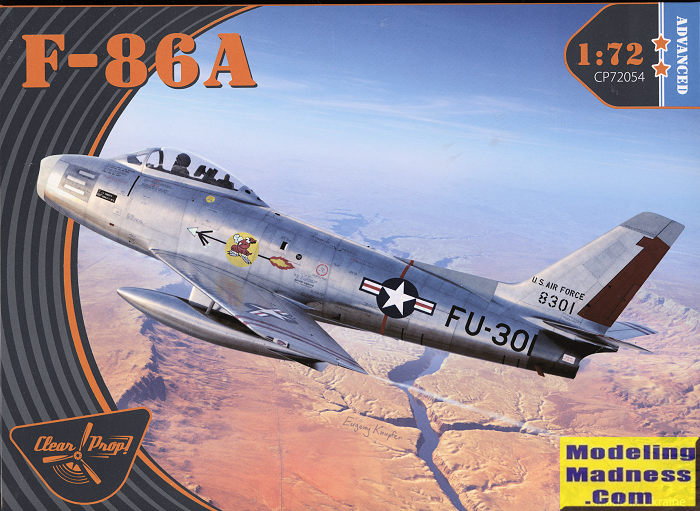
Clear Prop 1/72 F-86A Sabre (early)
| KIT #: | CP72054 |
| PRICE: | $52.00 delivered from Ukraine |
| DECALS: | Three optionse |
| REVIEWER: | Scott Van Aken |
| NOTES: | 2025 release |
| HISTORY |
Sabrejet, is a transonic jet fighter aircraft. Produced by North American Aviation, the Sabre is best known as the United States' first swept-wing fighter that could counter the swept-wing Soviet MiG-15 in high-speed dogfights in the skies of the Korean War (1950–1953), fighting some of the earliest jet-to-jet battles in history. Considered one of the best and most important fighter aircraft in that war, the F-86 is also rated highly in comparison with fighters of other eras. Although it was developed in the late 1940s and was outdated by the end of the 1950s, the Sabre proved versatile and adaptable and continued as a front-line fighter in numerous air forces.
Its success led to an extended production run of more than 7,800 aircraft between 1949 and 1956, in the United States, Japan, and Italy. In addition, 738 carrier-modified versions were purchased by the US Navy as FJ-2s and -3s. Variants were built in Canada and Australia. The Canadair Sabre added another 1,815 aircraft and the significantly redesigned CAC Sabre (sometimes known as the Avon Sabre or CAC CA-27), had a production run of 112. The Sabre is by far the most-produced Western jet fighter, with a total production of all variants at 9,860 units. The last military F-86 was retired from the Bolivian Air Force in 1994.
| THE KIT |
 Following
their well received 1/48 kit of this aircraft, Clear Prop has provided it in
1/72. This is not the only time an early Sabre has been kitted in this scale, as
Matchbox's offering from the early 1970s was an F-86A, however the difference
between the two is like day and night.
Following
their well received 1/48 kit of this aircraft, Clear Prop has provided it in
1/72. This is not the only time an early Sabre has been kitted in this scale, as
Matchbox's offering from the early 1970s was an F-86A, however the difference
between the two is like day and night.
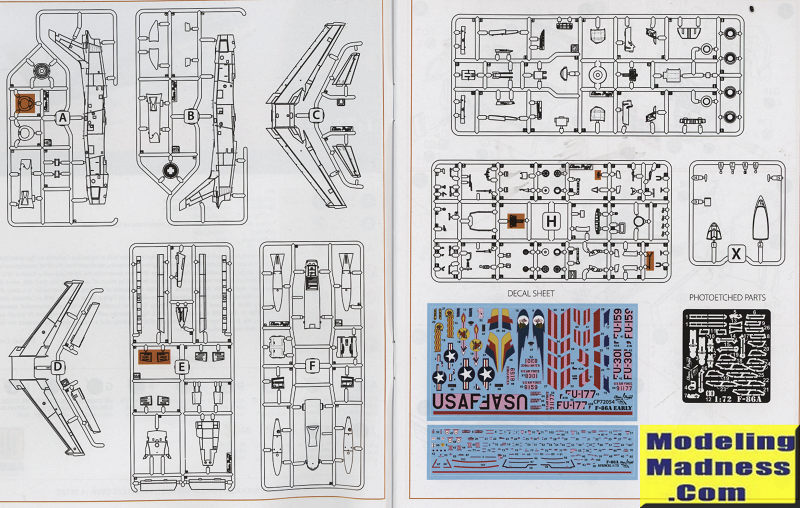
Clear Prop has developed this kit not only for early F-86A fans, but those who like a plethora of small parts and detail. Indeed, this one will not be for those who want a quick build. That is fairly obvious just looking at the number of sprues and the instruction booklet with its 46 construction steps.
The kit includes a photo etch fret for seat harness, slat tracks, drop tank braces, some landing gear detail and a few other minor bits. Some of the etched parts are truly small so care will need to be taken when removing them from the fret.
The cockpit is nicely done with a decal for the main instrument panel and raised detail on the side consoles. The seat is well appointed and will look the part when done. The kit provides a full intake to the first compressor stage and the nose gear 'roof' is molded on one half. Nose gear well side panels are separate and need to be built up prior to installation. Exhaust is equally well done from the final stage aft. Before installing any of the aforementioned subassemblies, there are the speedbrake wells that will need to be built up along with some fent areas. Then the main gear well center section will need to be constructed.
When all that is done, a two piece cap will need to be added to the exhaust, an upper vent to the fuselage along with the area behind the cockpit and 2.5 grams of nose weight. Then all those bits can be installed in a fuselage half and the halves joined together. For those of us used to building other brands of later F-86s, this is a lot of work with a lot of parts.
Attention then turns to the wings. Holes will need to be opened for the wing tank pylons and the pitot. Once installed a section behind the wing along with two vents will need to be attached followed by the lower forward fuselage. Next are the parts that make this an early F-86A. One is the intake without the gun radar, and next are the gun blast panels. These are rectangular as was typical in the F-86A-1. The kit provides these both open or closed. These blast doors were electrically operated and were less than popular with the maintenance types. Often the doors were left in the open position until retrofit with the standard panels we have all come to see in the F-86A-5 and later. The later blast plate and intake are included on the sprues if you wish to do a later type.
All the flight control surfaces are separate, and designed to be in the neutral position. The kit also includes separate slats. Each slat is held onto the wing by eight small photo etch slat tracks. While the separate wing tip lenses are shown as installed now, I'd wait until after painted. Moving to the main wheels each five piece main wheel is built up and attached to the main gear leg. The oleo scissors are two pieces and attached at this time. There is a gear retraction strut that is attached to the gear well at the same time as the strut. Both the inner and outer main gear doors have their own retraction mechanism as well. At the nose gear well, the nose gear and doors have a fair number of small parts and some p.e. to be installed as well.
Back at the cockpit, the gun sight is installed with its p.e. and an
additional clear armor piece is attached to the inside of the windscreen. The
canopy brace assembly of four parts is built up. If posing the canopy closed,
this brace will need to be trimmed to fit over all the stuff that fits behind
the ejection seat. The speed brakes with its retraction strut and p.e. part are
next with the last items being the drop tanks with their pylons and p.e. braces.
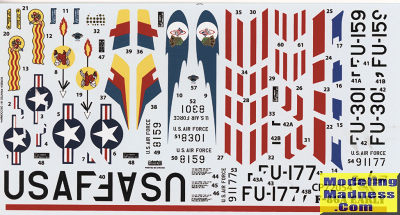
Instructions are very well done with Gunze and MiG paint references. Three options are provided, all in overall unpainted aluminum with some light gull grey panels. All are the same as what was offered in the 1/48 kit. One is the box art plane with red wing stripes and rudder from the 334 FS in 1950. Another is with the 62nd FIS with a multi-color fin marking while the third is with the 94th FS with the blue comet on the fuselage. Decals are well done and should provide no issues. Additional red stripes are provided in case they are needed.
| CONCLUSIONS |
I was very much looking forward to this kit in this scale and I'm sure many will be quite pleased with it. My enthusiasm was tempered when I saw the p.e. that was required to build it. I guess I should have expected that, but it is a disappointment to have to rely on this material in this day and age. I see no reason why p.e. couldn't be an option to plastic parts as other companies have managed. All of that aside, it is great to see an A model F-86 being offered as a good kit of this variant has been too long in the offering.
April 2025
Copyright ModelingMadness.com. All rights reserved. No reproduction in part or in whole without express permission from the editor.
If you would like your product reviewed fairly and fairly quickly, please contact the editor or see other details in the Note to Contributors.