Airfix 1/48 Meteor F.8/FR.9
|
KIT #: |
A04067 |
|
PRICE: |
$25.00 or so |
|
DECALS: |
Two options |
|
REVIEWER: |
Scott Van Aken |
|
NOTES: |
2022 release
|
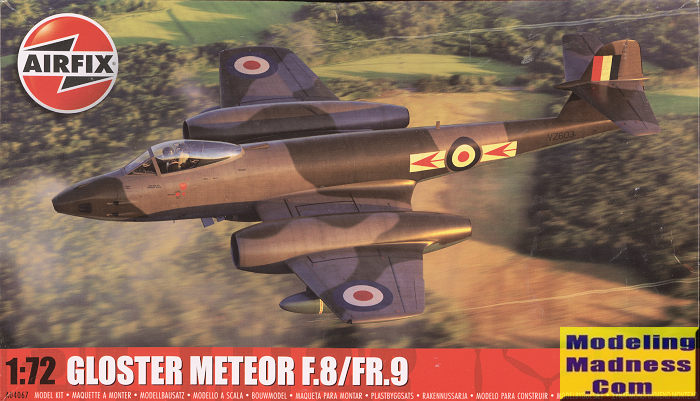
The first viable Allied jet fighter was the Meteor. Such was the ability
of the airframe to accept newer and newer engines that Meteors were flying in
the skies of the world for many years and in cases decades after the initial
aircraft first flew. Much of the success of the Meteor was that it was a basic
aircraft and other than its power plants, did not break any new ground.
Not only that, but the type was easy to fly and easy to maintain, a
trait that put it in good staid with the export market, where it sold well. It
was also developed into a viable night fighter and even decades after it was out
of front line service, there were Meteors flying in specialty roles such as
drones and ejection seat testing. I'm not sure if any are in the hands of war
bird enthusiasts, but I would be surprised if there was not at least one.
The ultimate fighter version was the F.8. This was the third major
production type following the F.3 and F.4. It can be easily identified from the
previous variants by the more square tail and longer length, which allowed great
fuel capacity. A photo recon version with a different nose section, but keeping
the same armament was the FR.9 and used for tactical reconnaissance.
It was nice to see Airfix release this kit as previously, what was
available in this scale was only in short run from Special Hobby as well as the
ancient Frog offering or the very difficult Merlin kit. There were also some
conversion sets and vacuform kits. Probably missed some, but I'm old and I can do that.
First thing I notice is that the box is crammed with sprues. A
quick build kit this is not with 154 parts. There are several options. The main
one is that you can do the F.8 fighter or the FR.9 reconnaissance fighter. The
difference is in the nose with the FR.9 having camera windows. Another option is
to make it gear up, though you'll have to source the display stand from
somewhere. You can choose to leave off the wing and belly tanks. Also optional
are open or closed speed brakes and an open or closed canopy. You are given a
choice of large or small intakes as well.
It is hard to tell where the majority of bits are to be placed, but
the cockpit/nose gear well would be an appropriate place to start. 13 of the 79
construction steps are dedicated to this area. Before closing the fuselage
halves, you are instructed to place 8 grams of weight under the cockpit. Good
luck getting that much to fit under there. Howerver there is room for more in
the general area.
before dealing with the wings, one will have to decide if they want
to open holes for the fuel tanks. Then it is time to install the front and rear
spars that also serve as attachment points for the main gear wells, exhaust and
intake bits. After attaching the wings, the aileron halves are joined and
installed along with the intakes of choice and the exhaust fairings.
That brings us to step 38, which starts us assembling and
installing the tailplanes. Then we move to the nose and build up the rest of the
nose gear attachment points before assembling our choice of nose halves and
attaching those. When it comes to landing gear, the wheels are in right and left
halves and keyed to fit into slots on each gear half. Gear doors have hinges so
no butt joins on this one.
The finishing steps involve attaching speed
brakes, some smaller bits like shell ejector cutes, then the windscreen and
canopy. Only the later canopy is provided so you cannot really do an early F.8
with the additional metal part on the rear of the glass unless you want to get
creative with masking. A pilot is included if you wish to use one.
Instructions are standard fare for Airfix
with bits of color included to show previously installed items, a feature I
really like. All color information during the build is by Humbrol paint number.
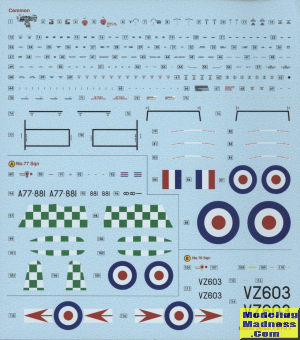
Two options are included. One is the box art plane from 79 Squadron RAF in the
day fighter scheme with PRU blue undersides. This was standard for tactical
recon planes. The other is a 77 Squadron RAAF plane in overall high speed silver
with white and green checkers on the fin. The speed fairing will need to be
painted to match. An extensive stencil suite is also included. This is something
I rarely completely use, but the choice is your. Decals are nicely printed and
there are aftermarket options if you want something different.
August 2025
Copyright ModelingMadness.com. All rights reserved. No
reproduction in part or in whole without express permission.
If you would like your product reviewed fairly and fairly quickly, please
contact the editor or see other details in the
Note to
Contributors.
Back to the Main Page
Back to the Review
Index Page
Back to the Previews Index Page