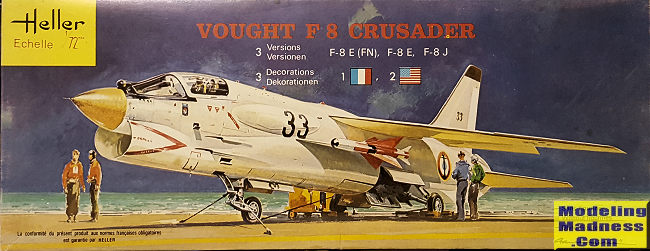
| KIT #: | 259 |
| PRICE: | $ |
| DECALS: | Three options |
| REVIEWER: | Scott Van Aken |
| NOTES: | Initial 1978 release |
| HISTORY |
The F-8 was used probably more intensely by the Marines in combat than by the Navy. There were no Marine aces during Vietnam and that is because they were using their F-8s to move mud, and lots of it. Sure, they carried Sidewinders just in case they got lucky, but the NVAF never flew any missions south of the DMZ (that I know of) to help support their troops, so the Marines had to be content with blowing up things on the ground.
The F-8E, which is the subject of this kit, is actually the same as the old F8U-2N. That meant it had better navigation systems that allowed it to operate in all types of weather, hence the (AW) in the unit designator of Marine squadrons that flew this version. Some of the distinguishing features of the F-8E over the earlier variants are the afterburner coolant scoops, the ventral fins, and the 'humped' area over the wing. It also carried wing pylons that enabled the aircraft to haul ordnance. Many were upgraded to J standards. The F-8 finally left service when the F-14 started to enter fleet squadrons and left lots of extra Phantoms around for the reserves.
| THE KIT |
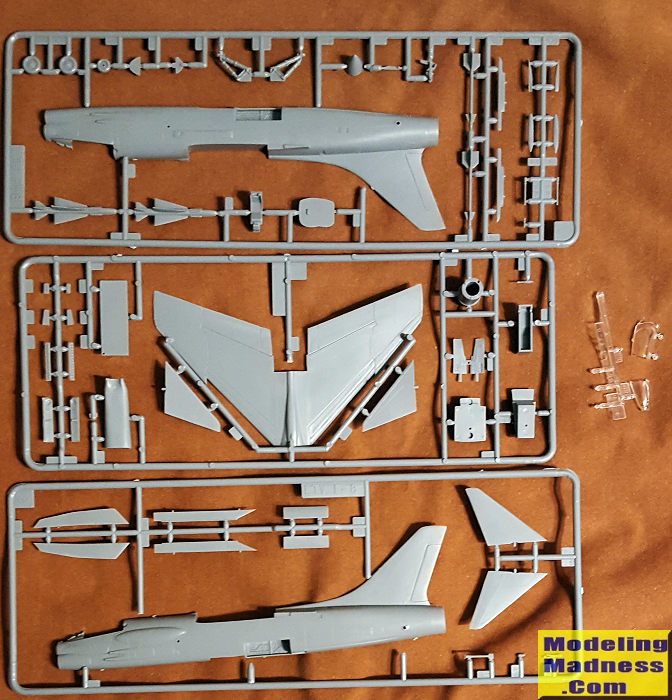 From
what I've been able to determine, the first injected kit of this aircraft in
1/72 scale was by Fujimi in 1968. This kit was really 1/70 scale but
marketed as 1/72. I built this kit way back when and found it not to be the
best kit I've ever built so would recommend to anyone considering it to stay
away. Next was this one by Heller in 1978, followed by the Hasegawa offering
in 1979. Both of these are raised panel lines with many at the time
preferring the Heller kit as the ventral strakes on the Hasegawa kit are the
wrong shape. In 1988, ESCI did one with engraved panel lines and modelers
flocked to that one. This kit was also released by AMT and while I've not
built it, it looks nice in the box. Many years later, Academy did the F-8
and that has since been the kit to get when modeling the Crusader in this
scale.
From
what I've been able to determine, the first injected kit of this aircraft in
1/72 scale was by Fujimi in 1968. This kit was really 1/70 scale but
marketed as 1/72. I built this kit way back when and found it not to be the
best kit I've ever built so would recommend to anyone considering it to stay
away. Next was this one by Heller in 1978, followed by the Hasegawa offering
in 1979. Both of these are raised panel lines with many at the time
preferring the Heller kit as the ventral strakes on the Hasegawa kit are the
wrong shape. In 1988, ESCI did one with engraved panel lines and modelers
flocked to that one. This kit was also released by AMT and while I've not
built it, it looks nice in the box. Many years later, Academy did the F-8
and that has since been the kit to get when modeling the Crusader in this
scale. 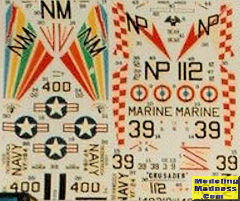 As
mentioned, my instructions are incomplete, but Heller instructions of the
time were basically a single exploded view with some detail illustrations,
in this case for the cockpit arrangement. Scalemates states there were three
markings options. The two USN offerings were with VF-24 and VF-194 while the
French option is with 12F. All three planes would be in light gull grey over
white. I'm sure that even if I did have the decals, they'd be useless so it
is a good thing that there are a number of aftermarket sheets that could be
used. The image for the sheet was snagged from the 'net.
As
mentioned, my instructions are incomplete, but Heller instructions of the
time were basically a single exploded view with some detail illustrations,
in this case for the cockpit arrangement. Scalemates states there were three
markings options. The two USN offerings were with VF-24 and VF-194 while the
French option is with 12F. All three planes would be in light gull grey over
white. I'm sure that even if I did have the decals, they'd be useless so it
is a good thing that there are a number of aftermarket sheets that could be
used. The image for the sheet was snagged from the 'net. | CONCLUSIONS |
November 2021
If you would like your product reviewed fairly and fairly quickly, please contact the editor or see other details in the Note to Contributors.