
ICM 1/72 He-70G
| KIT #: | 72233 |
| PRICE: | $30.95 SRP |
| DECALS: | Two options |
| REVIEWER: | Scott Van Aken |
| NOTES: |
| HISTORY |
The Heinkel He 70 Blitz was designed in the early 1930s to serve as a fast mailplane for Deutsche Lufthansa. The He 70 was developed in response to Lufthansa request for a faster aircraft than the Lockheed Vega and Orion (as used by Swissair) for employment on short routes. It was a low-wing monoplane, with the main characteristics of its revolutionary design its elliptical wing, which the Günther brothers had already used in the Bäumer Sausewind sports plane before they joined Heinkel, and its small, rounded control surfaces. In order to meet the demanding speed requirements, the design minimised drag, with countersunk rivets giving a smooth surface finish and a retractable undercarriage, a novel feature for a German aircraft. It was powered by a BMW VI V-12 engine, cooled by ethylene glycol rather than water, allowing a smaller radiator and therefore reducing drag. The pilot and radio operator were seated in tandem, with a cabin housing four passengers on two double seats facing each other.
The first prototype flew on 1 December 1932, and proved to have excellent performance, setting eight world records for speed over distance, and reaching a maximum speed of 377 km/h (222 mph).
Lufthansa operated He 70s between 1934 and 1937 for fast flight service which connected Berlin with Frankfurt, Hamburg and Cologne, as well as the Cologne/Hamburg route. Lufthansa He 70s were flown abroad from Stuttgart to Sevilla between 1934 and 1936. Remaining aircraft were transferred to the Luftwaffe in 1937.
| THE KIT |
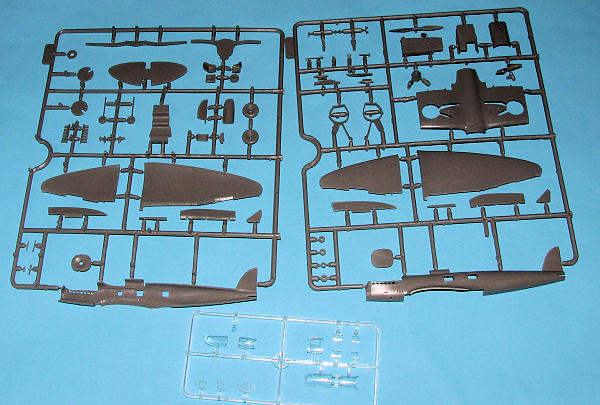 ICM's
second He-70 kit is nicely molded in a standard grey plastic. It has a bit
of flash on a few parts and I did notice a few sink areas and what looked
like some slightly short shot areas around the lower wing wheel well area.
Not sure if short shot is the right word, but it looks like an upper layer
of plastic has been removed along with the detail. Fabric representation is
quite subdued and is something most will appreciate. The kit provides
separate flaps, rudder and ailerons. Wing spars are there to help with wing
alignment.
ICM's
second He-70 kit is nicely molded in a standard grey plastic. It has a bit
of flash on a few parts and I did notice a few sink areas and what looked
like some slightly short shot areas around the lower wing wheel well area.
Not sure if short shot is the right word, but it looks like an upper layer
of plastic has been removed along with the detail. Fabric representation is
quite subdued and is something most will appreciate. The kit provides
separate flaps, rudder and ailerons. Wing spars are there to help with wing
alignment. Instructions
are a standard sheet of paper printed on both sides. As mentioned in the
previous He-70F article, this uses a CAD design which is fine unless the
printing is too washed out or too dark. Paint references are generic and
Model Master. There is a separate half sheet that provides the two markings
options. Both are pretty much identical except for the aircraft name
and the last letter of the registration number. The overall color is said to
be RLM 63. I don't think this is correct as Lufthansa had a bluish light
grey they used for all their aircraft and RLM 63 is definitely a green-grey
color. The nose on both of them is to be painted black before applying the
decals. Decals are quite nicely printed. I'm not sure if the tricolor tail
marking should be on both sides of the fin as it seems to me that sometime
in the mid-1930s there was a red band with white circle and swastika on one
side. In fact, if you look at the box top photo, you can see this on the
left side.
Instructions
are a standard sheet of paper printed on both sides. As mentioned in the
previous He-70F article, this uses a CAD design which is fine unless the
printing is too washed out or too dark. Paint references are generic and
Model Master. There is a separate half sheet that provides the two markings
options. Both are pretty much identical except for the aircraft name
and the last letter of the registration number. The overall color is said to
be RLM 63. I don't think this is correct as Lufthansa had a bluish light
grey they used for all their aircraft and RLM 63 is definitely a green-grey
color. The nose on both of them is to be painted black before applying the
decals. Decals are quite nicely printed. I'm not sure if the tricolor tail
marking should be on both sides of the fin as it seems to me that sometime
in the mid-1930s there was a red band with white circle and swastika on one
side. In fact, if you look at the box top photo, you can see this on the
left side. | CONCLUSIONS |
Despite the molding glitch, the overall look of the parts is that it will make into a very nice model. Though not the first He-70 kit done, it may very well be the best.
| REFERENCES |
http://en.wikipedia.org
August 2009 If you would like your product reviewed fairly and quickly, please
contact
me or see other details in the
Note to
Contributors.