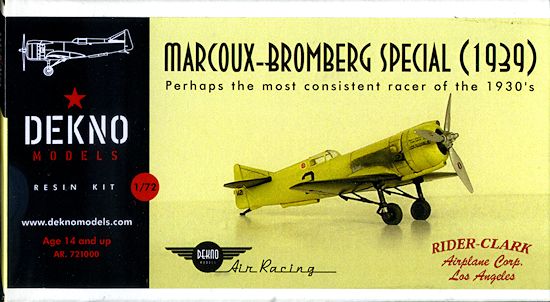
Dekno 1/72 Marcoux-Bromberg Special (1939)
| KIT #: | 721000 |
| PRICE: | 30 euros |
| DECALS: | One option |
| REVIEWER: | Scott Van Aken |
| NOTES: | Resin kit |
| HISTORY |
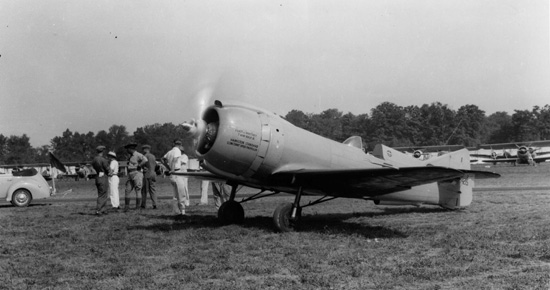 lap at 278 mph,
and took second place in the race at an average speed of 248 mph. It also
took second place at the Thompson race in 1937, and 1938, and third in 1939.
In 1936 it won the Golden Gate Trophy and in 1937 took second in the Bendix
Transcontinental, making it one of the most consistently successful air
racers of the 1930s. It was powered successively by Pratt & Whitney Wasp
Jr., Wasp and finally a Twin Wasp Jr. Special. The aircraft was also
featured in the Clark Gable movie, "Test Pilot." Fans of 1930s racers will
be pleased to know that the aircraft is still extant and is an exhibit at
the New England Air Museum.
lap at 278 mph,
and took second place in the race at an average speed of 248 mph. It also
took second place at the Thompson race in 1937, and 1938, and third in 1939.
In 1936 it won the Golden Gate Trophy and in 1937 took second in the Bendix
Transcontinental, making it one of the most consistently successful air
racers of the 1930s. It was powered successively by Pratt & Whitney Wasp
Jr., Wasp and finally a Twin Wasp Jr. Special. The aircraft was also
featured in the Clark Gable movie, "Test Pilot." Fans of 1930s racers will
be pleased to know that the aircraft is still extant and is an exhibit at
the New England Air Museum.
| THE KIT |
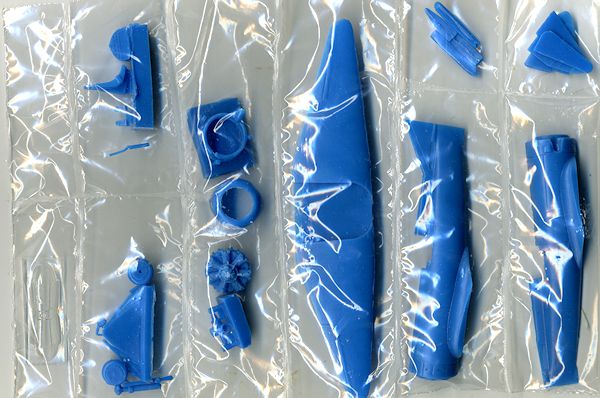 Molded
in a fetching blue resin, the kit is superbly packaged in a compartmentalized
poly-bag as you see. Only the prop blades were separate and in the box. The box
itself is rather neat being like an old fashioned matchbox where the parts tray
slides into a cover. The resin itself is superbly done. I saw no air bubbles or
voids in any of the parts, just a bit of roughness around the edges that will be
easily cleaned up.
Molded
in a fetching blue resin, the kit is superbly packaged in a compartmentalized
poly-bag as you see. Only the prop blades were separate and in the box. The box
itself is rather neat being like an old fashioned matchbox where the parts tray
slides into a cover. The resin itself is superbly done. I saw no air bubbles or
voids in any of the parts, just a bit of roughness around the edges that will be
easily cleaned up.
The fuselage has framework detail on the inside and
the interior provides the basics; seat, instrument panel, control stick and
rudder pedals. The wing is a single piece and fits under the fuselage. Rudder
and tail planes are butt join pieces. There is a separate exhaust collector t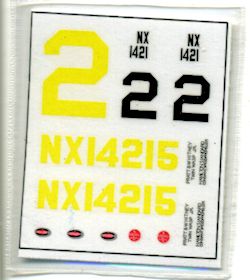 hat
fits on the rear of the nicely done engine. Over this fits a one-piece cowling
with long carb and oil cooler intakes. I noticed that the upper intake is offset
to the left. Landing gear are basic and well done with the very fine retraction
struts molded into a resin pour block. A tail skid is provided for the rear. The
prop has a hub and separate blades that slot into holes in the hub. That pretty
well cover it. It is a racing plane so is understandably a bare bones aircraft.
Two vacuformed canopies are included.
hat
fits on the rear of the nicely done engine. Over this fits a one-piece cowling
with long carb and oil cooler intakes. I noticed that the upper intake is offset
to the left. Landing gear are basic and well done with the very fine retraction
struts molded into a resin pour block. A tail skid is provided for the rear. The
prop has a hub and separate blades that slot into holes in the hub. That pretty
well cover it. It is a racing plane so is understandably a bare bones aircraft.
Two vacuformed canopies are included.
The instructions are well done with five well drawn construction steps that include color information. The aircraft itself is what I'd call Canary Yellow with black wings and horizontal stabilizers. There is a small decal sheet that includes all of the registration and racing numbers applied to the plane.
| CONCLUSIONS |
If you like to build racing aircraft that don't take up a lot of shelf space, then these Dekno kits are for you. They do require some skills to build as do all resin kits, but the end result will be a superb little model of a most successful 1930s racer.
January 2014
Thanks to Dekno Models for the preview kit. You can buy yours direct by visiting the link.
If you would like your product reviewed fairly and fairly quickly, please contact the editor or see other details in the Note to Contributors.