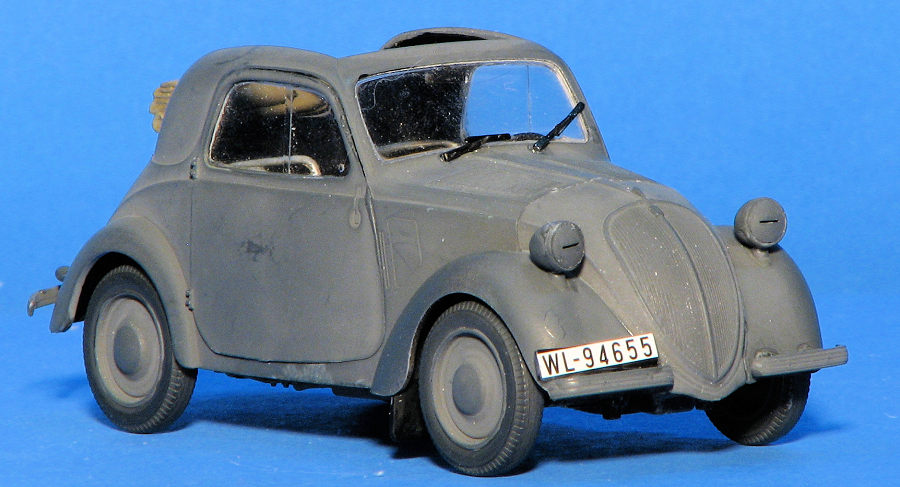
| KIT #: | 35321 |
| PRICE: | $18.27 on sale ($29.00 SRP) |
| DECALS: | Three options |
| REVIEWER: | Scott Van Aken |
| NOTES: | Recent tool kit |
| HISTORY |
The Simca 5 is a small Franco-Italian passenger car designed, by Fiat engineers at Turin. It was produced and sold in France by Simca. It was virtually identical to the Fiat 500 Topolino on which it was based, but was first presented, at the company's new Nanterre plant, three months ahead of the Fiat equivalent on 10 March 1936. Production was delayed, however, by a wave of strikes, that accompanied the June 1936 electoral victory of Léon Blum's Popular Front government.
Advanced features boasted by the Simca 5 included independent front suspension, a four speed gear box, hydraulically controlled drum brakes on all four wheels and a twelve volt electrical system.
 The car also offered exceptional fuel economy (in a
test it managed to travel 110 kilometers on just 5 litres of fuel).
The car also offered exceptional fuel economy (in a
test it managed to travel 110 kilometers on just 5 litres of fuel).
The car was intended for sale on the domestic market for less than 10,000 French Francs, an aspiration that would be overtaken by a decline in the currency's value that gathered pace in the second half of the 1930s. The manufacturer boasted at the time of its launch of being ahead of the plans across the Rhine: this was a reference to the already rumoured launch of the Volkswagen Beetle which would appear only in 1938.
Production of the Simca 5 was slowed down (but did not ever cease entirely) by the war and the period of German occupation in the early 1940s, but resumed in 1946. 46,472 of the cars had been produced by the time the car was delisted by Simca in 1949. By now it had been replaced on the company's production lines by the similar but partially reskinned and slightly more powerful Simca 6.
| THE KIT |
Coming soon after the release of Bronco's Fiat Topolino, the Tamiya version does not have the parts count of the Bronco kit, mainly due to the lack of an engine and overall simplified construction. This is pretty much a Tamiya trait as the idea seems to be to provide a kit that fits well with enough detail to please most.
As such the insides of the door are bare (you will
need to remove some ejector pin marks thanks to the open top). The doors are
separate but not shown as being able to be built open, though that
 should be
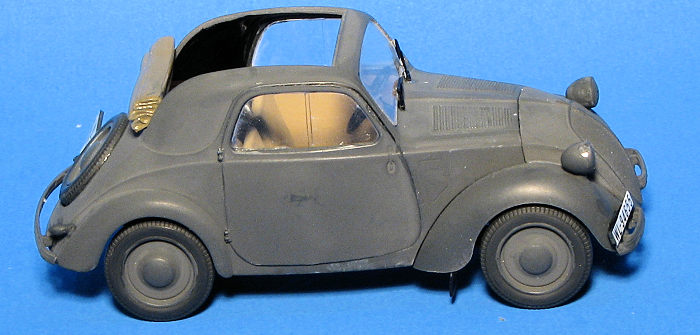
easy enough. You have options for open or closed windows. Also optional are the
use of standard or slit headlights. The dash has decals for instruments which is
a nice touch in this scale. Mud flaps are available for behind the front wheels
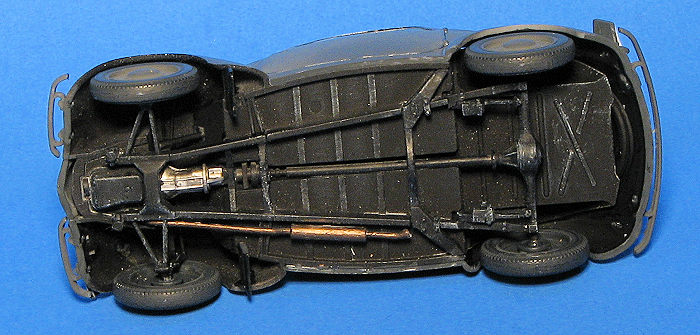
and there is a lower engine section combined with the front suspension piece so
when you turn it over you have something to see. Wheels are two piece plastic
with the outer rim and tire
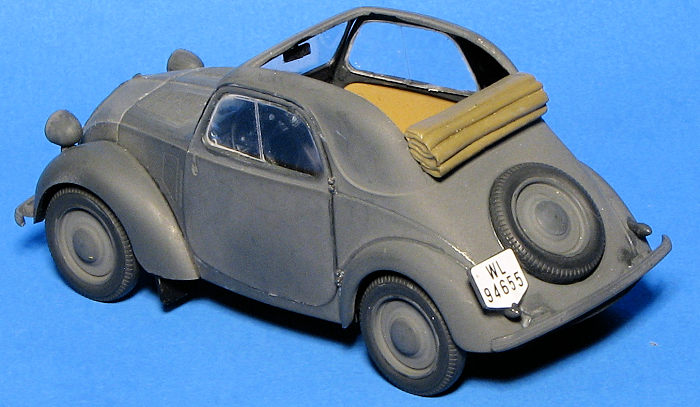
molded as one piece. The top can only be modeled in the lowered position. I
would have liked to have seen a top up option provided. A driver figure is
included as well.
should be
easy enough. You have options for open or closed windows. Also optional are the
use of standard or slit headlights. The dash has decals for instruments which is
a nice touch in this scale. Mud flaps are available for behind the front wheels
and there is a lower engine section combined with the front suspension piece so
when you turn it over you have something to see. Wheels are two piece plastic
with the outer rim and tire
molded as one piece. The top can only be modeled in the lowered position. I
would have liked to have seen a top up option provided. A driver figure is
included as well.
Instructions are standard Tamiya, being the long vertically folded sheet we often see with these smaller parts count kits. All paint references are Tamiya. The small decal sheet has three sets of license plates. You have two options in overall gloss German grey; one with the luftwaffe and one with the 3rd Infantry Division. The other is a civilian car in gloss black. You can find other colors if you do an internet search, some of which are quite interesting.
| CONSTRUCTION |
I took the usual steps for me when I do cars and actually followed the instructions. But first I did a lot of prepainting. Basically I chose to do a staff car so a lot of the parts were painted with Tamiya German Grey. I then painted the back part of the car with a sand shade and the rolled up top with khaki, both of these also Tamiya paints. The interior of the car was painted semi-matte black as was the inside of the body. I know it is a bit weird doing the colors and markings section right off the bat, but that was how it turned out.
 When I
started building the front and rear suspension, I realized that prepainting
those areas black was not a very wise move as I had difficulty seeing the cement
attachment points. Lesson learned for the next vehicle build. I also learned
that one has to install the exhaust when the instructions state. I left that off
until near the end and had to do some cutting on it to get it to actually fit.
When I
started building the front and rear suspension, I realized that prepainting
those areas black was not a very wise move as I had difficulty seeing the cement
attachment points. Lesson learned for the next vehicle build. I also learned
that one has to install the exhaust when the instructions state. I left that off
until near the end and had to do some cutting on it to get it to actually fit.
The kit's wheels are not full in that the tires are open on the inside, obviously assuming you won't see that on the completed model. That is true unless you turn the model over, as happens in contests. I am not sure why Tamiya did this as it is a fairly recent tooling.
One area that gave me fits was installing the clear parts. They just did not seem to want to go into the designated channels. I'll blame prepainting as I've run into issues on other Tamiya kits where prepainted parts don't fit. I also had one of the side window pieces slip during drying, causing an issue. I left it. The last thing I did was to attach the wheels. It all seems to have worked out well as all four tires touch a plate of glass with no wobbling. I chose the Luftwaffe version as I didn't want to gloss coat areas for the army unit decals.
| CONCLUSIONS |
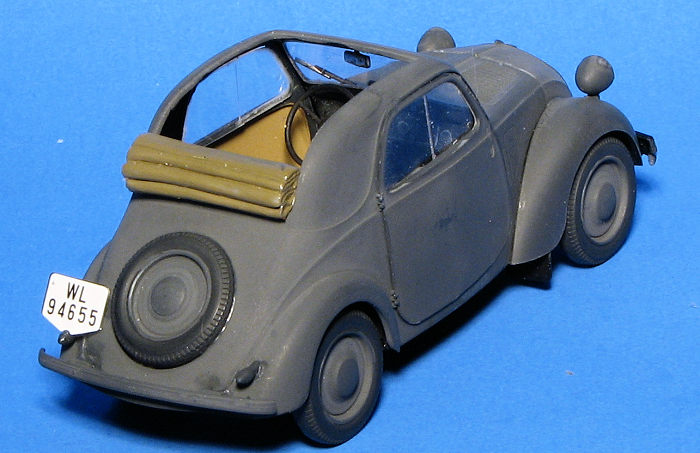 It seems
that nearly every kit I build as of late has some sort of disaster of varying
degrees. This one was small and the end result is pleasing. It was a fairly
quick build as the kit is quite small and doesn't really have a lot of parts.
The only pieces I didn't use were the civilian headlights and the driver figure.
It seems
that nearly every kit I build as of late has some sort of disaster of varying
degrees. This one was small and the end result is pleasing. It was a fairly
quick build as the kit is quite small and doesn't really have a lot of parts.
The only pieces I didn't use were the civilian headlights and the driver figure.
| REFERENCES |
http://en.wikipedia.org/wiki/Simca_5
29 August 2025
Copyright ModelingMadness.com. All rights reserved. No reproduction in any form without express permission from the editor.
If you would like your product reviewed fairly and fairly quickly, please contact the editor or see other details in the Note to Contributors.