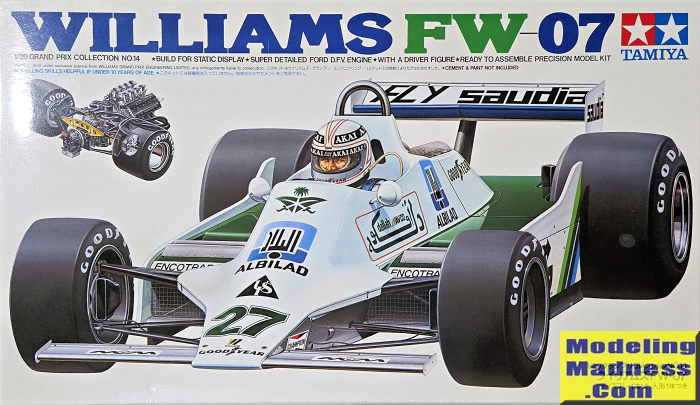
Tamiya 1/20 Williams FW-07
| KIT #: | 20014 |
| PRICE: | $25.95 when new |
| DECALS: | Two car number options |
| REVIEWER: | Scott Van Aken |
| NOTES: | 1980 release |
| HISTORY |
The 1979 Williams FW-07 was closely based on the Lotus 79, even being developed in the same wind tunnel at Imperial College London. Some observers, among them Lotus aerodynamicist Peter Wright felt the FW07 was little more than a re-engineered Lotus 79, just having a stiffer chassis. The car was small and simple and extremely light, powered by the ubiquitous Ford Cosworth DFV. It had very clean lines and seemed to be a strong challenger for the new season, but early reliability problems halted any serious threat for the title. While not the first to use ground effects in Formula One, an honour belonging to Colin Chapman and the Lotus 78 (the Lotus 79's predecessor), Dernie may have had a better grasp of the principles than even Chapman. While Head had been developing the Lotus 78's/79's basic principles in the FW07, Chapman's design team was attempting to take the ground effect idea further ahead of rivals on the Lotus 80 engaging the entire bottom of the chassis as an aerodynamic device for generating downforce without the necessity of external wings.
After a rough start of the year with many technical issues, the car proved to be nearly unbeatable in the second part of the season. The car was upgraded for the 1980 season and did equally as well. By 1981, the other teams had caught up and it was the last year of the basic design.
| THE KIT |
 Tamiya
decided to make 1/20 scale to be their standard for open wheel racers and it has
become one that other kit makers have generally followed.
The benefit of this scale is larger parts and this makes
for an easier build.
Tamiya
decided to make 1/20 scale to be their standard for open wheel racers and it has
become one that other kit makers have generally followed.
The benefit of this scale is larger parts and this makes
for an easier build.
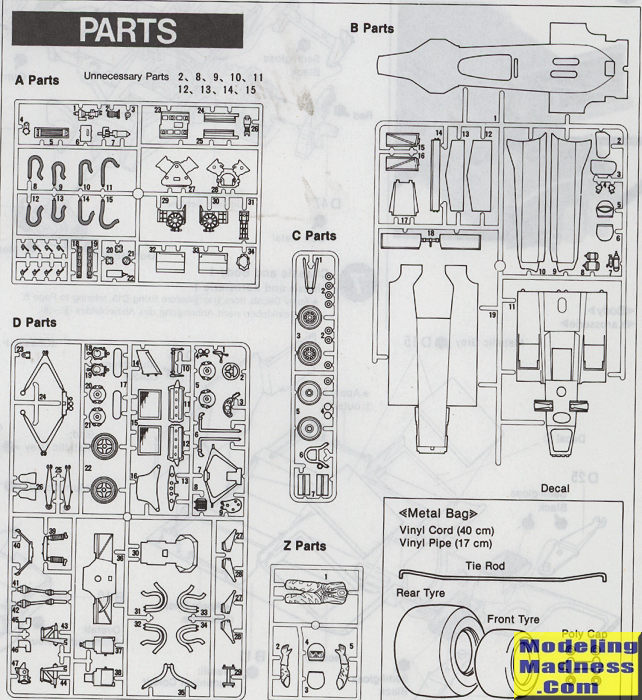
This kit is molded in white, grey and aluminum plated plastic. There is a bag with the rubber tires, the poly caps, a metal rod for the front steering, and a selection of flexible tubing for engine wiring.
As you might guess, the majority of the construction revolves around building the engine and rear suspension as it is all basically a single subassembly. I do appreciate that Tamiya plated the rear wheels in aluminum instead of chrome. Speaking of colors, this kit was developed before Tamiya brought out their extensive line of paints so all of the colors are generic. There is a nicely done cockpit into which a driver figure can be placed. If you leave it bare, then it would be worthwhile to look for an aftermarket seat harness.
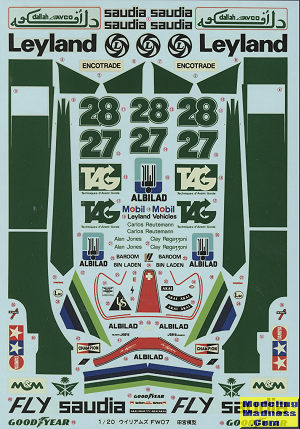 Like most
race car kits, this is one that will require you to paint things as you go. The
majority of the large parts are gloss white, hence the white plastic for the
body parts. Typical of Tamiya car kits, the external body colors aside from the
white, are provided on the decal sheet. This eliminates the need to do a lot of
masking and possible issues with matching paint and decals.
Like most
race car kits, this is one that will require you to paint things as you go. The
majority of the large parts are gloss white, hence the white plastic for the
body parts. Typical of Tamiya car kits, the external body colors aside from the
white, are provided on the decal sheet. This eliminates the need to do a lot of
masking and possible issues with matching paint and decals.
Two sets of instructions are provided. One in Japanese and the other in English and German. There is livery for one car with two different numbers and three different drivers. The sheet is well done and is typical old Japanese with off-white whites. You can do either the 1979 Dutch GP cars or the 1979 Brazilian GP cars which had slightly different sponsorship markings. For those wanting some newer decals, IndyCals does replacement sheets for either the #27 or #28 car at the Dutch GP. The IndyCals sheet does not include the helmet decals.
| CONCLUSIONS |
These early Tamiya 1/20 GP cars are well worth seeking out. They are often less fiddly builds and have generally simpler color/decal schemes. I know that the last ones I built turned out very well and I expect the same from this one.
| REFERENCES |
https://en.wikipedia.org/wiki/Williams_FW07
August 2025
Copyright ModelingMadness.com. All rights reserved. No
reproduction in part or in whole without express permission.
If you would like your product reviewed fairly and fairly
quickly, please
contact
the editor
or see other details in the
Note to
Contributors.