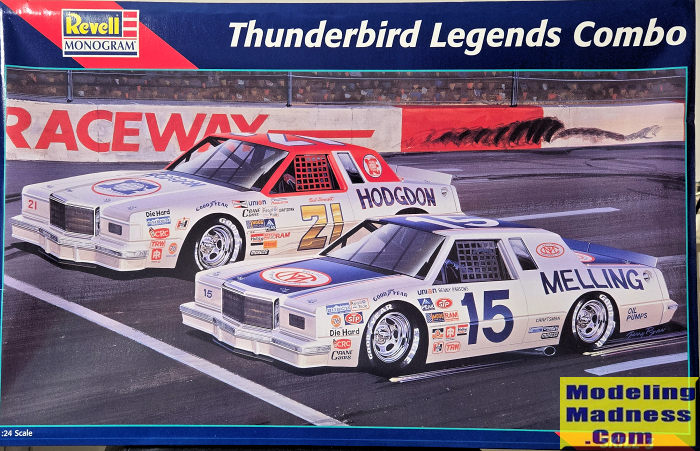
Revell-Monogram 1/24 Thunderbird Legends Combo
| KIT #: | 6857 |
| PRICE: | $25.00 when new |
| DECALS: | Two options |
| REVIEWER: | Scott Van Aken |
| NOTES: | Two full kits. 1997 release |
| HISTORY |
Benny Parsons started racing in the No. 15 Bud Moore Ford Thunderbird in 1981. He had wins at Nashville Speedway USA, the final race at Texas World Speedway, and Richmond. In addition, he received his final top-ten points finish, finishing tenth that year.
Parsons qualified for the 1982 Winston 500 at Talladega Superspeedway at 200.175 miles per hour (mph), which was the first NASCAR qualification run over 200 mph (322 km/h).
He amassed 21 Cup wins before retiring in 1998 and moving on to the broadcasting booth. He died in 2007.
| THE KIT |
Back from the mid-1980s until the late 1990s, the major US model makers hit upon a gold mine; NASCAR. During those years a bewildering number of cars and liveries were produced; mostly by AMT and Revell-Monogram. These kits were surprisingly similar in the way they built, but that was undoubtedly due to the simple fact that the real cars were built to a set of rules so there was little difference on the inside with only the bodies and liveries changing.
During that period, Revell-Monogram came up with the idea of doing combo kits, where two full NASCAR kits were in one box. These kits generally had a common theme and in this case it was 1981-82 Thunderbirds. What was particularly nice about these kits is that often they provided bodies that were not previously available in the 'standard' series of kits produced each year. In this case they were cars driven by Neil Bonnett and Bennie Parsons, drivers well known during the time and both were fairly successful.
The plastic for the two cars is identical. Each comes with a chrome sprue for wheels and engine bits. Most modelers will keep the chrome on the wheels as those are accurate, but strip the chrome from engine bits as, for the most part, those were either aluminum or painted.
 A
full engine and suspension is provided, which offers a good amount of detail and
room for improvement should the modeler be so inclined. The frame includes the
interior floor to which the seat, roll cage and other interior bits are
attached. The roll cage is extensive and the builder will spend quality time
removing the mold seam from the cage parts. Clear parts fit to the inside of the
body so one will want to paint these prior to installation. These cars can be
fairly quick builds and if you have done one, you will soon find them easy.
A
full engine and suspension is provided, which offers a good amount of detail and
room for improvement should the modeler be so inclined. The frame includes the
interior floor to which the seat, roll cage and other interior bits are
attached. The roll cage is extensive and the builder will spend quality time
removing the mold seam from the cage parts. Clear parts fit to the inside of the
body so one will want to paint these prior to installation. These cars can be
fairly quick builds and if you have done one, you will soon find them easy.
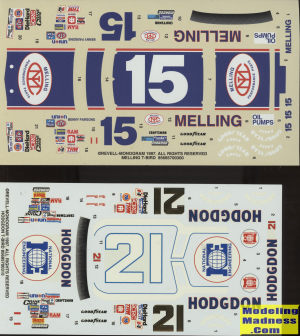
Instructions are standard fare for the time and provide both names and colors for the various parts. For the most part, these cars had light grey interiors so it was easy to see interior components. Both cars are basically white. The #21 car has a red roof that was typical of the Wood Brothers' cars so you will have to do some masking for that one. The instructions clearly state that the decals are NOT compatible with setting solutions. Past experience shows that they stick quite well on a gloss surface. Despite being over 25 years old, they should not offer any issues other than perhaps being thicker than today's decals. Not sure if aftermarket are available as several years back, NASCAR started suing all the aftermarket makers and the market dried up.
| CONCLUSIONS |
While NASCAR modeling isn't dead, those few new kits are expensive (as in $35-40) and are generally more recent cars. These older kits are not difficult to find and are generally quite reasonably priced, especially at swap meets and shows.
| REFERENCES |
https://en.wikipedia.org/wiki/Neil_Bonnett
July 2025
Copyright ModelingMadness.com. All rights reserved.
No reproduction in part or in whole without express permission. If you would like your product reviewed fairly and fairly quickly, please
contact
the editor
or see other details in the
Note to
Contributors.