 Germany's
rocket program was really on-going since the 1920s, though until the war got
well underway, it was the purview of civilian clubs. These enthusiasts managed
to develop working rockets and once Hitler got into power, those in his sphere
of influence felt that this should be brought into military control. There were
many scientists who contributed to the increasingly sophisticated design and
development of rockets and quite a few of them were whisked away to the US post
war to work on various US projects. But I'm getting ahead of myself.
Germany's
rocket program was really on-going since the 1920s, though until the war got
well underway, it was the purview of civilian clubs. These enthusiasts managed
to develop working rockets and once Hitler got into power, those in his sphere
of influence felt that this should be brought into military control. There were
many scientists who contributed to the increasingly sophisticated design and
development of rockets and quite a few of them were whisked away to the US post
war to work on various US projects. But I'm getting ahead of myself.
It wasn't until 1942/43 that a great deal of effort was
put into these programs. A dedicated lab/factory/launch complex was built on the
island of Peenemunde on the Baltic Sea coast. It was here that the two most well
known of the V-weapons were developed to maturity; the V-2 ballistic missile and
the V-1 cruise missile. Both programs consumed a great deal of funds that could
have been used elsewhere and while they were both successful, their overall
impact in the war was minimal. The third program, the V-3 was a static gun of
sorts that used cascading explosive charges to boost a shell, giving it great
range. This program never actually reached operational service, though various
tests showed the theory to be sound. Unlike the other V-weapons, this one was
static and could not be moved once built. As a side note, the theory for the V-3
was also planned for the Iraqi regime of Saddam Hussein, but was never actually
built, though components were gathered for construction.
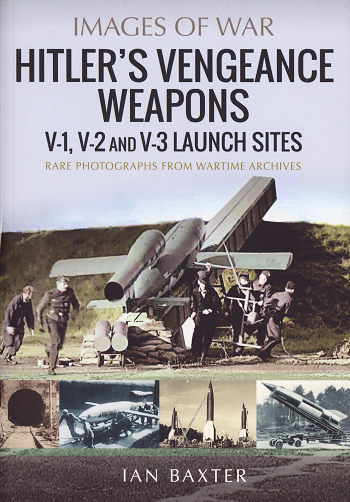
This is a photo book so there is a brief historical
background provided for each of the projects. The majority of the images are, as
alluded in the book title, the various launching sites and in many cases, the
remnants of some of the larger ones. These fixed sites were major targets for
Allied bombing once discovered and surprisingly, some of them are still extant.
This is mainly due to the inability of bombs to penetrate and the later
inability to destroy and get rid of the mass of concrete and rebar used to build
them.
This is another excellent addition to a fine series and
one that I can easily recommend to both the historian and modeler alike.
October 2026
Copyright ModelingMadness.com. All rights reserved.
Review book courtesy of
Casemate Publishers, where you can order your copy
at this link.
If you would like your product reviewed fairly and
fairly quickly, please
contact
the editor or see other details in the
Note to
Contributors.