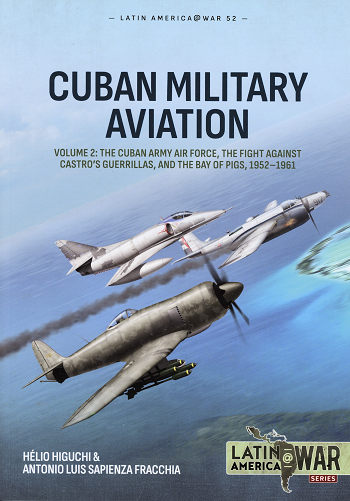
 One
of the more aviation-progressive nations of Central America was the island
nation of Cuba. The first volume covered Cuba's aviation history up to the
mid-1950s. By that time, Cuba had a pretty hefty military aviation that was
basically made from WWII era aircraft. This included B-26 Invaders, P-47
Thunderbolts and T-6 trainers. The service wasn't free of jet aircraft as they
eventually got a number of T-33s, each of which had wing pylons and a pair of
nose .50 caliber machine guns. All of the B-26s were the 'glass nose' B-26C
variants. Despite the attempts at getting jet fighters, that was not immediately
forthcoming.
One
of the more aviation-progressive nations of Central America was the island
nation of Cuba. The first volume covered Cuba's aviation history up to the
mid-1950s. By that time, Cuba had a pretty hefty military aviation that was
basically made from WWII era aircraft. This included B-26 Invaders, P-47
Thunderbolts and T-6 trainers. The service wasn't free of jet aircraft as they
eventually got a number of T-33s, each of which had wing pylons and a pair of
nose .50 caliber machine guns. All of the B-26s were the 'glass nose' B-26C
variants. Despite the attempts at getting jet fighters, that was not immediately
forthcoming.
The mid-1950s were also a time of what we could easily call a time of
civil war with the Castro brothers and Che Guevara doing what they could to
remove the US supported dictatorship of Fulgencio Batista. Not surprising was
that Batista came into power via overthrowing the previous democratically
elected government, part of many such events that had plagued Cuba and other
Latin American nations.
Though Cuba had a fairly large and well equipped Army, it was the Air
Force that seemed to be the most effective. The pilots had been trained in the
US and the service had a fairly large fleet of C-46 and C-47 transports that
were able to keep the Army supplied during its battles against the insurgents.
Against this, the insurgents had better tactics, but other than a few light
aircraft, lacked any sort of airpower. To make a long story short, the
insurgents were able to win battles and force Batista's government off the
island. This left them with a powerful air force with few pilots as all those
loyal to the previous regime were jailed.
Eventually trained pilots were found (as in many mercenaries) and some
additional aircraft that had been ordered by the earlier government (Sea Furies)
were added to the force. This was a good thing for Castro as the P-47s had been
pretty well grounded due to lack of parts. These aircraft along with the T-33s
were put to good use during the Bay of Pigs invasion. It also helped that the
USS Essex did not intervene, though kept a close eye on things. This particular
campaign also takes up a fair amount of page space with most of the combat
sorties covered. The book stops right after that and just before Soviet aircraft
were inducted into the Air Force.
As usual the book is very well researched and quite image intensive. This is something I appreciate
and it makes for one of the quicker reads. I can imagine that doing research on
a subject like this is not the easiest, but they have pieced together quite a readable history. It makes for a
great read and I can recommend this one to you.
June 2026
Copyright ModelingMadness.com. All rights reserved. No
reproduction in part or in whole without express permission.
Review book courtesy of
Casemate Publishers, where you can order your copy
at this
link.
If you would like your product reviewed fairly and quickly, please
contact
the editor or see other details in the
Note to
Contributors.