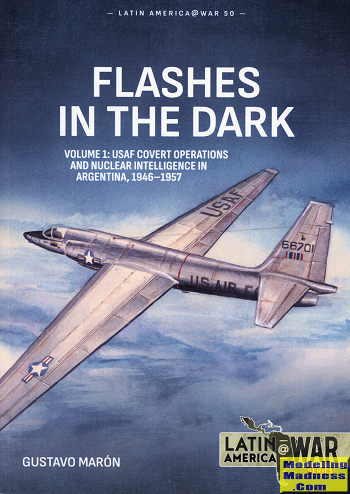
 When
the US entered the atomic age, it was assumed that the nation would hold a
monopoly on atomic weapons for at least another 15 years. Espionage and reality
changed that time table. One thing about being a nuclear power is that there
needs to be a fairly constant supply of fissionable materials. The major one is
uranium, an ore of which the US does not have the largest supply. However,
finding out where this heretofore un-desirable mineral was not the easiest task.
There are basically two ways to discover it. One is on the ground, which is time
consuming at best, and the other is to fly specially modified aircraft to sense
deposits.
At first this wasn't a pressing issue. However, a bill signed in 1946
authorized the search and acquisition of these materials. The easiest way to do
this, as mentioned, was via aircraft. As such, places where the US had
permission to fly military aircraft under the auspices of the US Geological
Survey over countries who agreed to have their nation mapped. In Latin America,
that was not a lot of countries. During the mapping surveys, equipment aboard
the aircraft (generally C-47s) also looked for deposits of strategic materials
using magnetometers.
A nation that did not agree to the mapping missions was Argentina. So
the US Air Mission in Argentina started doing clandestine missions using a
variety of transports. Basically, the itinerary would be from point A-point B,
but the actual flight would deviate considerably. This created some suspicious
circumstances when a plane crashed far off its flight plan. Later, the Argentine
dictator Peron announced that Argentina had successfully created fission in one
of its labs. This later proved to be false, but it sent a bit of a panic through
the US and so the now-USAF was directed to do missions over the lab to test for
markers of a successful test (which they never found). This unfettered USAF
freedom over the nation's air space was not appreciated and Argentina closed the
Air Mission and kicked the US out.
This was not good as in the meantime, the USSR had successfully
detonated a bomb. This was verified by air sampling which showed the traces of
the explosion. Things just got a lot more complex as air sampling for nuclear
tests became more and more of a priority. It is what led to the development of
the U-2 (which is covered in some detail in the book). This aircraft was used
'for scientific research of high altitude winds' to justify its operation. In
the meantime, Argentina had become much more US friendly and allowed the
aircraft to perform its 'weather' missions over its territory.
There is more to the story than just what I've mentioned, but I don't
want to ruin the book. Needless to say, it is a great read and has lots of
period photos and the usual great maps and color profiles. I very much recommend
this one to you and am looking forward to starting volume 2 to see where the
story takes me.
October 2026
Copyright ModelingMadness.com. All rights reserved. No
reproduction in part or in whole without express permission.
Review book courtesy of
Casemate Publishers, where you can order your copy
at this link.
If you would like your product reviewed fairly and quickly, please
contact
the editor or see other details in the
Note to
Contributors.