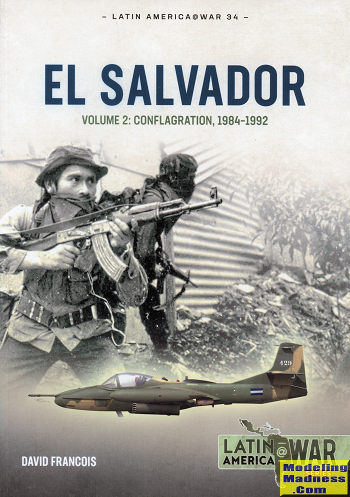
 The
1960s and 1970s were a time of turmoil in Central America. Actually, it still is
to some extent. It was a time when long running dictatorships were challenged by
an increasing communist or socialist movement. Much of this was encouraged by
the Soviet Union through their proxy; Cuba. It was felt by the revolutionaries
that too much power was concentrated in a small number of people. To be specific
those who owned most of the land and who controlled the politics of the nation.
Those of you who have studied much history will realize that this isn't
something new. However, the struggle in Central America was quite widespread
with the socialists/communists making some considerable ground. Nicaragua is a
prime example of where this was the case. Now we come to El Salvador. It is
typical of many of the surrounding nations. It has fairly rich land and was
basically dependent on the sale of a single crop, in this case coffee. In order
to maximize profits, land owners severely oppressed the peasants who worked the
land, providing them the bare minimum. It didn't help that the national military
force organized death squads to eliminate those who tried to speak out or rise
against the status quo.
This as much as anything caused strikes and sabotage of infrastructure
by a number of different groups. What really made the powers to be sweat was
that these different groups got together to better coordinate their actions.
Thanks to military assistance from the US, who, under Reagan, actively supported
what they saw as anti-communist regimes, the government was able to maintain the
upper hand. This was particularly the case during the time frame of
this book, which is 1984-1992.
During this time, the various anti-government factions blended into one
group, the FMLN, though they kept their individual structure. Having banded
together, it was possible to operate more effectively. Still, things were not
rosy as the FAS had full air superiority and could attack rebels at will.
However, once the FMLN was supplied with MANPADS, that superiority disappeared.
This allowed the FMLN to organize larger attacks, culminating on a nation-wide
attack on the largest of El Salvador's cities. Hoping for a civil uprising, that
did not happen and the operation failed. The end of the Cold War all but
eliminated assistance for both sides and while the fighting never really ceased,
it led to peace and major changes in both the FMLN and in the Salvadoran
military.
That is only a brief synopsis of the situation from 1984-1992 as there
are a lot of details left out that are fully covered within the book. There are
also the usual full color profiles and a lot of period photos to further enhance
an interesting volume. Highly recommended.
October 2026
Copyright ModelingMadness.com. All rights reserved. No
reproduction in part or in whole without express permission.
Review book courtesy of
Casemate Publishers, where you can order your copy
at this
link. This book is also available as a digital download.
If you would like your product reviewed fairly and quickly, please
contact
me or see other details in the
Note to
Contributors.