 As
bomber aircraft flew higher in order to help mitigate the effect of enemy
fighters, a problem arose for the defenders. This problem was that it took a
fair amount of time for the fighters of the day to reach the altitude of the
bombers in order to attack them. The efficiency of propeller driven piston
engines was such that they worked best in denser air down lower. Above 15,000
feet or so the ability of standard engines to produce sufficient power dropped
off considerably.
As
bomber aircraft flew higher in order to help mitigate the effect of enemy
fighters, a problem arose for the defenders. This problem was that it took a
fair amount of time for the fighters of the day to reach the altitude of the
bombers in order to attack them. The efficiency of propeller driven piston
engines was such that they worked best in denser air down lower. Above 15,000
feet or so the ability of standard engines to produce sufficient power dropped
off considerably.
The only way to improve things was to supercharge or
turbocharge the engines, forcing more air into them. However, even this had its
limitations so another method was sought. What was tried was that of rocket
propulsion. These engines required no air so provided the same power regardless
of altitude. However, it did have a drawback or two. One was that the engines
were not as flexible as a standard engine. It was difficult to provide a method
of reducing and increasing the power. Since they were very fuel thirsty, the
flight duration was quite short. They also used rather volatile and even toxic
fuels. Finally, when operational aircraft were finally developed, they proved to
be of little actual use.
Foremost in designing and developing these types of
interceptors was Germany, and they were the only nation to actually provide an
operational rocket interceptor, the Me-163. They were also quite prolific is
providing designs of possible aircraft. Other nations, such as the US, Soviet
Union, and Japan did design work on these craft and in some cases managed to
build working prototypes, but they soon proved to be a dead end and development
quickly ceased at the end or soon after the end of WWII.
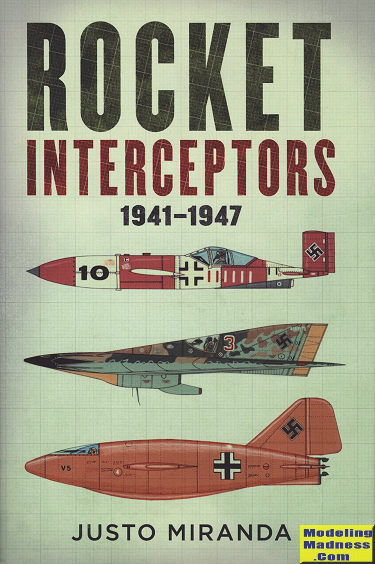
This book look into all of the myrad of designs for
these aircraft. It is of no surprise that the majority of them are German and
the majority of those are paper projects which never got off the drawing board.
Germany did manage to develop more functioning prototypes that anyone else, but
those flew during the last months of the war. The Soviet Union also developed a
rocket interceptor during the war but that was pretty much a failure. Same with
the US. The Soviet Union did have some success post war with ex-German designs.
The majority of this books 304 pages cover the various
German designs with smaller sections covering those of other nations. The book
is complete with hundreds of line drawings and some photos. There are also
several pages of full color profiles. The sections are in calendar sequence
covering early projects first. There is also a fairly complete history and
description of each and every project. In all it is a fascinating look at a
subject that is still of considerable interest to historians and modelers alike.
September 2026
Copyright ModelingMadness.com. All rights reserved.
Review book courtesy of
Casemate Publishers, where you can order your copy
from
this link.
If you would like your product reviewed fairly and quickly, please
contact
the editor or see other details in the
Note to
Contributors.