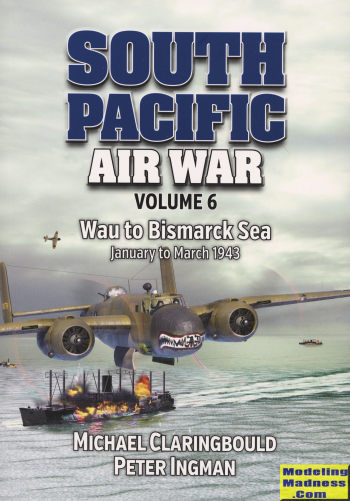
 Volume six continues from where
the previous volume left off and covers the air war in the south Pacific from
January 1943 through March 1943. It was during this time period when the
Japanese had started retreating from its advances of 1942.
Volume six continues from where
the previous volume left off and covers the air war in the south Pacific from
January 1943 through March 1943. It was during this time period when the
Japanese had started retreating from its advances of 1942. Avonmore's South Pacific Air War Vol 6
| Author/Artists: | Michael Claringbould & Peter Ingman |
|
Publisher |
Avonmore |
|
Price |
$48.95 MSRP from Casemate |
|
Reviewer: |
|
| Notes: |
220 pages, softbound, profiles and photos. ISBN: 978-0-9756423-6-8 |
Volume six continues from where
the previous volume left off and covers the air war in the south Pacific from
January 1943 through March 1943. It was during this time period when the
Japanese had started retreating from its advances of 1942.
During this period, the Japanese had realized that fighting in New Guinea and trying to build infrastructure in the areas it controlled were not going as planned. It was planned that it would be easy to provide supplies and reinforcements would be a routine matter. However the USAAF and RAAF were not making that such an easy matter. It was also hoped that they could build airfields and roads without issue. That was something else that was not going according to plan. The result was the increased inability to supply the army.
In order to help protect against Allied air raids, it was finally realized that the Navy simply didn't have the numbers to properly do the job. The Japanese army and navy were like two totally different entities. The idea of cooperation was foreign to both of them and in fact, there was a rather intense rivalry between the two.
However, the situation was such that it was finally realized that the Navy needed help in the air. As such, Japanese Army Air Forces was required to help fill the gap. The main IJAAF fighter of the time was the Ki-43 Oscar and two Sentai were ordered out of Taiwan and China to the South Seas. This caused some issues as army pilots were not trained in long range navigation over water. The only options were for navy bombers to act as pathfinders. While some units flew direct, others were transported by carrier to Truk and from there to Rabaul. \
Even the additional air power was not enough to cure the supply problem. Transports from Rabaul were still able to get in, though not wholly intact. Much of the reason for the fairly high interception was that the US broke the Japanese code so knew when ships and convoys departed Rabaul. The most devastating loss to the Japanese was the Battle of the Bismark Sea in late March 1943, the event on which this volume closes.
As with the previous editions, this book follows pretty much the day to day operations on both sides. Divided into chapters of 7-10 days, we are provided with a great deal of information and detail that has not previously been recorded. One thing that the reader learns, and it shouldn't be surprising, is that there was a huge amount of overclaiming of not only air to air victories, but also of successes in terms of bombing and ground attack.
Filled with great period photos, interesting stories, and some equally superb color profiles and artwork, it is a book that is not only an excellent reference, but a fascinating read as well. What is even better is that is is not the usual US-centric history but provides a lot of coverage Australian forces, which did the majority of the fighting in this theater during this time. It is a book that I most highly recommend.
September 2025
Review book courtesy of Casemate Publishers. You can get your copy from this link.
If you would like your product reviewed fairly and quickly, please contact the editor or see other details in the Note to Contributors.