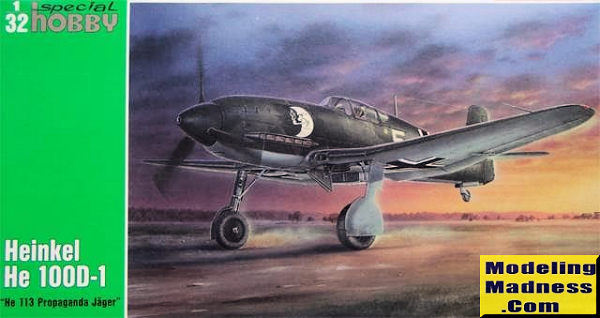
Special Hobby 1/32 He-100D "He-113 Propaganda Jaeger"
| KIT #: | 32009 |
| PRICE: | $79.95 SRP when new (2008) |
| DECALS: | Three options |
| REVIEWER: | Scott Van Aken |
| NOTES: | Short run with resin and p.e. parts. |
| HISTORY |
The Heinkel He 100 was a German pre-World War II fighter aircraft design from Heinkel. Although it proved to be one of the fastest fighter aircraft in the world at the time of its development, the design was not ordered into series production. Approximately 19 prototypes and pre-production examples were built. None are known to have survived the war.
The reason for the He 100 failing to reach production status is mostly unknown. Officially, the Luftwaffe rejected the He 100 to concentrate single-seat fighter development on the Messerschmitt Bf 109. Following the adoption of the Bf 109 and Messerschmitt Bf 110 as the Luftwaffe's standard fighter types, the Ministry of Aviation (the Reichsluftfahrtministerium or RLM) announced a "rationalization" policy that placed fighter development at Messerschmitt and bomber development at Heinkel.
Because there are no surviving examples, and since many factory documents - including all blueprints for the He 100 - were destroyed during a bombing raid, there is limited specific information about the design and its unique systems.
The final evolution of the short He 100 history is the D-1 model. As the name suggests, the design was supposed to be very similar to the pre-production D-0s, the main planned change being to enlarge the horizontal stabilizer.
But the big change was the eventual abandonment of the surface cooling system, which proved to be too complex and failure-prone. Instead an even larger version of the retractable radiator was installed, and this appeared to completely cure the problems. The radiator was inserted in a "plug" below the cockpit, and as a result the wings were widened slightly.
While the aircraft didn't match its design goal of 700 km/h (430 mph) once it was loaded down with weapons, the larger canopy and the radiator, it was still capable of speeds in the 644 km/h (400 mph) range. A low drag airframe is good for both speed and range, and as a result the He 100 had a combat range between 900 to 1,000 km (560 to 620 mi) compared to the Bf 109's 600 km (370 mi). While not in the same league as the later escort fighters, this was at the time a superb range, which suggests that a production Heinkel 100 might have offset the need for the Bf 110 to some degree.
By this point, the war was under way, and as the Luftwaffe would not purchase the aircraft in its current form, the production line was shut down. There were allegations that politics played a role in killing the He 100.
The remaining 12 He 100 D-1 fighters were used to form Heinkel's Marienehe factory defense unit, flown by factory test pilots. They replaced the earlier He 112s that were used for the same purpose, and the 112s were later sold off. At this early stage in the war, there were no bombers venturing that far into Germany, and it appears that the unit never saw action. The eventual fate of the D-1s remains unknown. The aircraft were also put to an interesting propaganda/disinformation role, as the supposed Heinkel He 113. In fact, the use of what looks like fresh paint behind the markings and possibility that the markings were even painted on paper and then applied made it look like the aircraft had reached unit service. Many Allied pilots report seeing or shooting down the Heinkel fighters.
| THE KIT |
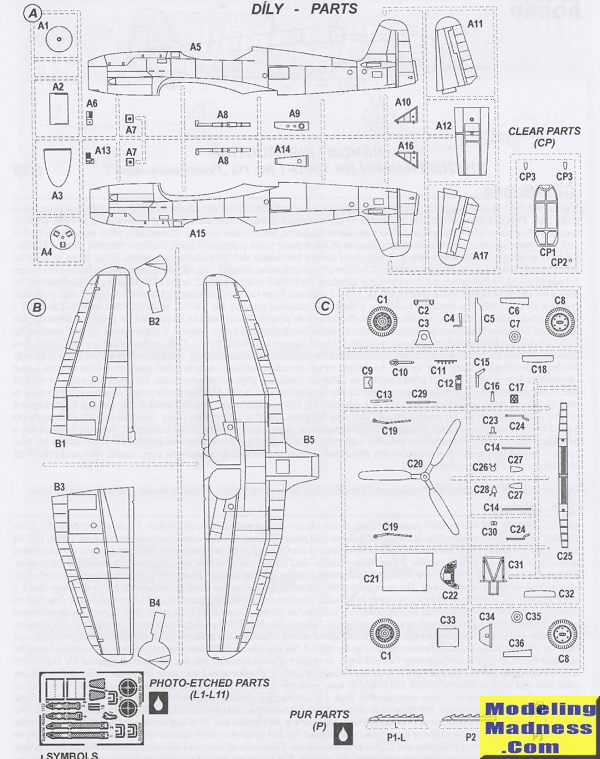 The
gang at MPM/Special Hobby have produced this kit in 1/72 as well as
this big one in 1/32 scale. HiPM did it in 1/48 and from what I
understand, it is a real bear to build. This one certainly does not
look complex at all. In fact, it looks like you could fit three or
four kits in the same box.
The
gang at MPM/Special Hobby have produced this kit in 1/72 as well as
this big one in 1/32 scale. HiPM did it in 1/48 and from what I
understand, it is a real bear to build. This one certainly does not
look complex at all. In fact, it looks like you could fit three or
four kits in the same box.
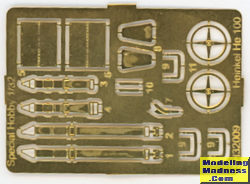 set, hand grabs for the windscreen and canopy, trim wheels, and
outside, there are the small main gear doors. Resin is provided for
the exhaust and the gun sight. One spends quite a bit of time in the
cockpit as there is a two piece seat that fits against a framework
pieces. This is actually attached to the fuselage side and not the
floor or rear bulkhead. There are various boxes for the inside of
the fuselage walls. The tail gear well, such as it is, is fitted
prior to closing the fuselage halves.
set, hand grabs for the windscreen and canopy, trim wheels, and
outside, there are the small main gear doors. Resin is provided for
the exhaust and the gun sight. One spends quite a bit of time in the
cockpit as there is a two piece seat that fits against a framework
pieces. This is actually attached to the fuselage side and not the
floor or rear bulkhead. There are various boxes for the inside of
the fuselage walls. The tail gear well, such as it is, is fitted
prior to closing the fuselage halves. 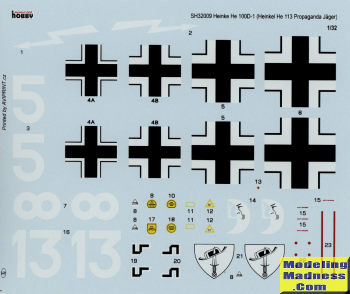 truts.
Main gear doors are a butt join. Behind all this is the three piece
radiator bath. It is quite small so I have to assume it is modeled
in the retracted position.
truts.
Main gear doors are a butt join. Behind all this is the three piece
radiator bath. It is quite small so I have to assume it is modeled
in the retracted position. | CONCLUSIONS |
| REFERENCES |
https://en.wikipedia.org/wiki/Heinkel_He_100
August 2017
Copyright ModelingMadness.com. All rights reserved.
If you would like your product reviewed fairly and fairly quickly, please contact the editor or see other details in the Note to Contributors.
Back to the Main Page Back to the Previews Index Page Back to the Review Index Page