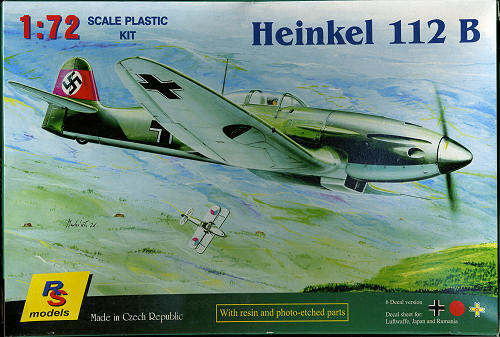
| KIT #: | 9210 |
| PRICE: | $25.15 from www.greatmodels.com |
| DECALS: | Seven options |
| REVIEWER: | Scott Van Aken |
| NOTES: | Short run with resin and photo etch parts |
| HISTORY |
During the fighter competition of the mid 30's that saw the Bf-109 come to the fore, one of the other competitors was the Heinkel He-112. Though the aircraft was generally better in all areas to the 109, two factors were against it. First was that Heinkel was thought to be more of a bomber manufacturer than one who did fighters. Secondly, though the 112 was a super aircraft, the Bf-109 was less expensive to build and as still goes on today, the government will sacrifice a bit of quality to get more of a cheaper product.
The He-112 was then released to be available for export, and except for a small number rushed into Luftwaffe service during the Munich Crisis of 1938, that is where the brunt of production went. Though small numbers were sent to Japan, it was Spain, Romania and Hungary that had the greatest use of the fighter. The Japanese did not like the rather high wing loading so soon relegated the planes to technical schools.
Though the aircraft was quickly outpaced by newer fighters, they did see use until the end of the war. A few Romanian aircraft were still in use post war, not finally being retired until the late 1940s.
| THE KIT |
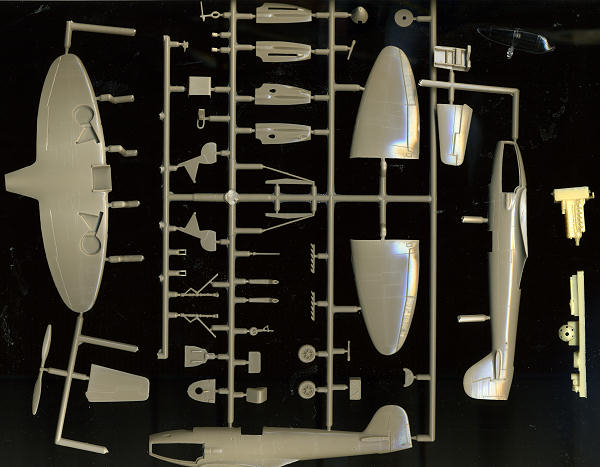 RS
has produced a number of rather nice short run kits and this one on the
He-112 is rather nicely done. Most of the kit is injected plastic with resin
and photo etch being used to enhance the kit as much as anything else. All
of the resin parts, which are very nicely molded, are for th
RS
has produced a number of rather nice short run kits and this one on the
He-112 is rather nicely done. Most of the kit is injected plastic with resin
and photo etch being used to enhance the kit as much as anything else. All
of the resin parts, which are very nicely molded, are for th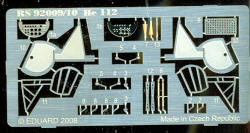 e
engine, a component that one does not have to install to complete the kit.
The equally well done photo etch fret is from Eduard and has a color
instrument panel as well as gear doors, radiator screen and a number of
smaller parts for the interior and exterior such as belts, oleo scissors and
control actuating arms. Not all these photo etch parts are absolutely needed
and, for instance, the gear doors are also part of the injected plastic
sprue.
e
engine, a component that one does not have to install to complete the kit.
The equally well done photo etch fret is from Eduard and has a color
instrument panel as well as gear doors, radiator screen and a number of
smaller parts for the interior and exterior such as belts, oleo scissors and
control actuating arms. Not all these photo etch parts are absolutely needed
and, for instance, the gear doors are also part of the injected plastic
sprue. 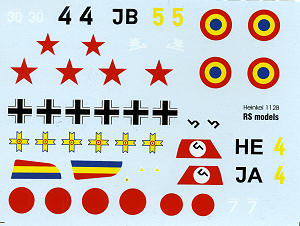 uilding.
Speaking of which, the instructions are basically two small folded sheets.
The parts layout and building instructions are on one side of one sheet,
while the other sheet contains painting instructions for the seven markings
options. Paint colors are by Agama and Humbrol references. Two of the
options are German JG 132 planes in a splinter camo of RLM 70/71/72. Next
there are three Romanian planes. Two are in Green/Light Green over Light
Blue with yellow noses and other Eastern Front markings. The third is a
pre-war plane in overall light grey (RLM 63). Also in RLM 63 are a Japanese
and a Soviet example. To be honest, real RLM 63 is a rather darkish
green-grey, so perhaps these planes allegedly in RLM 63 are actually in
Lufthansa Light Grey. The decals are nicely printed and look to be quite
thin. The back of the box has a few photos of the planes, instrument panel
and engine that are nice touches. If you really must have the Hungarian or
Spanish versions, then there are separate boxings for those.
uilding.
Speaking of which, the instructions are basically two small folded sheets.
The parts layout and building instructions are on one side of one sheet,
while the other sheet contains painting instructions for the seven markings
options. Paint colors are by Agama and Humbrol references. Two of the
options are German JG 132 planes in a splinter camo of RLM 70/71/72. Next
there are three Romanian planes. Two are in Green/Light Green over Light
Blue with yellow noses and other Eastern Front markings. The third is a
pre-war plane in overall light grey (RLM 63). Also in RLM 63 are a Japanese
and a Soviet example. To be honest, real RLM 63 is a rather darkish
green-grey, so perhaps these planes allegedly in RLM 63 are actually in
Lufthansa Light Grey. The decals are nicely printed and look to be quite
thin. The back of the box has a few photos of the planes, instrument panel
and engine that are nice touches. If you really must have the Hungarian or
Spanish versions, then there are separate boxings for those.| CONCLUSIONS |
For many decades, the only 112 available was the still nice, but difficult to find Heller kit. This one brings the 112 into the 21st century and pretty well seems to have everything covered
| REFERENCES |
http://en.wikipedia.org
August 2010
You can get this and other neat kits and accessories at GreatModels
If you would like your product reviewed fairly and quickly, please contact me or see other details in the Note to Contributors.