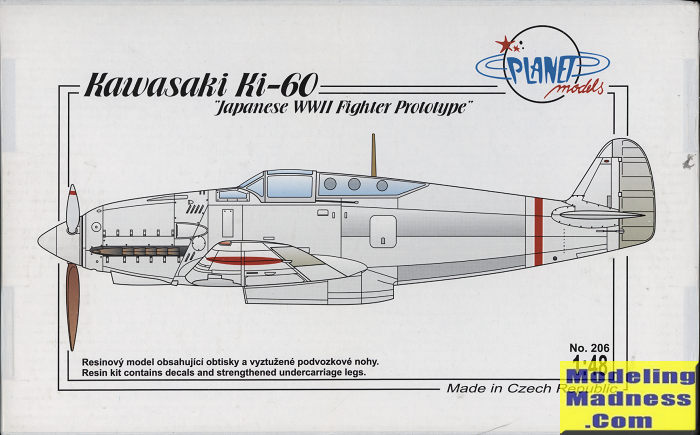
Planet Models 1/48 Ki-60
| KIT #: | 206 |
| PRICE: | $35.00 'used' |
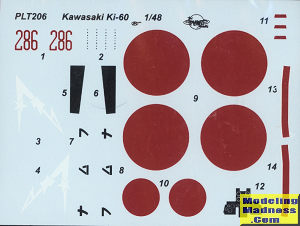
| DECALS: | Two options |
| REVIEWER: | Scott Van Aken |
| NOTES: |
Resin kit with plastic landing gear and vacuform canopies |
| HISTORY |
The Ki-60 was designed by Takeo Doi and his deputy Shin Owada of Kawasaki Aircraft Industries (川崎航空機工業株式会社, Kawasaki Kōkūki Kōgyō K.K.) in response to a 1939 Imperial Japanese Army Aviation Bureau requirement for a heavily armed, specialised interceptor fighter to be powered by the liquid-cooled Daimler-Benz DB 601 inverted V12 engine, which had been selected for license production by Kawasaki as the Ha-40. The emphasis in the requirements was for a high speed and a good rate of climb, along with a cannon armament. This was a complete change from the usual IJAAF penchant for lightly armed, highly manoeuvrable fighters with lightweight structures, epitomised by the Nakajima Ki-27 and the later Nakajima Ki-43. A requirement was issued at the same time for a lighter, less heavily armed, general-purpose fighter, which was to be designed almost in parallel with the Ki-60; this became the Ki-61. Priority was to be given to the Ki-60, design of which started in February 1940.
From the start of flight testing, it became apparent that the design was seriously flawed in several key areas. The take-off run was unacceptably long, while, in flight, the aircraft displayed some lateral instability, excessively heavy controls, and poor control response. The spinning characteristics were described as "dangerous", and the stalling speed was extremely high. Although a top speed of 600 kilometres per hour (370 mph) had been projected the Ki-60 was only able to achieve 548 kilometres per hour (341 mph).
As a result, the second and third prototypes, which were still being built, were hurriedly modified in an attempt to mitigate some of the more undesirable traits. Approximately 100 kilograms (220 lb) were removed, primarily by replacing the MG 151 cannon with Ho-103 machine guns. This reduced the normal loaded weight to 2,750 kilograms (6,060 lb). Coupled with a slight increase in wing area to 1.5 m2 (16 sq ft), this resulted in a slightly lower wing loading of 169.7 kg/m2 (34.76 lb/ft2). Detail changes were made to airframe sealing and to the contours of the air intakes and radiator bath. Flight tests were still disappointing, with both of the modified prototypes displaying most of the shortcomings of the first. A top speed of only 560 kilometres per hour (350 mph) was reached, with a climb rate still well below specifications. By this time, the Nakajima Ki-44, which had also been designed as a dedicated interceptor, was beginning to show some promise, and the Koku Hombu selected this in fulfilment of its requirements. From early 1941, the full attention of Takeo Doi and Shin Owada was focused on the Ki-61; the Ki-60 became important in that the Ki-61 design was able to be improved using the lessons learned from the poor characteristics of the Ki-60. Plans for production were cancelled in late 1941 after three airplanes had been built.
| THE KIT |
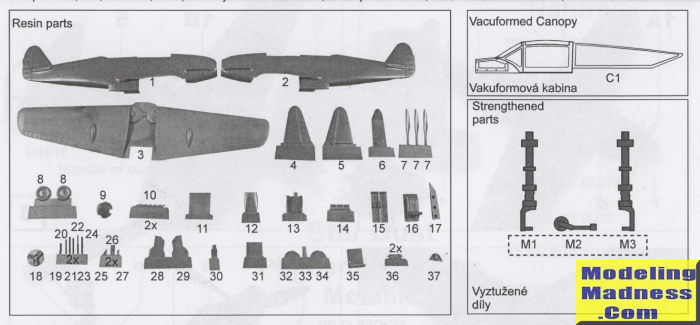 As
with every Planet Models kit I've ever had, it comes in a very sturdy box. All
the parts are enclosed in sealed plastic bags except the fuselage halves which
are wrapped in bubble wrap. This is old style, non-3D printed resin. There are
fairly thin pour stubs on some of the parts while they have been removed for the
larger bits. The kit provides two very clear vacuformed canopies.
Despite it being a resin kit, there is no photo etch and the parts count is fairly low. The detail level on the parts is excellent. There is interior detailing molded on the inside if the fuselage halves. There is a well done interior with seat, stick, and pedals to go on the cockpit floor. A well detailed instrument panel assembly included the breeches of the nose guns.
Wings are a single piece as are the tailplanes. A nice addition is that the landing gear legs are plastic and listed as strengthened parts. This is to keep them properly thin as resin would soon warp unless it was reinforced with wire.
 Instructions
are well done with the various steps in a photo-like format. Personally, I'd
prefer drawings as the images are fairly dark and it is difficult to see exactly
where parts fit.
| CONCLUSIONS |
November 2026
Copyright ModelingMadness.com. All rights reserved. No reproduction in part or in whole without express permission.
If you would like your product reviewed fairly and fairly quickly, please contact the editor or see other details in the Note to Contributors.