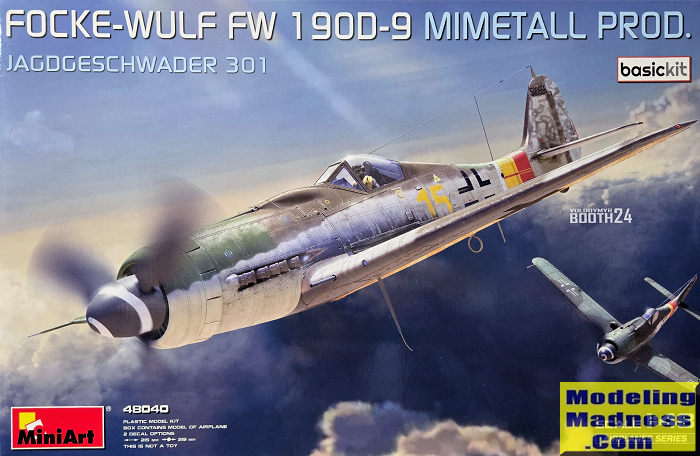
MiniArt 1/48 FW-190D-9 'Mimetall Production'
| KIT #: | 48040 |
| PRICE: | $48.00 |
| DECALS: | Two options |
| REVIEWER: | Scott Van Aken |
| NOTES: | 2026 tooling |
| HISTORY |
The Fw 190 D (nicknamed the Dora; or Long-Nose Dora, "Langnasen-Dora") was intended to improve on the high-altitude performance of the A-series enough to make it useful against the American heavy bombers of the era. In reality, the D series was rarely used against the heavy bomber raids, as the circumstances of the war in late 1944 meant that fighter-versus-fighter combat and ground attack missions took priority. A total of 1,805 D-9s were produced. Production started in August 1944.
The liquid-cooled 1,750 PS (1,726 hp, 1,287 kW) Jumo 213A could produce 2,100 PS (2,071 hp, 1,545 kW) of emergency power with MW 50 injection, improving performance to 426 mph (686 km/h) at 21,650 ft (6,600 m). Early D-9s reached service without the MW 50 installation, but in the meantime Junkers produced a kit to increase manifold pressure (Ladedrucksteigerungs-Rüstsatz) that increased engine output by 150 PS to 1,900 PS, and was effective up to 5,000 m (16,400 ft) altitude. It was fitted immediately to D-9s delivered to the units from September, or retrofitted in the field by TAM. By the end of December, all operational Doras, 183 in total, were converted. From November 1944, a simplified methanol water (MW 50) system (Oldenburg) was fitted, which boosted output to 2,100 PS. By the end of 1944, 60 were delivered with the simplified MW 50 system or were at the point of entering service. The 115 L tank of the Oldenburg system would hold the MW 50 booster liquid, which was single purpose, while later systems were to be dual purpose, holding either MW 50 or additional fuel.
The fighter lacked the high turn rate and higher rate of roll of its close coupled radial-engined predecessor. It was a bit faster, however, with a maximum speed of 680 km/h (422 mph) at 6,600 meters (21,650 ft). Its 2,240 horsepower with methanol-water injection (MW 50) gave it an excellent acceleration in combat situations. It also climbed and dived more rapidly than the Fw 190A, and so proved well suited to the dive-and-zoom ambush tactics favored by the Schlageter pilots. Many of the early models were not equipped with tanks for methanol, which was in very short supply in any event. At low altitude, the top speed and acceleration of these examples were inferior to those of Allied fighters. Hans Hartigs recalled that only one of the first batch of Dora 9s received by the First Gruppe had methanol water injection, and the rest had a top speed of only 590 km/h (360 mph).
Due to the failure of multiple attempts to create an effective next generation 190, as well as the comments of some Luftwaffe pilots, expectations of the Dora project were low. These impressions were not helped by the fact that Tank made it very clear that he intended the D-9 to be a stopgap until the Ta 152 arrived. These negative opinions existed for some time until positive pilot feedback began arriving at Focke-Wulf and the Luftwaffe command structure.
Sporting good handling and performance characteristics, the D-9 made an effective medium altitude, high speed interceptor, although its performance still fell away at altitudes above about 20,000 ft (6,100 m). When flown by capable pilots, the Fw 190D proved the equal of Allied types.
| THE KIT |
 MiniArt
got a lot of positive commentary on their P-47 series and I'm sure it will be
the same for this kit. This boxing is for a late 190D-9 built in Erfurt by
Mimetall. By late I mean that it has the 'blown' canopy introduced in December
1944 and used on those planes built in the last months of the war.
MiniArt
got a lot of positive commentary on their P-47 series and I'm sure it will be
the same for this kit. This boxing is for a late 190D-9 built in Erfurt by
Mimetall. By late I mean that it has the 'blown' canopy introduced in December
1944 and used on those planes built in the last months of the war.
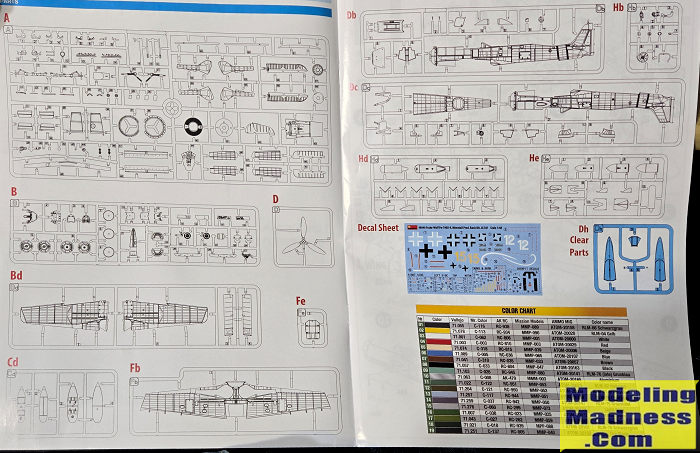
This is the basic kit boxing which means no aftermarket quality stuff such as a canopy mask or photo etch or resin parts. That is fine with me as the canopy is simple enough that standard masking techniques work fine and for me, the inclusion of p.e. and resin does little more than extend the building time and opportunity to screw something up.
The cockpit is nicely detailed with molded in seat harness and uses deals for instrument panel and side consoles. The D-9 had a more open main gear well where you could see the aft accessory compartment of the engine. Earlier kits of the D-9 often did not include that, but MiniArt does and this is nicely detailed. The kit does offer some optional parts for a wheels up build and the first time you run across that is when you need to install the tail gear. Before adding the inside bits and closing the fuselage halves, the exhaust will need to be glued in place.
The forward cowling is eight parts with the option for open or closed cowling flaps. There are separate upper cowling and lower cowling pieces to be installed. When it comes to the wings, the upper wings have separate gear well brace, while the lower wing has a wing spar with a number of smaller items to attach to it that includes the inner cannon. When attaching the upper to the lower wings, there are gun bay covers to attach. Separate ailerons and flaps are provided and shown in the neutral position.
When it comes to the main gear, there are parts for lowered and raised gear. Some trimming in the main gear well is required for the raised option. The kit has a separate lower fuselage insert and if you want a centerline pylon, holes in this part will need to be opened. Horizontal stabilizers have separate elevators and again, are designed to be modeled in the neutral position. Two different canopies are included with one for the open position and the other for closed. If using the pylon, there are four bomb options and two fuel tank options.
 Instruction
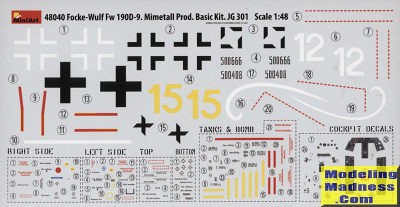
book is nicely printed with a color chart for multiple paints. The two markings
options are for JG 301 aircraft. One has an RLM 81/82 fuselage with RLM 81 and a
greenish RLM 76 wings and tailplanes. The fuselage sides and most of the
underside save the wings are in this greenish RLM 76 that in the past was called
'RLM 84'. The wing underside is bare metal with RLM 75 forward section. The
other is RLM 81/82 upper surfaces with the greenish RLM 76 on the underside
except the wing. The wing underside is unpainted metal with RLM 81 forward
section. Decal sheet is nicely printed with a full stencil suite. The red/yellow
fuselage band will need to be painted.
Instruction
book is nicely printed with a color chart for multiple paints. The two markings
options are for JG 301 aircraft. One has an RLM 81/82 fuselage with RLM 81 and a
greenish RLM 76 wings and tailplanes. The fuselage sides and most of the
underside save the wings are in this greenish RLM 76 that in the past was called
'RLM 84'. The wing underside is bare metal with RLM 75 forward section. The
other is RLM 81/82 upper surfaces with the greenish RLM 76 on the underside
except the wing. The wing underside is unpainted metal with RLM 81 forward
section. Decal sheet is nicely printed with a full stencil suite. The red/yellow
fuselage band will need to be painted.
| CONCLUSIONS |
One never can tell for sure how a kit will build just by looking at the sprues, but I feel that if one is looking for a well detailed kit that doesn't rely on p.e. or resin for detail, then this one might well be for you. It has all the right options to please most modelers. While it probably will not be as straight-forward a build as the Trumpeter kit, it has to be easier than the Eduard kit. If you are looking for what looks like a nice kit, this is for you. If you are cash strapped, then get the Trumpeter version.
May 2026
Copyright ModelingMadness.com. All rights reserved. No reproduction in part or in whole without express permission from the editor.
If you would like your product reviewed fairly and fairly quickly, please contact the editor or see other details in the Note to Contributors.