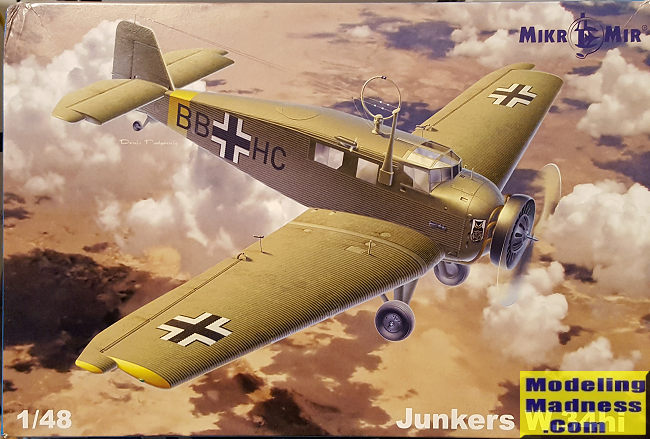
MiroMir 1/48 Junker W.34hi
| KIT #: | 48019 |
| PRICE: | $23.50 SRP |
| DECALS: | Two options |
| REVIEWER: | Scott Van Aken |
| NOTES: |
| HISTORY |
One Junkers W 34 be/b3e managed to break the then-current altitude record on 26 May 1929 when it reached 12,739 meters (41,795 feet). That aircraft carried the markings D-1119 and it was equipped with a Bristol Jupiter VII engine. The airplane was flown by Willi Neuenhofen.The Junkers W 34 was manufactured in many different versions. The total production numbers for the civil market were around 1,000, a further 2,024 his and haus were built under license for the RLM and Luftwaffe. The unit price was between RM 65,000 and 70,400.
On 31 January 1944 the Luftwaffe still had 618 W 34hi's and 516 W 34haus in service: the majority were used by flight schools; mainly as navigator and radio operator training (3 or 4 navigator or radio-operator trainees). The type was also used by a number of other nations in both military and civil use.
| THE KIT |
 MikroMir
is one of several companies that has concentrated on doing subjects that the
major manufacturers won't do. These are still considered short run kits, but
the quality of short run kits has come a long way since the early days of
VeeDay and Merlin where one was provided with basic shapes and the builder
had to supply a lot of other parts to complete the project.
MikroMir
is one of several companies that has concentrated on doing subjects that the
major manufacturers won't do. These are still considered short run kits, but
the quality of short run kits has come a long way since the early days of
VeeDay and Merlin where one was provided with basic shapes and the builder
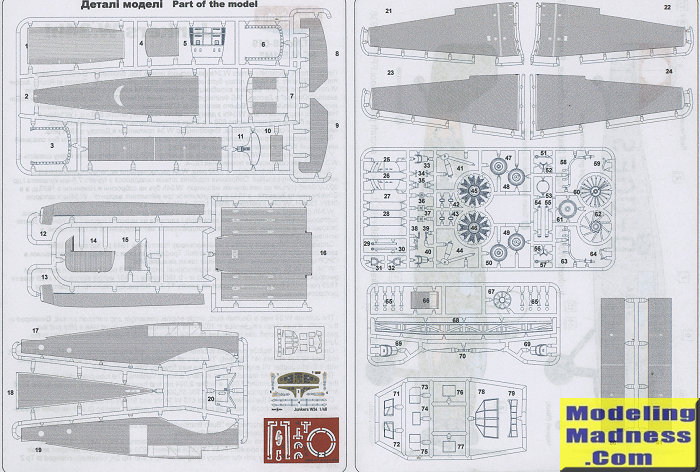
had to supply a lot of other parts to complete the project. 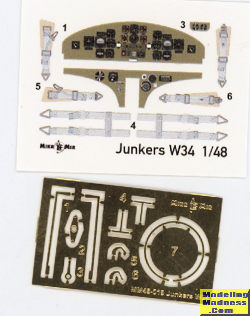 The kit
has very nice surface detail and the corrugated surfaces will require some
very careful construction so as to not destroy this detailing when attaching
the pieces. As usual with these types of kits, the sprues themselves are
somewhat numerous, the fuselage, for instance, being built up of top, side
and bottom pieces as befits its boxy shape. The builder is provided with a
nice 3D decal for the instrument panel and the seat harnesses. This is
becoming a regular feature with some kits from Ukraine and I welcome it. You
are also provided with a photo etch fret that is minimal in size for the DF
loop antenna as well as hinges for the control surfaces.
The kit
has very nice surface detail and the corrugated surfaces will require some
very careful construction so as to not destroy this detailing when attaching
the pieces. As usual with these types of kits, the sprues themselves are
somewhat numerous, the fuselage, for instance, being built up of top, side
and bottom pieces as befits its boxy shape. The builder is provided with a
nice 3D decal for the instrument panel and the seat harnesses. This is
becoming a regular feature with some kits from Ukraine and I welcome it. You
are also provided with a photo etch fret that is minimal in size for the DF
loop antenna as well as hinges for the control surfaces.
The cockpit is fairly well appointed and needs to be done well as you will be able to see a lot of it through the large transparency. The cabin is bare, though you do have interior side wall detailing as well as some frame supports. The cabin windows are attached during the fuselage construction and need to be masked fairly early in the process. Also nicely done is the engine as you will see quite a bit of it as it is not close cowled and many planes flew without this item as they saw more and more use later in the war.
 Instructions
are nicely drawn but are quite lightly printed making it somewhat difficult
to read. As seems to be a standard trend among several companies, no color
information is provided at all during construction, which to me is a huge
oversight. The only time you see colors given are generic ones for the two
profiles. One aircraft is the box art plane from a pilot's school in 1938.
This is shown as a single green shade with yellow fuselage band and lower
wing tips. The other is an overall light grey civil offering from Lufthansa
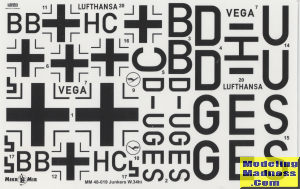
in 1937. The decals are nicely done and will hopefully conform well over all
those corrugations. I am hoping for a nice aftermarket sheet or two for this
one.
Instructions
are nicely drawn but are quite lightly printed making it somewhat difficult
to read. As seems to be a standard trend among several companies, no color
information is provided at all during construction, which to me is a huge
oversight. The only time you see colors given are generic ones for the two
profiles. One aircraft is the box art plane from a pilot's school in 1938.
This is shown as a single green shade with yellow fuselage band and lower
wing tips. The other is an overall light grey civil offering from Lufthansa
in 1937. The decals are nicely done and will hopefully conform well over all
those corrugations. I am hoping for a nice aftermarket sheet or two for this
one.
| CONCLUSIONS |
To my knowledge, this is the first injected kit of this plane in this scale to be offered. I'd not be surprised to see other versions done as it was operated quite a bit on floats. Probably not for the tyro, but one that anyone with experience in short run kits should be able to handle without any trauma.
| REFERENCES |
https://en.wikipedia.org/wiki/Junkers_W_34
January 2022
Copyright ModelingMadness.com. All rights reserved. No reproduction in part or in whole without express permission of the editor.
If you would like your product reviewed fairly and fairly quickly, please contact the editor or see other details in the Note to Contributors.