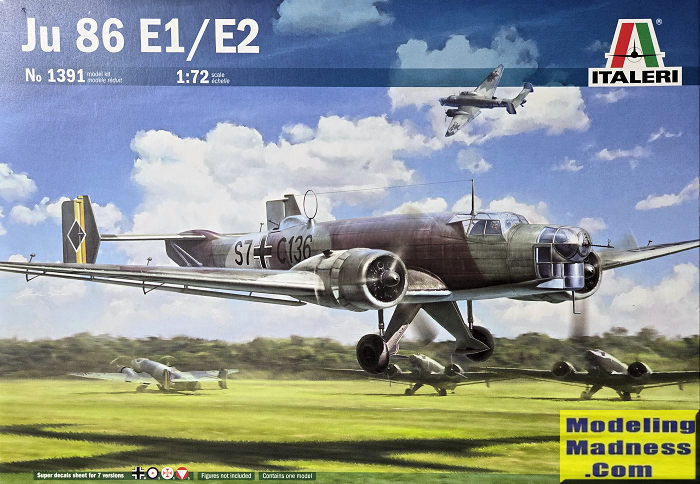
Italeri 1/72 Ju-86E
| KIT #: | 1391 |
| PRICE: | $43.89 plus shipping |
| DECALS: | Six option |
| REVIEWER: | Scott Van Aken |
| NOTES: | 2018 Release |
| HISTORY |
The Junkers Ju 86 is a monoplane bomber and civilian airliner designed and produced by the German aircraft manufacturer Junkers. It was designed during the mid-1930s in response to a specification for a modern twin-engined aircraft suitable for use as both a high-speed airliner and a bomber. Junkers responded with a low-winged twin-engined all-metal monoplane; unusually, it was intended to be powered by Junkers Jumo 205 diesel engines instead of petrol engines for greater fuel efficiency. It also had a smooth metal skin instead of the company's traditional corrugated exterior. On bomber-configured aircraft, bombs were carried vertically in four fuselage cells behind the cockpit; these bomb cells were replaced by seating for up to ten passengers on the civil airliner version of the Ju 86. On 4 November 1934, the first prototype, powered by Siemens SAM 22 radial engines, made its maiden flight; on 4 April 1935, the third prototype, which was the first civil-configured aircraft, flew for the first time.
The type was employed by various air forces on both sides of the conflict, although the first military use of the Ju 86 was during the Spanish Civil War, where it was flown by the Condor Legion with mixed results. The Luftwaffe deployed its Ju 86s during the invasion of Poland, but opted to withdraw its diesel-engined aircraft fairly promptly due to its fragility of operation during a wartime pace. The radial-engined Ju 86 models were predominantly assigned to training roles thereafter and later turned into transports.
The aircraft had some export success with Sweden as the first customer. Sweden also obtained a license to build the type and several export customers flew Swedish built planes, often with a variety of different radial engines. The Swedish have the only extant example, which was a German built plane that was retired from service in 1958.
| THE KIT |
 Originally
tooled in 1972 with the diesel engines, it has since been released as an
airliner and as the one with radial engines. Apparently it has been quite
popular as there have been dozens of reissues not only by Italeri but also by
Testors and Revell.
Originally
tooled in 1972 with the diesel engines, it has since been released as an
airliner and as the one with radial engines. Apparently it has been quite
popular as there have been dozens of reissues not only by Italeri but also by
Testors and Revell.
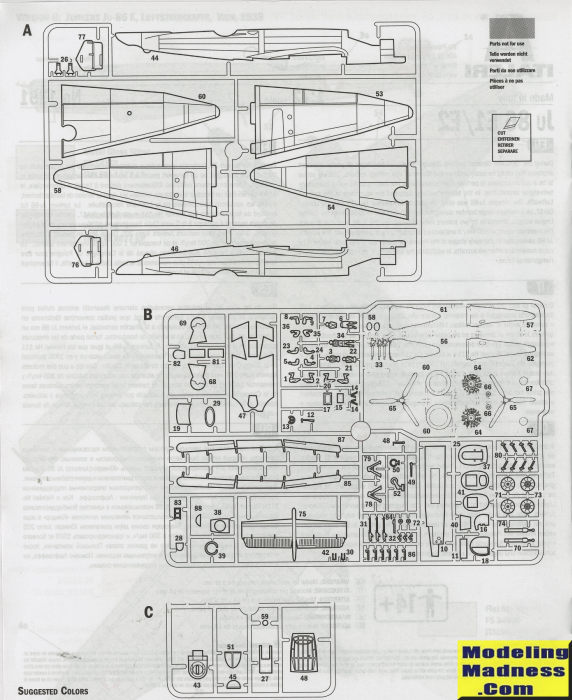
I was quite pleased to note that the kit parts were in excellent condition. No flash or sink areas are readily apparent, though there are a few ejctor pin marks on the inside of some of larger pieces. External detail is mostly raised panel lines and something I don't recall on older tooling are rivets. This tells me that perhaps the tooling has been refurbished. The cockpit is fairly Spartan, as was typical of the era. Figures are provided for the seats and there are decals for the instrument panel and seat harness. You are provided alternate machine guns for all the gun positions. It appears that the lower gun tub can be moved up and down, but I would treat it gingerly.
Engines are basically a face that fits into the one piece cowling. In order to allow for the different engine of the earlier versions, the upper and lower nacelle pieces are separate items. You'll find that the four bomb bays can be posed open, but there is nothing to see in there so best to have them closed. Also saves from having to cut them apart. An entrance door and ladder are provided as well. Probably the fussiest part of the build will be attaching the long flap/aileron pieces as they have fairly fragile looking attachment hinges and will need you to install mass balances, which also go on the elevators.
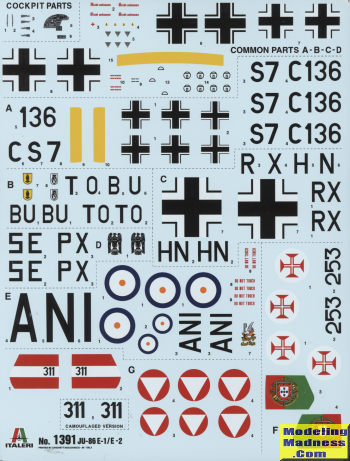
Instructions are very well done and use both Italeri and FS 595 paint references. RLM options are provided on the color and markings pages. Seven options are provided with four of them with the Luftwaffe. All are with training units. Two are in prewar four color splinter patterns and two are in the later RLM 70/71/65 scheme. A South African plane is provided in a fairly light export scheme. A darker scheme is provided for a Portuguese option with the Austrian aircraft in an unpainted metal over sky scheme. The huge decal sheet is a highlight of this kit and while not printed by Cartograf, looks very good. You will need to source swastikas from an aftermarket sheet. Aftermarket parts and decals have been done, but finding them will not be as easy as with other types.

| CONCLUSIONS |
To be honest, I almost did not get this kit. The rather outrageous price of the kit (typical for anything imported/distributed by MRC) had me thinking several times. But I was persuaded by the excellent number of decal options and there it is. Other than the near impossibility of finding canopy masks in Kabuki tape, this should be a fairly smooth build. Probably the most difficult part will be choosing which option to build.
August 2026
Copyright ModelingMadness.com. All rights reserved. No reproduction in part or in whole without express permission.
If you would like your product reviewed fairly and fairly quickly, please contact the editor or see other details in the Note to Contributors.