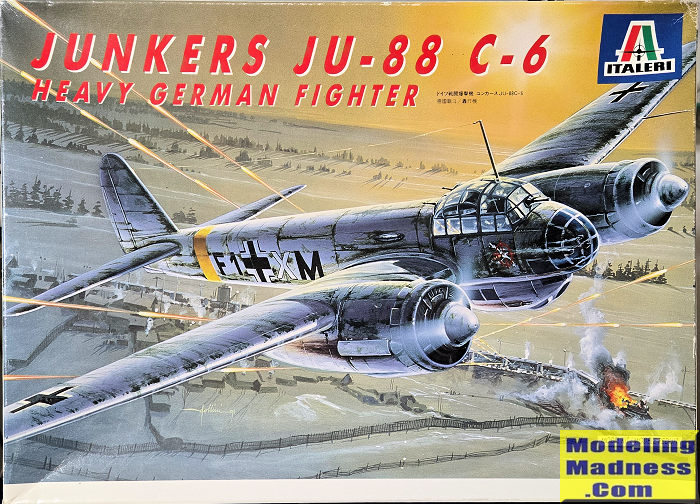
Italeri 1/72 Ju-88C-6
| KIT #: | 022 |
| PRICE: | $5.00 'used' without instructions or decals |
| DECALS: | Two options |
| REVIEWER: | Scott Van Aken |
| NOTES: | Bargain table kit |
| HISTORY |
The Ju-88C models were the first of the 'heavy fighter' versions of this fast bomber. Based on the Ju-88A-5 bomber and entering production in late 1940, the C models featured a solid gun nose without the bombardier's equipment. On the C-4, there were three MG 17 machine guns and one MG 151 15mm cannon, or two MG-FF and two MG-FFM cannon located in the gondola. Only about 65 of the C-4 versions were build and in 1941 it was replaced by the C-6.
The C-6 was based on the later Ju-88A-4 version and had the asymmetrical bulges under the engines that were typical of the Jumo 211J engines. The nose armament was identical to the C-4 but the defensive armament in the cabin was changed to two guns. Many C-6s were issued to bomber groups to act as escorts and as ground attack aircraft. By 1943, the C-6 was called upon more and more for night fighting. Late production C-6s were equipped with FuG 220 antenna and flame damping exhaust covers. The lower gondola was removed to shed some weight. It was finally replaced in 1944 by the Ju-88G version. Often the C-6 3was re-engined with the BMW 801 radial engines in place of the inline Jumo 211s. This was as much to bring back lost performance due to increasing weight as to making the aircraft faster.
| THE KIT |
 This is a kit that I bought on the sale
table at the now gone LHS several years ago. It had no instructions and no
decals, but all the parts were there. Fortunately, I had a spare set of marking
guide and decals from the AMT boxing so all was not lost. I was also able to
download a set of instructions from Scalemates. This is actually, for me, a more
desirable version as it doesn't have the bomber 'beetle' nose so less to mask.
This is a kit that I bought on the sale
table at the now gone LHS several years ago. It had no instructions and no
decals, but all the parts were there. Fortunately, I had a spare set of marking
guide and decals from the AMT boxing so all was not lost. I was also able to
download a set of instructions from Scalemates. This is actually, for me, a more
desirable version as it doesn't have the bomber 'beetle' nose so less to mask.
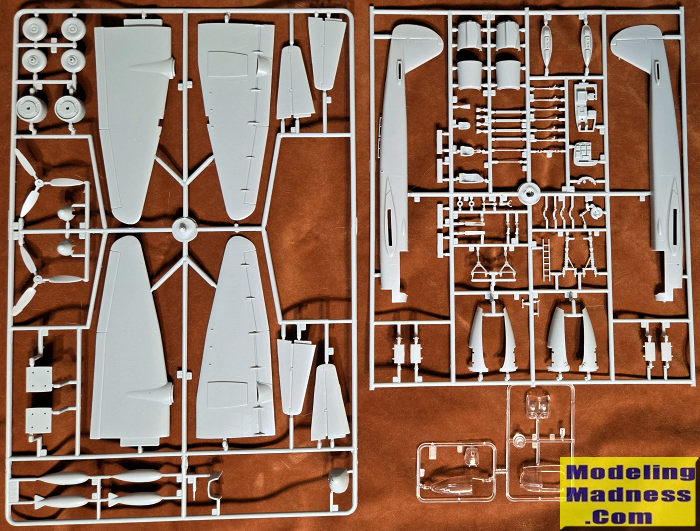
Though it is blessed with engraved panel lines, the Italeri kits are not the easiest to build as there are definite fit problems, especially the engines that require careful fitting. There are also a few inaccuracies, such as too shallow and narrow an engine nacelle which can be cured by locating the appropriate AIMS resin replacements. However, unless you are really concerned about these things, the kit can be built into a nice model.
So let's have a look at what you get. First of all, it comes in a very large box. This is mostly due to the length of the nacelle/landing gear sprue as otherwise, there is a lot of room in the box. The parts are well molded in a light grey plastic, though there is some flash that appears on some of the sprues and parts. My kit came with the sprues loose in the box, but I assume a new one would have them bagged.
General detail is fairly good. There is detail on the sidewalls of the interior, the engine fronts and inside main gear doors. Nothing outstanding, but more than adequate for most builders. Cockpit has a goodly amount of detail with seats and control sticks and rudder pedals. The clear bits are a tad thick so seeing any of this detail may be a moot point. Engine front detail is fair with the builder having to cut away the appropriate number of openings in the radiator for the variant being built. The flame dampers are half tubes and not the full tubular ones that I'd have expected. However, it is possible that these early night fighters used the half tube version. I have no real references to say one way or the other. If doing a radar equipped C-6 the antennas and masts are butt fit to the nose, not an easy task as I found when doing the 88G.
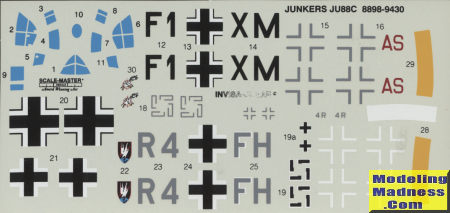 Markings from
the AMT kit are for three aircraft. The Italeri instructions provide only
Italeri paint and FS595 references. They are grossly off. For instance, they
list the underside color as a medium grey when it actualy is RLM 65 light blue.
Do your research. Back to the decals, first is the C-6 day fighter
version as shown on the box art with the false 'glass' nose from 4./KG 76.
This is in a winter scheme of white over RLM 65. The other a night
fighter from 8./NGJ 2 in 'Light Grey' uppers and 'Light Blue' undersides
with 'Medium Grey' patches. This variant cannot be built from the sprues as they
do not include the nose radar antennas. The final aircraft is
from 1./NJG 2 in overall black (making it easy to paint). The decal sheet
is by ScaleMaster and it seems as if the white is a bit off register as the
white surround to the F is out of alignment and there is extra white bits
sticking out the side of the insignia. Interestingly, the two piece
swastikas are in register. Go figure.
Markings from
the AMT kit are for three aircraft. The Italeri instructions provide only
Italeri paint and FS595 references. They are grossly off. For instance, they
list the underside color as a medium grey when it actualy is RLM 65 light blue.
Do your research. Back to the decals, first is the C-6 day fighter
version as shown on the box art with the false 'glass' nose from 4./KG 76.
This is in a winter scheme of white over RLM 65. The other a night
fighter from 8./NGJ 2 in 'Light Grey' uppers and 'Light Blue' undersides
with 'Medium Grey' patches. This variant cannot be built from the sprues as they
do not include the nose radar antennas. The final aircraft is
from 1./NJG 2 in overall black (making it easy to paint). The decal sheet
is by ScaleMaster and it seems as if the white is a bit off register as the
white surround to the F is out of alignment and there is extra white bits
sticking out the side of the insignia. Interestingly, the two piece
swastikas are in register. Go figure.
| CONCLUSIONS |
I built this kit not all that long ago and it was fairly painless. I wish I still had the instructions, but thanks to Scalemates,they are not needed. The Italeri kit has been made obsolescent by the Hasegawa and the Zvezda Ju-88s, but it is probably the most easily obtained. Worth building.
August 2026
Copyright ModelingMadness.com. All rights reserved. No reproduction in any form without express permission from the editor.
If you would like your product reviewed fairly and quickly, please contact the editor or see other details in the Note to Contributors.