ICM 1/48 Do-217M-1
|
KIT #: |
48274 |
|
PRICE: |
$92.00 SRP |
|
DECALS: |
Four options |
|
REVIEWER: |
Scott Van Aken |
|
NOTES: |
2025 release |
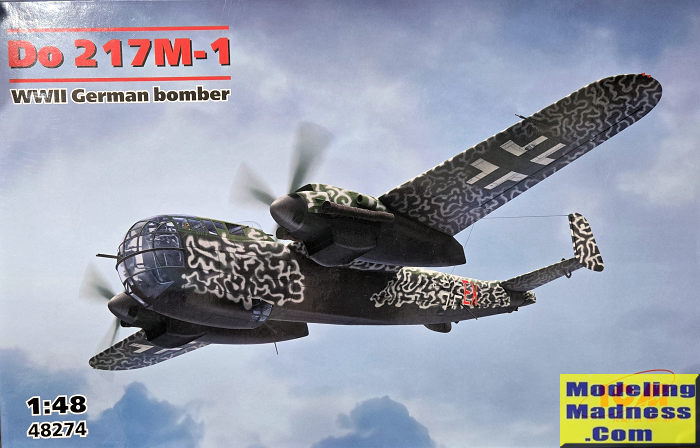
The Dornier Do 217 was a bomber used by the German Luftwaffe during World War
II. It was a more powerful development of the Dornier Do 17, known as the Fliegender
Bleistift (German: "flying pencil"). Designed in 1937–1938 as a heavy bomber but
not meant to be capable of the longer-range missions envisioned for the larger
Heinkel He-177, the Do 217 design was refined during 1939 and production began
in late 1940. It entered service in early 1941 and by the beginning of 1942 was
available in significant numbers.
The aircraft was consistently modified and upgraded during its operational life.
The K and M used a greatly modified front end, removing the stepped cockpit and
replacing it with a more aerodynamic and fairly smooth all 'glass' nose. The
difference between the K and M versions was that the K stayed with BMW radial
engines while the M used the Daimler-Benz DB 603A liquid cooled versions.
ICM has embarked on doing a wide range of Do-17/217 aircraft. This kit was
recently released along with the D0-217K that differs in the engines used.
Going through the instructions, the first twelve steps have you build up the
interior. They then have you build the bomb bay, the forward bulkhead also
including stub wing spars. Note that the kit includes two full fuselages,
though only one set is for this variant. Instructions provide two different
paints for the interior bits. One is RLM02 and the other is RLM 66. The
latter color was deemed to be the standard starting in November 1941, but
many companies continued to use the lighter shade.
After closing the fuselage halves, trapping the cockpit and bomb bay. An
option for twin nose guns is provided and one has to enlarge the opening if
you want this option. Two tail cones are also provided with one having a
machine gun. One then builds up the tail gear and the lower gun position,
installing those. The next several steps are on the bomb bay doors. If you
are lazy, you can simply install the 'closed door' option. Otherwise, there
are several steps for the open bay doors along with several size bombs.
Things move on to attaching the upper wing to the fuselage, followed by the
lower. The tail section, which has separate rudders and elevators is then
built up, which includes some external hinges. This is then glued on the
fuselage and the separate ailerons attached.
We then move to the engine nacelles. This kit provides the option to have
full exposed engines or to build the kit with the cowlings closed. For the
exposed engines, some surgury needs to be done to the engine nacelles to
remove the cowlings. There are also a few additional bits to add. The
instructions provide a separate sequence of construction steps based on your
choice.
Building the engines also means boxing in the main gear wells. The landing
gear itself is somewhat complex and the build steps show this being
installed in the engine nacelles. It looks like this could be done after
painting. The engines are then attached to the wings. The various gun
positions are then attached to the upper transparency and when done, this is
attached to the fuselage. The last steps are the various antennas. The
instructions provide a template for doing your own canopy masks, but the
lazy among us will probably go with a ready cut aftermarket step.
Instructions
are very nicely done and provide detail steps from time to time. It is
recommended that one study these prior to building as it will really help.
Four markings options are provided. All of them have black undersides. Three
have RLM 76 uppers with a variety of squiggly camo in what appears to be RLM
74 but may be RLM 71. The fourth one is the box art
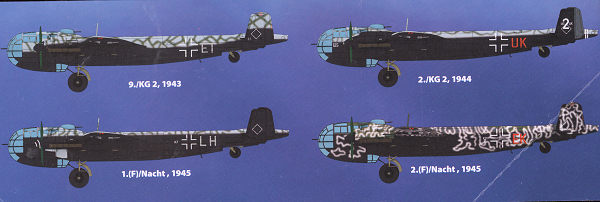 plane in overall 'camouflage green' (which may be RLM 71) with RLM 76 wave
pattern markings. The paint references are all ICM paints and none of them
provide RLM numbers so you are left guessing. Those of us who have built a
lot of Luftwaffe kits will probably be able to figure things out, but others
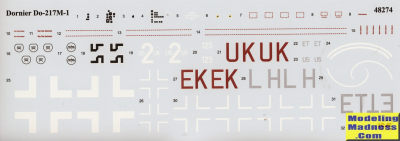
may well have trouble figuring what's what. The decals are nicely printed
and provide a split swastika so the kits can sell in western Europe.
plane in overall 'camouflage green' (which may be RLM 71) with RLM 76 wave
pattern markings. The paint references are all ICM paints and none of them
provide RLM numbers so you are left guessing. Those of us who have built a
lot of Luftwaffe kits will probably be able to figure things out, but others
may well have trouble figuring what's what. The decals are nicely printed
and provide a split swastika so the kits can sell in western Europe.
I built ICM's 1/32 Yak-9 and was fairly pleased with that one. I fully expect
this one to be quite nice as well. I do encourage anyone building a kit like
this with a lot of clear panes to spend the additional funds for an aftermarket
masking set as it will alleviate some of the frustration when it comes to
masking these sorts of clear bits.
https://en.wikipedia.org/wiki/Dornier_Do_217
January 2026
Copyright ModelingMadness.com. All rights reserved. No reproduction
in part or in whole without express permission.
Thanks to me for picking this one up when it was on sale.
If you would like your product reviewed fairly and quickly, please
contact the editor
or see other details in the
Note to
Contributors.
Back to the Main Page
Back to the Review
Index Page
Back to the Previews Index Page