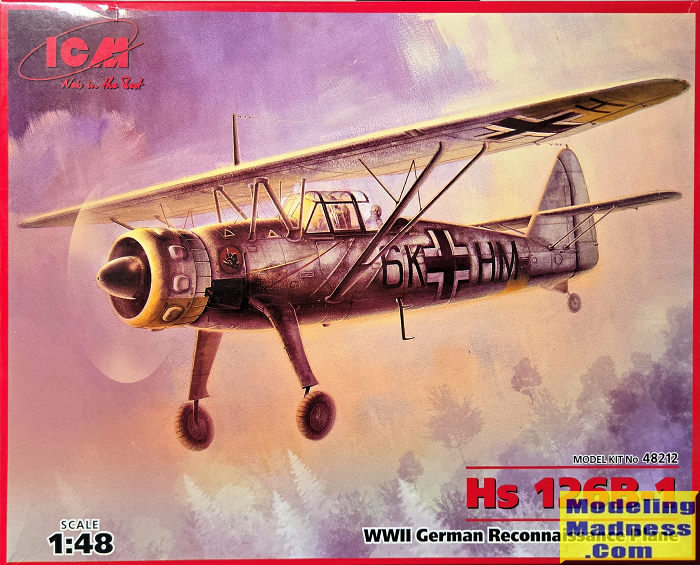
ICM 1/48 Hs-126B-1
| KIT #: | 48212 |
| PRICE: | ~$40-50.00 |
| DECALS: | Three options |
| REVIEWER: | Scott Van Aken |
| NOTES: | 2010 boxing |
| HISTORY |
Altogether about 802 were delivered, maintaining the Aufklarungsstaffein (recce squadrons) at a front-line strength of around 280 aircraft. By June 1941 virtually all were on the Eastern Front or in the Balkans or North Africa. A few survived until 1944-45 in operations against partisans in the Balkans, but most had been replaced by the Fw189 and used for towing gliders. The 200-odd combat veterans served in Nachtschlacht (night ground attack) wings, often using a variety of armament schemes.
| THE KIT |
 The
Hs-126 has been available in 1/72 for quite a while with kits from Matchbox,
Airfix and Italeri around since the 1970s. In 1/48 modelers have not been that
well served. To my knowledge, prior to this one, only FM did a short run 1/48
126 which relied on resin for a lot of the parts.
The
Hs-126 has been available in 1/72 for quite a while with kits from Matchbox,
Airfix and Italeri around since the 1970s. In 1/48 modelers have not been that
well served. To my knowledge, prior to this one, only FM did a short run 1/48
126 which relied on resin for a lot of the parts.
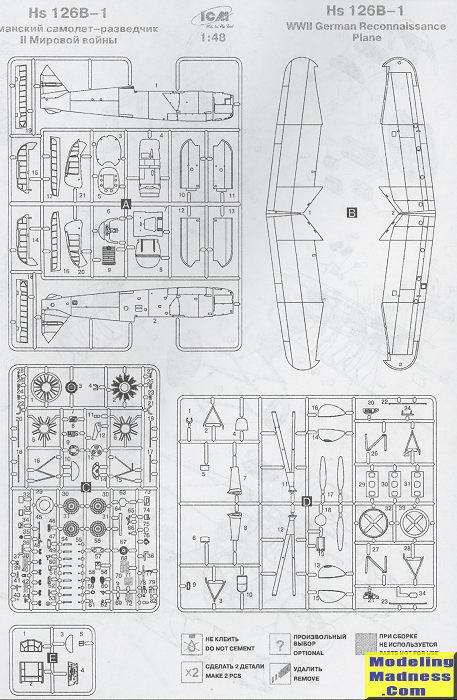
Generally speaking, the molding is very good. You do have to be concerned with short injector towers on the inside of large parts. It would be wise to test fit these and other parts prior to appling cement. The kit has a nicely done interior with all of the various black boxes and controls. Frame detail is on the inside of the fuselage halves and here a fairly large number of radios, spare bullet casings and other bits are provided. The kit also has a complete engine mount framework that attaches to the firewall.
Once all the interior bits are attached, the fuselage halves are glued together, trapping the interior subassembly. With that done, the landing gear is attached. ICM provides the option of either having the wheel pants or having them off. Two of the three markings options have them off. During this time the tail gear is installed along with the clear bits.
 Engine is
assembled and when done, it is installed in the five piece cowling. The prop has
separate props and when it is done, is attached to the prop shaft. The final
bits are the wing and tail planes along with their struts. ICM provides separate
flight control surfaces. Looking at period photos, the aircraft normally had
these in the neutral position when on the ground. If anything was different, it
would be the elevators.
Engine is
assembled and when done, it is installed in the five piece cowling. The prop has
separate props and when it is done, is attached to the prop shaft. The final
bits are the wing and tail planes along with their struts. ICM provides separate
flight control surfaces. Looking at period photos, the aircraft normally had
these in the neutral position when on the ground. If anything was different, it
would be the elevators.
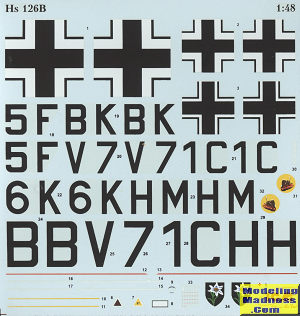
Instructions are mostly exploded views with color references in either Model Master or generic and RLM shades. All of the three camo options are basically RLM 70/71/65 with RLM 02 interiors. One option is based in Finland during 1941 with yellow on the underside of the wing tips. Another is one in Russia during the winter of 1942 with a white upper surface and yellow on the lower fuselage band, underside of wing tips, and lower cowling. Finally one with a heavy coat of RLM 79 desert sand and a white fuselage band based in North Africa in 1942. The decal sheet is nicely printed, but does not include a swastika so you'll need to get that from some other source.
| CONCLUSIONS |
All the bits are there to make a nicely detailed model. This is not a small airplane and regardless of what camo option you choose, it will look great. There are aftermarket sheets if you want to go that route.
February 2026
Copyright ModelingMadness.com. All rights reserved. No reproduction in part or in whole without express permission.
If you would like your product reviewed fairly and fairly quickly, please contact the editor or see other details in the Note to Contributors.