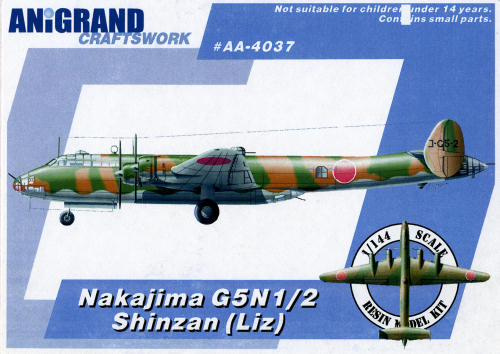
Anigrand 1/144 G5N 'Shinzan'
| KIT #: | AA-4037 |
| PRICE: | $96.00 from www.nostalgicplastic.com Free US shipping |
| DECALS: | Yes, there are decals |
| REVIEWER: | Scott Van Aken |
| NOTES: | Resin, includes Ki-78, E16A, and R2Y aircraft as well |
| HISTORY |
In 1938, with success of the Mitsubishi G4M attack bomber, the Japanese Navy issued requirement for an advanced four-engine heavy bomber which could operate more long-range and bomb load than the G4M. Nakajima and Kawanishi were selected to create two new bombers, one was the land-based airplane and the other was flying boat. Kawanishi agreed to tackle the flying boat that became H8K Emily, and Nakajima took the land-based bomber that led to the G5N Shinzan program. The G5N Shinzan was the first Japanese large aircraft ever built. The Japanese Army also interested in this heavy bomber. The Army owned Douglas DC-4E was handed over to Nakajima for both the Navy G5N and Army Ki-68 programs. Nakajima engineers took the wings, landing gears and powerplant installation from the DC-4E to complete the G5N1 prototype. The first prototype made its first flight in 1942. Performance was as disappointing as the DC-4E (not surprising as it used the same wings and engines). A total of six prototypes were completed. Four prototypes were converted to G5N-2 transport airplanes. Due to the lack of experience with large aircraft development, the G5N program was cancelled in 1944.
| THE KIT |
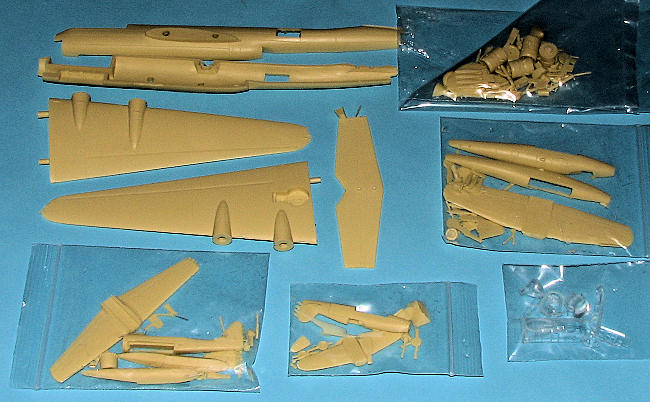 This
is the latest from Anigrand and I'm pleased to see them continuing to do
large aircraft in 1/144 scale like this. Like most of their 1/144 kits, it
comes with three other aircraft. In this case the Aichi E16A floatplane,
Yokosuka R2Y, and Kawanishi Ki-78. The E16A saw unit service, the R2Y never
made it out of initial construction, and the Ki-78 never made it off paper
(as far as I know).
This
is the latest from Anigrand and I'm pleased to see them continuing to do
large aircraft in 1/144 scale like this. Like most of their 1/144 kits, it
comes with three other aircraft. In this case the Aichi E16A floatplane,
Yokosuka R2Y, and Kawanishi Ki-78. The E16A saw unit service, the R2Y never
made it out of initial construction, and the Ki-78 never made it off paper
(as far as I know). 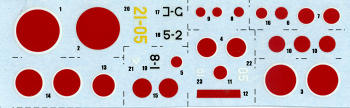 The
instructions are well done with the usual exploded views from the top and
bottom quarters to show where the bits fit. On the Shinzan, an additional
view of the fit of the interior bits is provided. The Shinzan can be done in
two schemes. One is the usual dark green over light grey with yellow wing
leading edges. The other has Earth added to the upper camo scheme in a
disruptive pattern. Though not shown, at least some of these planes were
painted orange on the underside if one is to believe several popular
illustrations of the type. As usual, you get two identical decal sheets to
take care of the usual insignia and tail codes. These are very nicely
printed and will provide no surprises, though they are a tad thicker than
what you may be used to.
The
instructions are well done with the usual exploded views from the top and
bottom quarters to show where the bits fit. On the Shinzan, an additional
view of the fit of the interior bits is provided. The Shinzan can be done in
two schemes. One is the usual dark green over light grey with yellow wing
leading edges. The other has Earth added to the upper camo scheme in a
disruptive pattern. Though not shown, at least some of these planes were
painted orange on the underside if one is to believe several popular
illustrations of the type. As usual, you get two identical decal sheets to
take care of the usual insignia and tail codes. These are very nicely
printed and will provide no surprises, though they are a tad thicker than
what you may be used to.| CONCLUSIONS |
| REFERENCES |
http://en.wikipedia.org
July 2009
If you would like your product reviewed fairly and quickly, please contact me or see other details in the Note to Contributors.
Back to the Previews Index Page