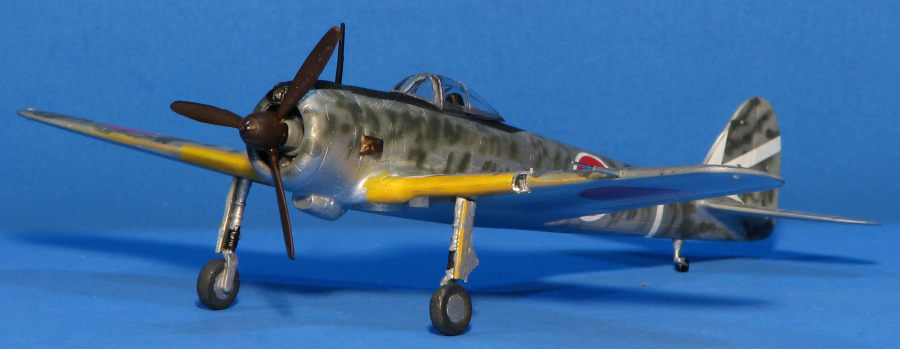
Special Hobby 1/72 Ki-43-II otsu Hayabusa
| KIT #: | SH 72193 |
| PRICE: | $25.00 or so delivered |
| DECALS: | Four options |
| REVIEWER: | Scott Van Aken |
| NOTES: |
| HISTORY |
 The Ki-43 is to the Japanese Army what the A6M was to the Japanese Navy
during WWII. It was the first modern, low winged, retractable landing gear
fighter of either service. Both were designed with maneuverability as the
major factor in their design. The result was that the aircraft were lacking
in other areas that were considered just as important to other powers. They
did not have adequate armor protection, and the Ki-43 had rather weak
armament of twin 12.7mm machine guns, even compared to the A6M which also
had two 20mm cannon. The Ki-43 also had very good range, but this was a
result of the lightweight airframe construction and lack of heavy things
like armor plating and self-sealing fuel tanks.
The Ki-43 is to the Japanese Army what the A6M was to the Japanese Navy
during WWII. It was the first modern, low winged, retractable landing gear
fighter of either service. Both were designed with maneuverability as the
major factor in their design. The result was that the aircraft were lacking
in other areas that were considered just as important to other powers. They
did not have adequate armor protection, and the Ki-43 had rather weak
armament of twin 12.7mm machine guns, even compared to the A6M which also
had two 20mm cannon. The Ki-43 also had very good range, but this was a
result of the lightweight airframe construction and lack of heavy things
like armor plating and self-sealing fuel tanks.
Initially the Army did not like the Ki-43 as it was not as maneuverable as the lighter and smaller fixed undercarriage Ki-27. However, it did have superior range and the war in China required a longer ranged fighter. Despite not being considered maneuverable enough, Allied pilots who attempted to dogfight with the Ki-43 soon found themselves in trouble. Fortunately, the lack of heavy armament of the Oscar often saved the foolish Allied pilots. Despite the known shortcomings of the Ki-43, the type was continually modified and produced even after the type was obsolescent. Many were expended in suicide attacks near the end of the war.
| THE KIT |
For decades the Hasegawa Ki-43 was considered to be the best in this scale. While not a bad kit, it is showing its age and this one has a lot more detail. Of course with that detail comes smaller parts and more of them. Also part of the deal is a bit more guesswork in terms of where bits go.
The cockpit is nicely done with a two part seat that fits onto a floor piece along with the control stick and rudder pedals. There is nice sidewall detail and a few bits to attach to it. The main instrument panel attaches to one of the fuselage halves before closing them. The instructions call for you to paint the interior a dark olive green, but I'm betting these planes were Nakajima Interior Green, a sort of greenish yellow color available in some paint brands. Once you close the fuselage halves, you attach the horizontal stabs and the three piece wing. No holes to open for the pylons as there aren't any holes for these items.
 With that done the engine cowling, which is a center
and upper piece with two side pieces, gets the engine face trapped within. The
prop is glued to the front of the engine unless you modify both to allow it to
spin. This is the 'late' -II which, unlike the -I and 'early' version, has exhaust that point
to the rear adding a bit of thrust. The kit also includes the later individual
ejector exhaust, though that is marked as do not use. The engine oil cooler is
three parts and you have a headrest assembly to place aft of the cockpit before
attaching the separate windscreen and canopy.
With that done the engine cowling, which is a center
and upper piece with two side pieces, gets the engine face trapped within. The
prop is glued to the front of the engine unless you modify both to allow it to
spin. This is the 'late' -II which, unlike the -I and 'early' version, has exhaust that point
to the rear adding a bit of thrust. The kit also includes the later individual
ejector exhaust, though that is marked as do not use. The engine oil cooler is
three parts and you have a headrest assembly to place aft of the cockpit before
attaching the separate windscreen and canopy.
The kit does provide pylons, anti-sway braces and fuel tanks for under the wings, but there is no placement guide on the lower wings, just a drawing that shows each pylon 26mm from the centerline. Landing gear and main gear doors are nicely done and while the tail gear is shown attached early in the assembly, I'd leave it off until as late as possible to keep from breaking it.
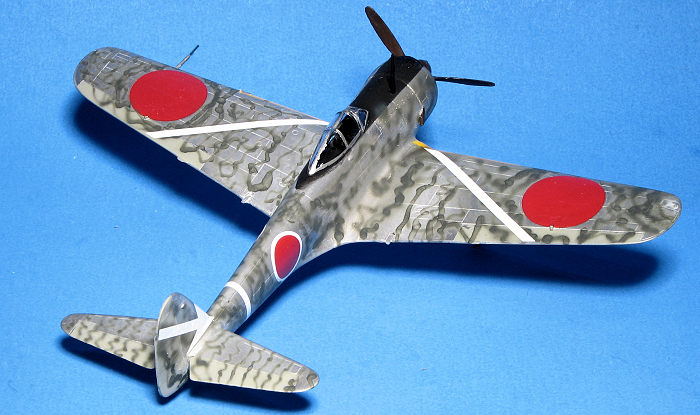
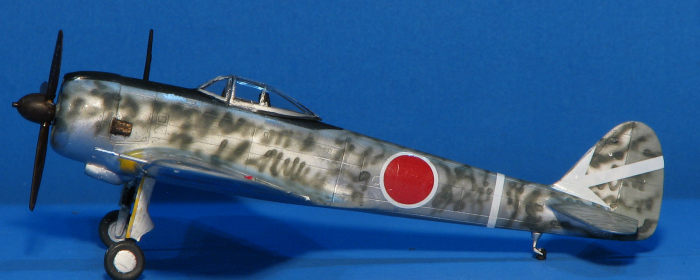
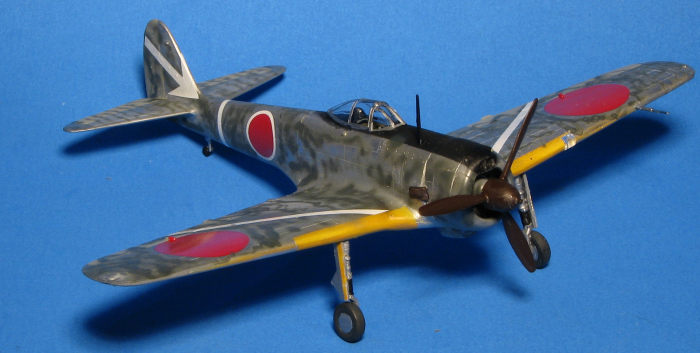
Instructions are well drawn with detail images as needed. Four very nice options are provided. One is the box art plane in unpainted metal with dense green 'giraffe' spots on it. This 64 Sentai plane is a presentation aircraft as you can see from the fin marking. Next, with a squiggly 'mirror wave' camo over unpainted metal is a standard 64 Sentai plane which, like the first option, is from later in 1944. The next two are in dark green over unpainted metal with the first of these being from the 264th Sentai in New Guinea in early 1944. The other is with the 63rd Sentai also at Hollandia in New Guinea during early 1944. All options have yellow wing leading edges and black upper fuselage anti glare areas which will need to be painted. Note that on the unpainted metal areas, all the flight control surfaces are in a grey-green primer. Decals are very nicely printed.
| CONSTRUCTION |
First thing I did was to go over the instructions and look at the parts. There is a bit of flash that will have to be dealt with, which is fairly normal with Special Hobby kits. I then brush painted all the interior parts with Mission Models Mitsubishi interior green. The Nakajima interior green is quite close, but I didn't have that shade handly.
I then detached and cleaned up the seat parts, rudder pedals, and control stick along with the two small pieces that fit on the sidewall. The instructions list quite a few of these as being on the A sprue. However, there is no A sprue and these bits are on the large B sprue. I found the fit of the two seat parts to be fairly poor. Also the mounting parts of the seat back to the floor are square while the mounting holes are round so that had to be trimmed. I also drilled out the mounting space for the control stick as that is just a butt join and will be sure to be knocked off otherwise.
 Meanwhile I cleaned up the wing parts and joined the upper
and lower sections. I had to cut off most of the mounting pins and sand down the
socket areas to get a good fit. The kit comes with wing pylons, but there are no
mounting holes for them nor is there any indication on the wing as to exactly
where they fit. I'll probably leave them off. The seams were then sanded. Note
that the inner forward section of the upper wing halves is a bit larger than the
lower part so you'll have to deal with that.
Meanwhile I cleaned up the wing parts and joined the upper
and lower sections. I had to cut off most of the mounting pins and sand down the
socket areas to get a good fit. The kit comes with wing pylons, but there are no
mounting holes for them nor is there any indication on the wing as to exactly
where they fit. I'll probably leave them off. The seams were then sanded. Note
that the inner forward section of the upper wing halves is a bit larger than the
lower part so you'll have to deal with that.
There are several parts that need to be painted silver/aluminum and I used Tamiya LP-11 lacquer paint for those. I then started to build up the engine/cowling subassembly. The kit comes with two different aft cowling pieces, both with the exhaust molded in place. This kit has the part for the -II late version and for the -III with its separate ejector exhaust. If you have 1/72 decals for the -III, then you can use them with this kit as the exhaust is the only exterior difference between the two. As you might guess, the fitting of the cowling over the engine is a real chore as there are no positive attachment areas; just butt joins. Fortunately, the engine is generic with no magnetos so no 'up' or 'down' so you basically just glue it in. Unfortunately, the fit of the cowling pieces is poor. This causes the fit onto the forward fuselage to be poor as well.
I then glued the wings and tailplanes in place. The wing fit wasn't the best and the mounting holes for the tailplanes were either fully or partially flashed over. The spacing of the holes was different on each side so a bit of fudging of the mounting holes was needed to get both tailplanes to fit. I stuffed the cockpit with tissue and headed for the paint shop.
| COLORS & MARKINGS |
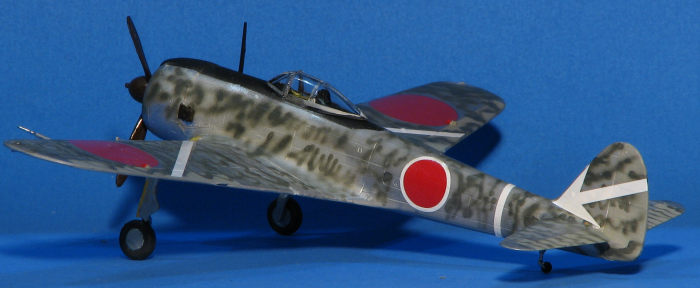 This was to
be overall aluminum with green-grey control surfaces and mottling on the upper
surfaces. I foolishly did not primer the airframe and that caused real issues
with the Mr.Color Aluminum that I used. Not only did this color come off on my
hands while handling it, but it totally succumbed to even the weakest tape,
pulling up in large section when masked. Eventually I got all of it on (well,
most of it). I gave the airframe an overall coat of semi-matte Tamiya clear in
hopes that would seal in the aluminum so I wouldn't have issues with the paint
coming off on my hands. It sort of worked when I masked the airframe again for
the black anti-glare panel. The canopy and windscreen were masked and attached
with clear glue. These did not fit each other at all well so if building this
kit, do it canopy open.
This was to
be overall aluminum with green-grey control surfaces and mottling on the upper
surfaces. I foolishly did not primer the airframe and that caused real issues
with the Mr.Color Aluminum that I used. Not only did this color come off on my
hands while handling it, but it totally succumbed to even the weakest tape,
pulling up in large section when masked. Eventually I got all of it on (well,
most of it). I gave the airframe an overall coat of semi-matte Tamiya clear in
hopes that would seal in the aluminum so I wouldn't have issues with the paint
coming off on my hands. It sort of worked when I masked the airframe again for
the black anti-glare panel. The canopy and windscreen were masked and attached
with clear glue. These did not fit each other at all well so if building this
kit, do it canopy open.
I then added the insignia and rear fuselage stripe as those items would be painted around. The Cartograf decals worked great. They are thin enough, but not so thin as to cause folding issues. Once those were on I sprayed on all the mottling with my Iwata Revolution and some dark green I had. This turned out fairly well. With all that done, the prop was built up and painted primer brown then attached. I also attached the landing gear, wheels, radio mast, landing light and the pitot for the final steps.
| CONCLUSIONS |
I am sure that there are those of you out there who can do this kit justice. I'm just not one of them. Rarely have I had a smooth build with a Special Hobby kit and I blame myself for that. The end result is generally pleasing enough, but the road to get there has a lot of speed bumps and potholes. My next 1/72 Ki-43 will be the Arma Hobby version.
11 July 2025
Back to the Main Page Back to the Previews Index Page
Back to the Previews Index Page