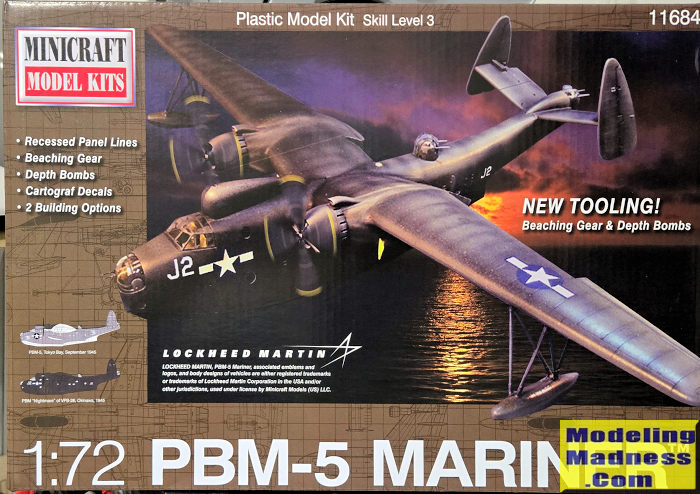
Minicraft 1/72 PBM-5 Mariner
| KIT #: | 11684 |
| PRICE: | $55.99 |
| DECALS: | Two options |
| REVIEWER: | Scott Van Aken |
| NOTES: | 2016 release |
| HISTORY |
The first PBM-1s entered service with Patrol Squadron Fifty-Five (VP-55) of the United States Navy on 1 September 1940. Prior to the entry of the United States into World War II in December 1941, PBMs were used (together with PBYs) to carry out Neutrality Patrols in the Atlantic, including operations from Iceland. Following Japan's attack on Pearl Harbor, PBMs were used on anti-submarine patrols, sinking their first German U-boat, U-158, on 30 June 1942. PBMs were responsible, wholly or in part, for sinking a total of ten U-boats during World War II. PBMs were also heavily used in the Pacific War, operating from bases at Saipan, Okinawa, Iwo Jima, and the South West Pacific.
Towards the end of the conflict, the threat posed by submarines diminished substantially; in response, Mariners were redirected towards other combat operations, including night time raids against Japanese shipping, the bombing of enemy shore installations across numerous Pacific islands and on mainland Japan. Furthermore, by means of its defensive turrets, the type claimed the downing of several Japanese fighters. In early 1945, the type was deployed in quantity in support of the Invasion of Okinawa, throughout the operation, Mariners frequently performed anti-shipping strikes against enemy convoys and rescued the downed aircrews of Boeing B-29 Superfortresses and various carrier aircraft.
| THE KIT |
This is the second boxing of Minicraft's PBM-5 kit. The previous issue was the -5A which had landing gear. This one is the original pure flying boat variant. There are two additions to this kit that were not with the previous release. One is beaching gear. This was not required for the wheeled variant. The other are depth bombs, something that many modelers of the initial boxing were unhappy were not provided.
I apologize for not showing the parts layout, but I just couldn't justify the work of combining six pages into a single image. The kit provides a very nicely done cockpit with seats, control wheels, instrument panel, rudder pedals. In addition there is a full radio compartment and other crew stations behind that which, to be honest, probably will not be visible when the kit is finished.
There are a lot of windows on the fuselage side and while it would have been nice to have these attached from the outside, they must be installed prior to closing the fuselage halves. It is because of all these that I'd fork out the additional funds for a canopy masking set. The parts are the same for this and the -5A, though these bits are shown as not used. There are plugs for the main gear that will require a bit of work to blend in and for the nose gear doors. There are also some holes that will need opened throughout the build.
The lower engine nacelles are where the bomb bays are located. These are fairly nicely detailed and where you'll put the depth bombs. The bay doors are molded closed for those who want them closed and will need to be cut for the open option. The wings are five pieces; two upper, two lower, and an upper center section. The kit also provides separate ailerons and flaps which can be modeled in the lowered position if one wishes. Tailplanes and fins also have separate control surfaces. Wing floats have positive locators so installing these should be a breeze.
The kit provides separate banks for the engines. Thanks to the close cowling, not much will be seen past the reduction gear housing. Open and closed cowl flaps are also optional. You are provided with both three blade props for earlier versions and four blade for the later variants. All of the turrets can be installed from the outside after painting is done. Another option is the ability to have the bombsight doors open or closed. Most will want to display the aircraft on the ground so this is where the beaching gear comes into play. Note also that the two markings options include the large upper fuselage radome.
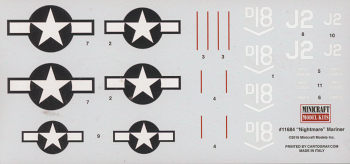 Instructions
are well done with FS 595 and generic color information. Two markings options
are provided. One is for the late war box art plane in overall dark sea blue
from VPB-26 at Okinawa in 1945. The other is in the tricolor scheme. This
aircraft uses the four blade prop, which is sort of opposite from what I'd
think. Decals are nicely done though sort of boring. There are aftermarket if
you want something different.
| CONCLUSIONS |
I have seen this built and it makes into a fairly large model. This kit has also been released under the Academy label and I believe it has instructions for either a -5 or -5A. If you know what bits go with the -5A then you can build it from this kit, but you'll be on your own for markings. Thanks to IPMS Gateway who gave away a number of kits, including this one, at one of our meetings.
| REFERENCES |
https://en.wikipedia.org/wiki/Martin_PBM_Mariner
October 2026 Copyright ModelingMadness.com. All rights reserved. No
reproduction in part or in whole without express permission. If you would like your product reviewed fairly and fairly quickly, please
contact
the editor or see other details in the
Note to
Contributors.